Low White Blood Cell Count Causes and Clinical Significance
Genetic context matters more than the number itself when a blood test flags low white cells.

Someone opens a patient portal, sees a routine blood panel, and finds "WBC" flagged low. No context, no explanation, just a number sitting below a reference range. That number by itself tells almost nothing useful. A low white blood cell count is a starting point for investigation, not a diagnosis, and what it actually means depends entirely on which cell type is depleted and by how much.
White blood cells are not one thing. The total WBC count is an aggregate of five distinct cell types, each with its own job. Neutrophils make up roughly half to two-thirds of total white blood cells and serve as the body's front-line defense against bacterial and fungal infection. Lymphocytes, which include B cells, T cells, and natural killer cells, handle viral response and coordinate the broader immune system. Monocytes, eosinophils, and basophils round out the count, each tied to its own inflammatory or allergic function.
Here is why that breakdown matters so much: a low total WBC could come from a drop in any one of these subtypes while the others sit perfectly normal. A patient could have a severe neutrophil deficit masked by normal lymphocyte levels, or the reverse. Without the differential, the lab test that breaks the total count down by cell type, a clinician is working blind. Two patients can share the exact same total WBC number and face completely different risks<sup>1</sup><sup>2</sup><sup>3</sup><sup>4</sup>.
Adding to the confusion, reference ranges are not universal. A result that falls slightly below the cutoff at one lab might be within range at another, depending on the population used to build that lab's baseline. That alone should settle the question of whether a single number can carry diagnostic weight on its own, and it can't. The differential is what turns a flagged lab value into something a clinician can actually act on.
The three mechanisms that drive WBC down, and the causes that map to each
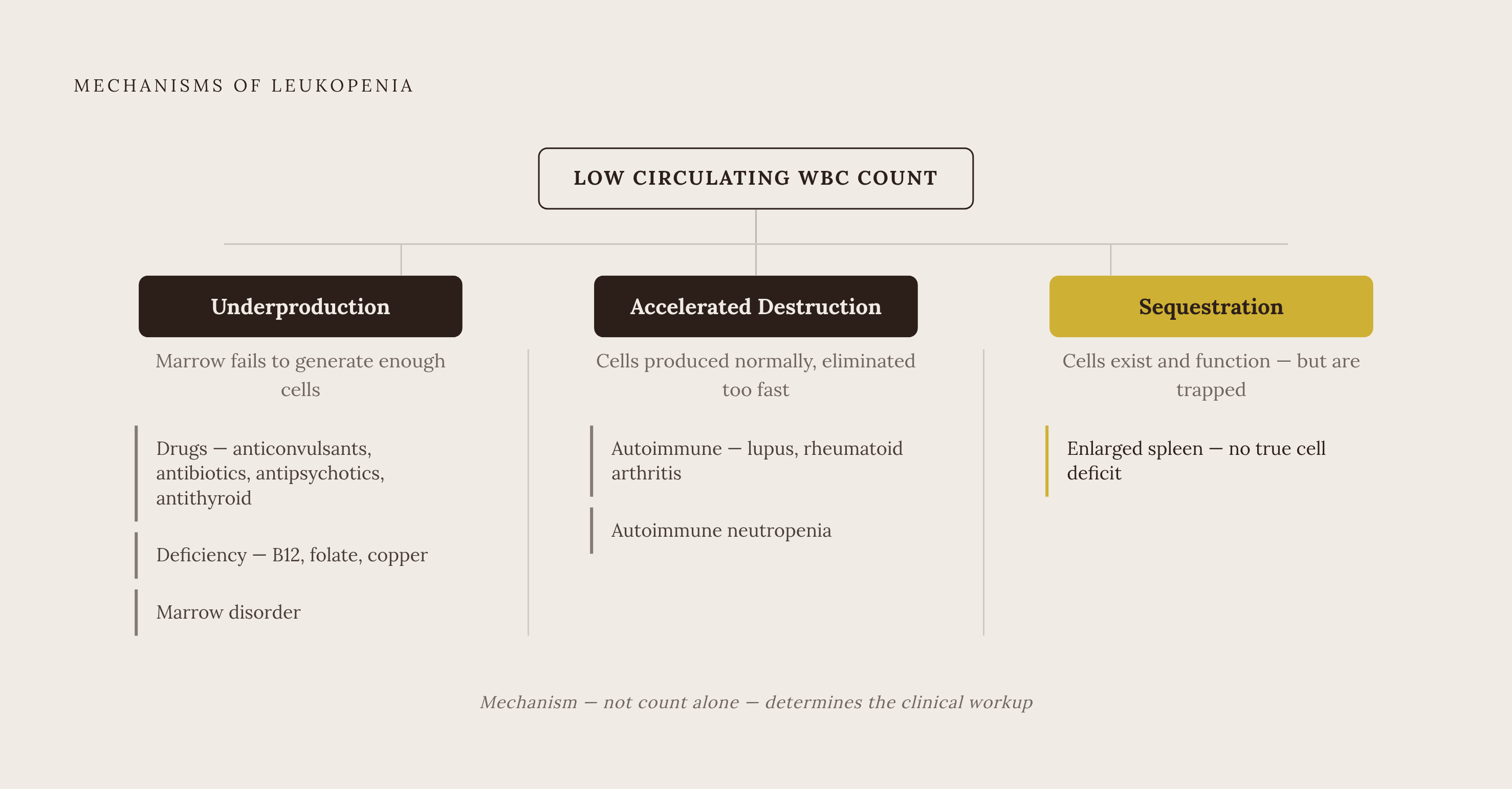
Once the differential identifies which cell type is low, the next question is why. Every case of leukopenia traces back to one of three biological failures, and figuring out which one is in play determines the entire direction of the workup.
The first is underproduction, where the bone marrow simply isn't making enough cells. Anticonvulsants, certain antibiotics, antipsychotics, and antithyroid drugs can suppress this production directly. Nutritional deficiencies belong here too: vitamin B12, folate, and copper deficiency are all established causes of neutropenia specifically, not just generalized fatigue or anemia. Bone marrow disorders, including malignancies, impair the production system at its source, which is the most serious category underproduction can point toward.
The second mechanism is accelerated destruction, where cells are produced normally but eliminated faster than the marrow can replace them. Autoimmune diseases sit at the center of this category. Lupus and rheumatoid arthritis cause the immune system to attack the body's own tissue, and in some patients that same misdirected attack targets white blood cells directly, a condition known as autoimmune neutropenia.
The third mechanism is sequestration, where the cells exist and function normally but get trapped somewhere other than general circulation. An enlarged spleen is the classic cause here. It can pool white blood cells, which lowers the number showing up in a blood draw without any real deficit in immune capacity.
A patient on chemotherapy and a patient with no medications at all who shows up with unexplained leukopenia are walking two entirely different diagnostic paths, even if their lab numbers look identical. Mechanism determines the next step, not the number alone.
There's a fourth category that doesn't fit into underproduction, destruction, or sequestration at all: genetic baseline variation. This is a normal, polygenic difference in where a person's WBC count naturally sits, and it deserves its own section because of how often it gets missed.
Genetically low WBC versus pathologically low WBC
Some people simply run a lower white blood cell count as part of their baseline biology, the same way some people run a lower resting heart rate. That variation is common, and on its own it carries no clinical meaning. The trouble starts when standard reference ranges get applied without accounting for it.
Research out of Vanderbilt University Medical Center, published in Nature Communications, put this to the test directly. Jonathan Mosley and colleagues built a polygenic score for WBC count using genetic variants that are not associated with any disease, then tracked clinical outcomes across tens of thousands of participants in BioVU and other biobank cohorts. Patients with a genetic predisposition toward a lower WBC count were more likely to receive a leukopenia diagnosis, more likely to undergo a bone marrow biopsy, and more likely to have medications discontinued, regardless of whether that biopsy found disease.
The ancestry dimension of this finding needs precision. A single genetic variant that lowers WBC count is common in individuals of African ancestry, and the same Vanderbilt research program had previously shown that this specific variant contributed to unnecessary bone marrow biopsies and to the discontinuation or dose reduction of azathioprine, an immunosuppressant used to treat inflammatory conditions. A biologically normal variant, concentrated in a specific population, was driving invasive procedures and treatment changes that had no clinical justification behind them.
One might argue that the biopsy finding is secondary detail, but it isn't. Among patients with a genetic predisposition to lower counts, those biopsies were significantly less likely to identify any pathology, so the procedure delivered risk and cost without clinical benefit. The population reference ranges used across most of medicine were built without accounting for this kind of polygenic variation. The system is structurally set up to flag physiologically normal readings as abnormal for a predictable subset of patients.
What does a clinician do with this? The strongest objection is reasonable: a clinician cannot ignore a low count purely on the chance it's genetic, because missing true pathology is the costlier mistake. The polygenic score doesn't ask anyone to ignore the count. It asks clinicians to weigh genetic context before escalating to an invasive procedure, particularly when the trajectory is stable and no other signs of disease are present. The Vanderbilt team's conclusion, that a WBC polygenic score could inform whether to pursue further workup, is a tool that exists today. The evidence supports a shift in clinical judgment, short of a wholesale rewrite of reference ranges, as clinical practice catches up.
Once genetic variation gets set aside as a factor, the remaining question becomes how to size up genuine risk. That's a matter of severity, and severity has specific thresholds.
The neutrophil thresholds that determine clinical urgency

The number that actually determines how urgent a low count is is the absolute neutrophil count, or ANC, because neutrophils are the cells most responsible for fighting off bacterial and fungal infection.
An ANC between 500 and 1,000 cells per microliter is classified as moderate neutropenia. This carries meaningful infection risk, and clinicians may consider preventive antibiotics or antifungal medication at this stage. Below that, in the range clinicians call severe neutropenia, the risk of life-threatening bacterial or fungal infection climbs sharply, and any fever at this level counts as a medical emergency regardless of how the patient otherwise feels. Below that still, in profound neutropenia, hospitalization and protective isolation are often required, because the margin for a minor infection turning serious shrinks to almost nothing.
Certain symptoms call for an emergency room visit regardless of what a scheduled follow-up appointment might say. Shaking chills or sweats are one. Rapid heart rate or difficulty breathing is another. Confusion or unusual drowsiness belongs on that list too, along with any wound or area of redness that appears to be spreading quickly. None of these should wait for a callback.
Trajectory carries as much weight as the number itself. A patient with a stable low ANC tied to a known, benign condition is in a fundamentally different position than a patient whose ANC has dropped sharply over two weeks. The stable case might call for routine monitoring. The sharp decline demands immediate workup, because a fast drop suggests something active is driving the count down right now, not a baseline that has settled.
That distinction also shapes how urgent a case is on the lower end of severity. Mild, stable leukopenia tied to a confirmed cause, a recent viral illness or a known medication, is typically managed with repeat blood work to confirm recovery. The qualifier that matters here is "known cause." Unexplained mild leukopenia, even when it looks unremarkable on paper, still warrants investigation.
The autoimmune and metabolic dimensions of WBC count that routine care tends to miss
Most people associate a low WBC count with one thing: vulnerability to infection. That framing isn't wrong, but it's incomplete. The same number also carries signal about autoimmune disease activity and, in the opposite direction, about metabolic risk.
On the autoimmune side, reduced WBC counts appear in a large share of people with systemic lupus erythematosus, to the point that low counts are written into SLE's formal classification criteria. Mendelian randomization analyses have found significant genetic associations between SLE and lower WBC counts, and separately between multiple sclerosis and lower WBC counts. That genetic link suggests the low count isn't a coincidental finding sitting alongside these diseases. It may be a downstream effect of the immune dysregulation driving the disease itself. The practical implication follows directly: unexplained leukopenia in a patient presenting with other vague systemic symptoms, joint pain, fatigue, unexplained rashes, should prompt autoimmune screening, not just a bone marrow evaluation.
But what if the number runs the other direction? This is where the data gets genuinely counterintuitive, because the assumption that a high WBC count is simply "fine" doesn't hold up. The PREDIMED study, a multicenter Spanish trial that examined a cross-sectional sample of 4,377 participants alongside a prospective cohort followed for roughly four years, found that participants in the upper quartile of baseline WBC count had substantially higher odds of metabolic syndrome compared to those in the lowest quartile. Neutrophil and total leukocyte counts tracked strongly with hypertriglyceridemia and low HDL cholesterol. Lymphocyte count specifically tracked with low HDL and elevated fasting glucose.
Turn that finding over for a moment. Higher WBC, not lower, is the direction that predicts metabolic disease risk. A low WBC count by itself does not signal "immune weakness" when the clinical question is metabolic health. The same number means something close to the opposite depending on what question is being asked of it.
The reversal itself is the argument of this section: WBC count's clinical meaning depends entirely on which question is being asked of it. WBC count is a non-specific marker, and its clinical meaning flips depending on whether the question on the table is infection risk, autoimmune activity, or metabolic health. The number needs to be read alongside other markers, C-reactive protein, a metabolic panel, the differential itself. A retrospective study linking WBC count to CRP found that higher WBC levels track with increased inflammation, tying routine CBC data to markers already well established in cardiovascular risk assessment. The number is doing more work than most lab reports give it credit for.
What WBC count signals about aging and long-term health
Zoom out to the scale of an entire lifespan, and WBC count looks less like a single test result and more like a running signal of how the body is aging. In older populations, the count functions as a bidirectional risk marker. Both chronically low and persistently elevated counts correlate with worse survival outcomes, which reframes the goal of long-term monitoring: not avoiding a low reading, but maintaining trend stability within a healthy range over time.
UK Biobank research has used WBC count as one marker of inflammaging, the slow accumulation of inflammation that comes with age, alongside CRP and glycoprotein acetyls. That research found WBC count mediates a statistically significant, though relatively modest, share, around 7 percent, of the effect that cardiovascular health behaviors have on white matter brain aging. Glycoprotein acetyls, notably, did not turn out to be a significant mediator in the same analysis, which suggests WBC count is capturing something the other marker isn't.
The mortality data sharpens this picture further. In elderly populations, WBC count differed significantly between survivors and nonsurvivors in both men and women, with higher counts appearing among nonsurvivors. Elevated WBC in aging populations carries its own prognostic weight, separate from and in addition to whatever risk sits at the low end of the range.
The low end carries its own long-term consequence too, and it isn't a neutral one. Chronic lymphocytopenia, a persistently low lymphocyte count sustained over time, signals immunosenescence, the gradual erosion of immune competence that comes with age, and it's associated with elevated cancer risk. An immune system running quiet isn't necessarily an immune system running efficiently. It may simply be one that's lost the capacity to respond.
What should a reader take from two extremes that both carry risk? Longevity research hasn't settled on a single optimal WBC range for tracking healthspan over time. Both extremes get flagged as harmful in the literature, but the precise middle ground where risk is lowest has not been pinned down. That's an open question in the field, not a gap in this explanation. It reframes what a WBC count is actually for, long after the result clears a routine physical: not a single verdict delivered once, but a direction and a stability tracked across years, not just a position against a cutoff on the day of the draw.
Sources
- Genetic variation associated with low white blood cell count impacts clinical decisions - Vanderbilt Health News
- Clinical associations with a polygenic predisposition to benign lower white blood cell counts
- Clinical associations with a polygenic predisposition to benign lower white blood cell counts
- White Blood Cell Count in Elderly Is Clinically Useful in Predicting Long-Term Survival