Zinc and Copper Balance in Blood Test Results
Why your copper and zinc ratio matters more than either number alone.

Copper and zinc almost never get flagged as a pair on a standard blood panel, but their ratio carries information neither mineral shows on its own. Looking at copper and zinc together forms a picture of how much oxidative stress a body is under, how inflamed it's running, and whether metabolism is drifting off course. That's the case for treating this ratio as a real diagnostic tool instead of two numbers sitting side by side on a lab report.
Both minerals feed into copper-zinc superoxide dismutase (SOD), the enzyme that mops up superoxide, a reactive oxygen species that damages cells if left unchecked. Moving the ratio moves SOD activity with it. Copper also supports ceruloplasmin and a range of enzymes involved in energy production and structural tissue maintenance, while zinc runs a much bigger operation: over 300 enzymes tied to immune function, DNA synthesis, wound repair, and metabolic signaling. During inflammation, copper climbs and zinc drops, almost like a seesaw. Measuring either mineral alone leaves half the story hidden. The ratio is what catches both movements at once.
Reading a copper-to-zinc result: reference ranges, sample type, and the caveats that change interpretation
Functional medicine guidance tends to put the optimal serum copper-to-zinc ratio somewhere in the range of 0.8 to 1, based on reference panels such as the NutriStat Basic Profile. Crossing above roughly 1.2 points to copper dominance or a zinc shortfall relative to copper, regardless of where the individual numbers fall within standard reference ranges. Dropping below about 0.6, particularly in someone taking zinc supplements, often signals zinc-induced copper depletion.
Standard reference ranges list serum copper around 70 to 140 mcg/dL and serum zinc around 60 to 120 mcg/dL, spreads wide enough to hide real problems. Those ranges are wide enough to hide real problems, though. Functional targets usually sit toward the middle or upper end of that spread, and the ratio between the two numbers tells you more than either one sitting by itself.
Sample handling matters just as much as the numbers themselves. Plasma drawn in an EDTA tube beats serum, because red blood cells can lyse during serum prep and artificially push zinc readings up. Timing counts too, especially for zinc: draw it fasting, in the morning. Eating shifts zinc out of the bloodstream and into tissue, so a post-meal draw can read meaningfully lower than a fasting one, enough to change how the result gets interpreted.
The inflammatory, hormonal, and environmental forces that raise copper relative to zinc
Inflammation is the single biggest driver. During an acute-phase response, the liver ramps up ceruloplasmin, the copper-binding protein, which pushes circulating copper higher. At the same time, serum zinc falls as the acute-phase response shifts mineral distribution. The ratio gets hit from both sides simultaneously. It spikes faster and further than either mineral alone would suggest.
Chronic stress works on a slower timeline but points the same direction. Cortisol is associated with copper retention and changes in zinc handling, tilting the balance toward a higher ratio over time. No overt illness required. Sustained stress alone tilts the ratio upward, month after month.
Hormones matter too, and this one gets missed constantly. Estrogen increases ceruloplasmin synthesis, which raises copper retention and drags the zinc side of the ratio down. Hormonal contraceptives and hormone replacement therapy both carry this effect, making it one of the more under-recognized drivers in women of reproductive age. Baseline copper already runs a bit higher in women than in men for the same reason, and pregnancy can push ceruloplasmin and serum copper up well beyond non-pregnant levels.
How zinc supplementation, malabsorption, and genetic factors deplete copper
High-dose zinc supplementation is the most common self-inflicted cause of a low ratio. Zinc competes with copper for absorption in the gut, and the two minerals fight for the same transport pathway. The Food and Nutrition Board at the National Academies of Sciences, Engineering, and Medicine set the tolerable upper intake level for zinc at 40 mg a day for adults, yet plenty of popular supplements sail past that number without much thought.
The damage appears at doses lower than most people would expect. Research has found reductions in erythrocyte copper-zinc SOD activity at zinc intakes of around 60 mg a day, sustained over an extended period. That's not just a shift in a lab value on paper. It's a functional drop in antioxidant capacity, measurable at the enzyme level.
One source of excess zinc catches people off guard entirely: denture adhesives. Heavy, long-term use of zinc-containing adhesive can deliver enough excess zinc to deplete copper, an exposure route almost nobody thinks to ask about during a workup. Malabsorption conditions do similar damage through a different mechanism. Celiac disease, Crohn's disease, chronic diarrhea, and bariatric surgery all impair copper absorption, pulling the ratio down even without anyone touching a zinc supplement.
What copper deficiency looks like: the symptoms that are easy to misattribute and the diagnostic pitfall clinicians miss
Neurological symptoms are the most serious consequence of copper deficiency: sensory ataxia, myelopathy, peripheral nerve deficits. These don't always fully reverse even after copper gets corrected, which raises the stakes on catching the deficiency early rather than after nerve damage sets in.
The sharpest diagnostic trap involves blood cell production. Copper deficiency can produce hematologic findings that overlap with more serious conditions, including changes in blood cell production that may be mistaken for other causes. Addressing the underlying mineral deficiency is what resolves the blood picture, a distinction that underscores the value of testing trace element status directly.
Anemia and neutropenia occur too, and both overlap with dozens of other conditions. The trace element angle gets missed without a targeted test. Copper plays roles in metabolic enzyme activity, and imbalances in trace minerals can contribute to symptoms that overlap with other conditions and may go uninvestigated without a targeted mineral panel.
The hormonal, immune, and mood consequences of a high copper-to-zinc ratio
Zinc deficiency weakens how immune cells develop and regulate themselves, so frequent infections, slow recovery from illness, and sluggish wound healing tend to appear early. These are functional consequences, not abstract lab findings, and they're often the first thing a patient notices before anyone thinks to check a mineral panel.
Mood takes a hit too. High copper paired with low zinc has been associated with mood-related symptoms, given that copper is neuroactive and both minerals influence neurological function. For women, elevated copper interacts with estrogen metabolism in ways that may worsen hormone-related symptoms, given that estrogen itself raises ceruloplasmin and copper retention.
Men see a different hormonal cost. Zinc plays a role in male reproductive hormone metabolism, including aspects of testosterone production and related enzymatic activity. A high ratio driven by zinc depletion may affect male reproductive function, often without any single symptom loud enough to point straight back to zinc.
The cardiovascular and metabolic risk signals embedded in an imbalanced ratio
Cardiovascular research has tied dietary zinc and copper imbalances to atherosclerosis, coronary artery disease, and myocardial infarction, with copper identified as a mediator in how these conditions progress. That's not a fringe finding. It sits at the intersection of two things clinicians already watch closely: inflammation and lipid metabolism.
A cross-sectional analysis of NHANES data from 2017 to 2020, covering 8,092 adults, found that higher zinc intake tracked with a lower likelihood of elevated hs-CRP (odds ratio 0.69) and elevated triglycerides (odds ratio 0.30). That frames zinc sufficiency as protective against exactly the inflammatory and lipid markers that tend to appear before a cardiovascular event, not after.
A meta-analysis pooling 75 studies, drawn from an initial pool of 23,165 records, found that zinc supplementation significantly lowered triglycerides, total cholesterol, fasting blood glucose, HbA1C, HOMA-IR, CRP, IL-6, and TNF-α. That's lipid metabolism, glycemic control, and inflammatory signaling, all moving in the same direction at once. But what if the causal arrow runs backward? Whether inflammation drives the ratio imbalance or the imbalance drives inflammation is still genuinely debated, since acute infection shifts micronutrient metabolism toward copper as part of the immune response itself. The direction matters for how anyone should act on a single result, so it's better not to read too much into one snapshot.
The ratio as a longevity biomarker
The ratio climbs with age across population data, and the reason is more specific than "everything drifts with age." Most of that rise comes from a steady decline in plasma zinc, not a dramatic jump in copper. Zinc insufficiency, not copper excess, is the primary driver behind the age-related shift, which reframes the whole conversation: this isn't really a copper problem in older adults so much as a slow zinc problem.
One cohort study of 218 subjects over age 70 found plasma Cu:Zn linked to every inflammatory marker measured, and to serum albumin as well. Subjects with stable cardiovascular disease carried higher ratios than those without it, so the ratio was tracking inflammatory burden and nutritional status at the same time, in the same number. That same cohort found plasma Cu:Zn predicted all-cause mortality over a 3.5-year follow-up, which moves this from an interesting nutritional observation into something with real prognostic weight.
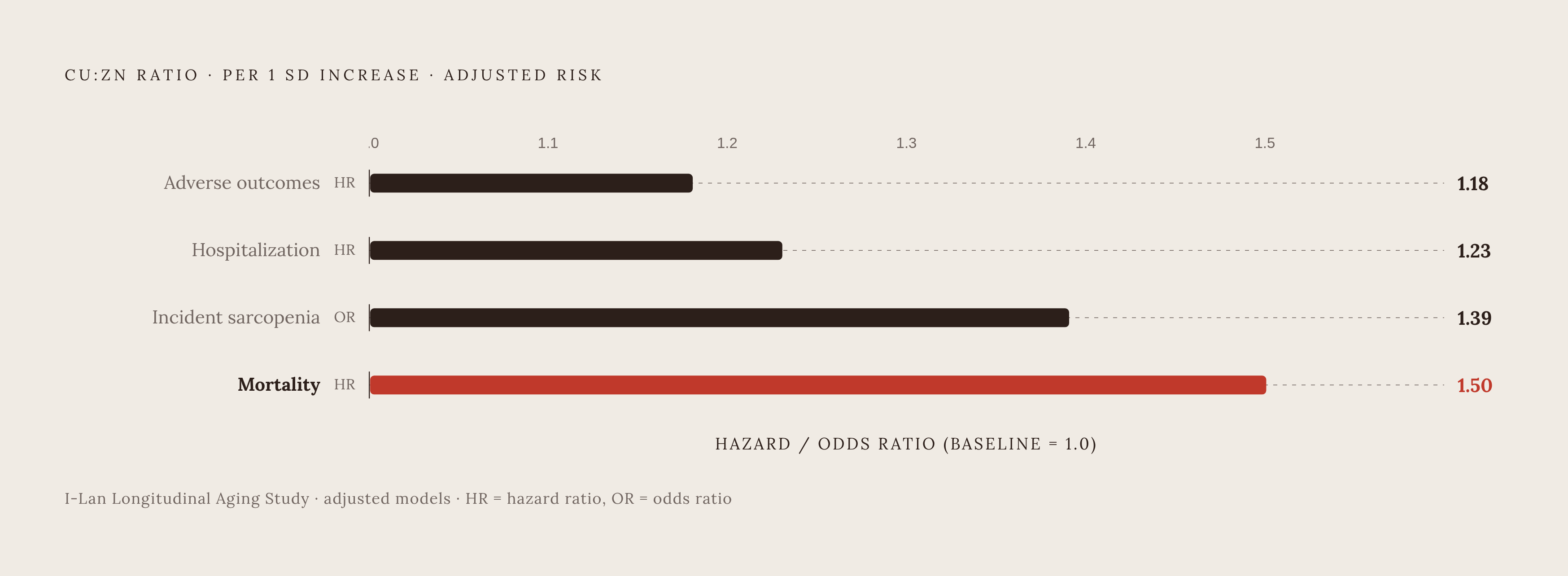
The I-Lan Longitudinal Aging Study adds detail to that picture. Each standard deviation increase in the Cu:Zn ratio carried a higher risk of adverse outcomes (adjusted hazard ratio 1.18), hospitalization (1.23), mortality (1.50), and incident sarcopenia (adjusted odds ratio 1.39). Out of 1,474 non-sarcopenic participants tracked, 311 developed sarcopenia within three years. Higher copper specifically predicted low muscle mass (adjusted odds ratio 1.18), while higher zinc worked the other way, protecting against muscle weakness (adjusted odds ratio 0.84). Two minerals, one ratio, and a measurable split in outcomes depending on which direction it leans. A single copper or zinc value, read alone, would never surface that kind of divergence.