Omega-3 Index Testing and Cardiovascular Relevance
A blood test that measures omega-3 tissue levels predicts heart risk better than standard panels do.

The Omega-3 Index measures one specific thing: EPA plus DHA as a percentage of the total fatty acids in your red blood cell membranes. That number predicts cardiovascular risk better than most people realize, and it catches something a standard lipid panel never looks at. Understanding why it's measured in red blood cells, and what the result actually means, changes how you think about a risk factor most checkups skip.
Start with the "why red blood cells" question, because it isn't arbitrary. Red blood cell membranes track the omega-3 content of heart tissue membranes closely, which is the exact relationship the researchers who introduced the metric in 2004 were after. Fatty acids build into every cell membrane in the body, heart cells included, and that composition shapes how the cell behaves: how it handles inflammation, how electrically excitable it is, how readily a platelet clumps. Red blood cells give a window into that process without a biopsy.
Timing matters too. Red blood cells turn over roughly every three to four months, so the Omega-3 Index is a running average rather than a snapshot of what you ate last Tuesday. It's closer to a running average of what actually made it into tissue over an entire season, which is a very different thing to measure than "how much salmon did you report eating on a survey."
One comparison makes this click faster than any technical explanation: the Omega-3 Index is to omega-3 status what hemoglobin A1c is to blood sugar. Red blood cells are where both markers get measured. Both come back as a percentage. Both reflect sustained status rather than a single spike or dip. Nobody manages diabetes off one fasting glucose reading taken on one morning, because it swings too much on its own. The same logic holds here.
That's also why older ways of estimating omega-3 status fall short. A questionnaire asking "how much fish do you eat" can't account for absorption efficiency, which fish someone actually chose, how it was cooked, or how much competing omega-6 fat in the rest of the diet blocked incorporation. A plasma fatty acid test moves with whatever was eaten in the last day or two, the same way a random glucose stick moves with the last meal. The Omega-3 Index sidesteps both problems by measuring what actually got built into the membrane, not what passed through the bloodstream or what someone guessed they ate.
Reading an Omega-3 Index result: the three risk zones
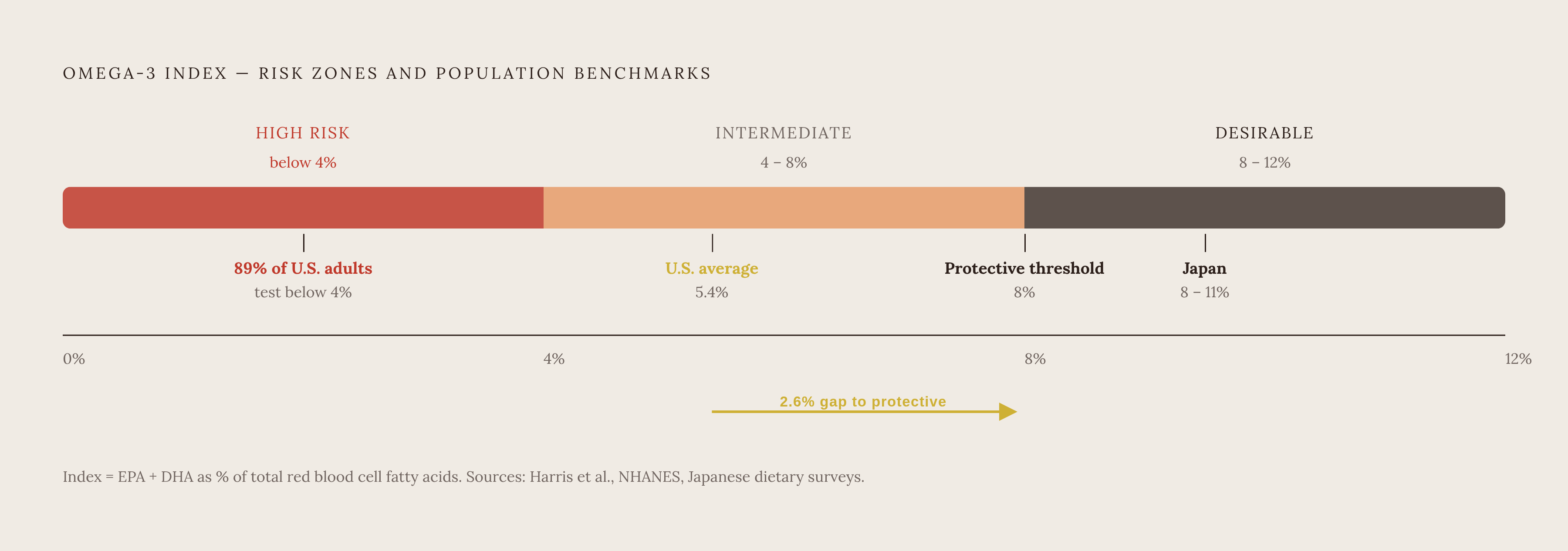
The index breaks into three bands, and that framework has held steady since it was first proposed.
Below 4% is the high-risk zone, tied to elevated risk of cardiovascular events and sudden cardiac death. From 4% to 8% is intermediate, and this is where most people land: neither protected nor acutely at risk. Above 8%, up through roughly 12%, is the desirable range, linked to cardiovascular protection and, more broadly, to better outcomes for the heart, brain, eyes, and joints.
That 8% line deserves a second look, because it isn't a soft cutoff. Current literature treats values above 8% as meaningful cardiovascular protection, and the 8-to-12% range functions as a target zone: pushing toward 12% counts as optimal, not as overshooting.
So what separates a "risk factor" from a "marker" here? A marker just correlates with something bad. A risk factor causes it, or behaves like a cause: it's biologically plausible, it's measurable, and changing it changes outcomes. A low Omega-3 Index meets the criteria researchers use to designate a novel cardiovascular risk factor: biologically plausible, measurable, and associated with meaningful differences in outcomes.
Once you know your number, the zone tells you the urgency. Being below 4% calls for a different response than being at a modestly elevated level wondering whether to push higher. Which raises the obvious next question: where does most of the population actually fall?
Where most people land: a particular country population's omega-3 gap
Available population data gives a stark answer. A large share of Americans sit in the undesirable range, below the 4% threshold, while only a small slice reaches the optimal zone above 8%.
Separate NHANES 2021 figures sharpen that picture: about 89% of adults tested landed in the high cardiovascular risk category. Over 95% of children and 68% of adults came in below the omega-3 levels tied to federal dietary guidelines, a shortfall that describes the norm rather than an unlucky minority. These aren't fringe numbers describing an unlucky minority. They describe the norm.
A paper in Mayo Clinic Proceedings found the average American takes in around 100 milligrams a day of combined EPA and DHA, producing a mean Omega-3 Index of about 5.4%. Squarely intermediate: not catastrophic, but nowhere near protective.
Seafood habits are the obvious lever, and the data backs that up. A CDC NCHS Data Brief found only 24.3% of adults 20 and older ate seafood at least twice a week, which is roughly the frequency associated with meaningfully higher omega-3 intake. Most people are simply falling short of the input required.
Compare that to traditional Japanese populations, which carry some of the lowest cardiovascular mortality rates in the world and typically run Omega-3 Index values of 8% to 11%, driven by sustained, high, regular fish intake. The gap between 5.4% and 8-to-11% isn't a rounding error. An Omega-3 Index of 5.4% falls in the intermediate zone, while 8-to-11% falls in the protective one.
A 2024 update to the Omega-3 World Map showed the USA, Canada, Italy, Turkey, the UK, Ireland, and Greece all moving from "red," the highest-risk category, into "orange," intermediate risk. Progress, technically. But moving from red to orange isn't the same as reaching green, and none of these countries sit anywhere close to the desirable zone as a population. This is a structural feature of how Western countries eat, built from decades of food availability, cost, and habit, not personal failure on anyone's part.
Why a standard cardiovascular panel misses this risk factor
Someone with normal LDL, normal blood pressure, normal glucose, and clean CRP looks low-risk on paper. Often that holds up. But not always, and the space between "well-managed on paper" and "actually protected" is exactly where a lot of unexplained cardiovascular events happen.
Standard panels test real, important things. Nobody's arguing otherwise. But none of them look at membrane-level fatty acid status, the balance that governs low-grade inflammation, arrhythmia risk, and how readily platelets clump into a clot. That's a distinct biological pathway from how much cholesterol happens to be floating in the blood. A lipid panel and a blood pressure cuff aren't built to see it.
The Omega-3 Index doesn't move in lockstep with LDL or blood pressure either. It isn't restating information a doctor already has in a different format. It adds signal because it tracks a separate process entirely, which is why prediction models get better when the Index gets folded in.
The reach goes beyond the heart, too. The Omega-3 Index started inside cardiovascular research, but a review in Current Opinion in Clinical Nutrition & Metabolic Care notes it's since been applied across a range of other health conditions. Cardiovascular disease remains where the evidence is strongest and best validated, though the metric's relevance doesn't stop there.
So why isn't this test sitting on every routine panel already? Clinical inertia, mostly. Standard panels were built around tests that became convention decades ago, and convention changes slowly, not because the science underneath is thin. That's less a knock on conventional medicine than an observation about how slowly test menus evolve. Practically speaking, closing this gap tends to fall to people willing to go looking for it themselves. No referral required, no symptom needed as a trigger. Just a decision to test.
What two large 2025 studies show about the O3I as a predictive tool
An improvement in a prediction model's AUC from 0.689 to 0.698 doesn't sound dramatic on its face. So what does that actually mean for someone trying to figure out who's genuinely at risk?
AUC, area under the curve, measures how well a model separates people who'll have an event from people who won't, on a scale where a coin flip sits at the midpoint and 1.0 is perfect prediction. At population scale, even a modest jump in discrimination reclassifies real people, moving some out of "low risk, don't worry about it" and into "actually should be paying attention."
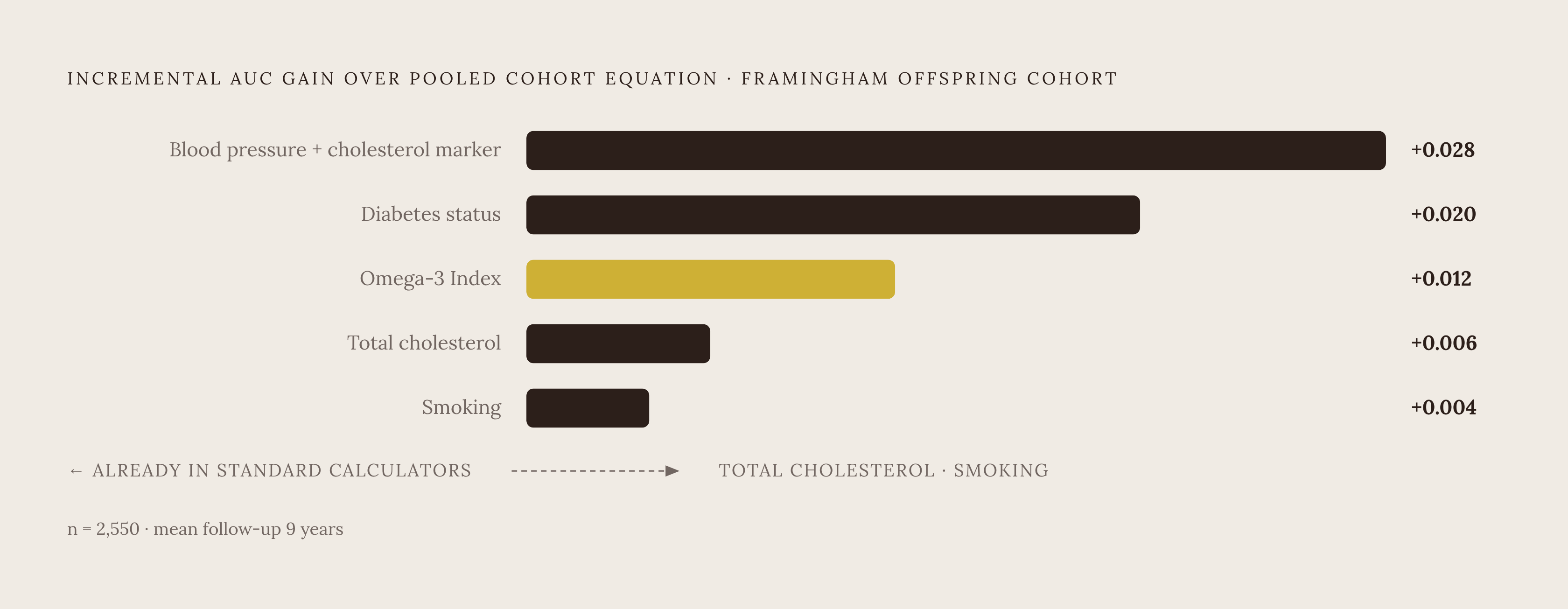
A study in the Journal of Clinical Lipidology tested exactly that. Researchers followed 2,550 participants from the Framingham Offspring Cohort, averaging 65 years old and free of cardiovascular disease at baseline, for a mean of nine years. The benchmark was the Pooled Cohort Equation, the standard clinical tool for estimating ten-year ASCVD risk, which scored an AUC of 0.689 on its own. Adding the Omega-3 Index pushed that to 0.698, a statistically significant gain (p <.05).
Break down where that predictive power actually came from, and the Index's contribution looks more notable still. Blood pressure and a marker of favorable cholesterol together added 0.028 to the model. Diabetes status added 0.020. The Omega-3 Index added 0.012, ahead of total cholesterol's 0.006 and smoking's 0.004. Third place, ahead of two factors that sit on every standard risk calculator in clinical use today.
William Harris, one of the researchers behind the original metric, told Nutritional Outlook in March 2025: "If people are concerned about correcting their high cholesterol level to reduce their risk for CVD, then they should be equally concerned about correcting their Omega-3 Index." He went further, saying "the medical community does not yet realize" the Index carries weight comparable to risk factors it already tracks closely. The researchers called for the finding to be replicated in more diverse cohorts, a fair caveat given the study population's age and composition.
A second study, published in Frontiers in Nutrition in October 2025, tested a related but distinct idea using 183,230 UK Biobank participants aged 50 to 69, free of baseline cardiovascular disease or diabetes, with a separate validation cohort of 54,940 people. This one used the plasma omega-6 to omega-3 ratio, measured by a spectroscopy-based lab method, rather than the erythrocyte Omega-3 Index. Different metric, reflecting inflammatory balance rather than tissue-level incorporation, though the two are clearly related.
Adding that ratio to a standard cardiovascular risk model moved the C-index from 0.742 to 0.747 (p < 0.001), with a net reclassification improvement of 8.4% (95% CI: 3.6 to 12.2%). The effect was more pronounced in men than women, and both versions of the model showed improved discrimination. The study authors framed their finding around a "substantial residual risk" that persists even in people whose traditional risk factors are managed about as well as they can be. Fatty acid balance is catching something the standard factors structurally cannot see.
Omega-3 status, aging biology, and all-cause mortality
No single number anchors this section. Several independent lines of evidence point the same direction, and it's the accumulation across different mechanisms that makes the case, not any one finding on its own.
Start with mortality broadly. A pooled analysis of 17 prospective cohort studies, published in Nature Communications in 2021, found people in the highest quintile of circulating long-chain omega-3s had a 15 to 18% lower risk of death from any cause than those in the lowest quintile, after adjusting for the usual confounders. All-cause, not just cardiac.
Data from the Framingham cohort, published in the American Journal of Clinical Nutrition, found something more concrete still: people with a higher Omega-3 Index lived an average of 4.7 years longer than those with lower levels. Set that next to the lifespan gains typically credited to quitting smoking or maintaining a healthy weight: 4.7 years stops looking like a footnote.
The UK Biobank turns up again here, this time in a 2024 analysis of more than 117,000 participants: higher plasma DHA tracked with significantly lower risk of death from cardiovascular disease, cancer, and all causes combined. The association widens out well past the heart specifically.
Then there's the aging-biology angle, newer and more mechanistic. Post-hoc analyses from the DO-HEALTH Trial, published in 2025, found that 1 gram per day of omega-3 supplementation over three years modestly slowed several epigenetic aging markers, the molecular clocks researchers use to estimate biological age rather than calendar age. The effect strengthened when omega-3 intake was paired with vitamin D and regular physical activity, suggesting these interventions work better stacked together than any one alone.
Telomeres round out the picture. Blood levels of EPA and DHA predict how fast telomeres shorten over time, and at least one human study has shown omega-3 supplementation actually lengthening telomeres, with reduced oxidative stress and lower chronic inflammation proposed as the mechanisms. A related question sits currently in press at the American Journal of Clinical Nutrition, from the VITAL trial, examining whether omega-3 supplementation slows telomere attrition in leukocytes over four years. That data hadn't fully released as of mid-2025, so treat it as forthcoming rather than settled.
None of these findings would carry much weight alone. Stacked together, mortality data, epigenetic clocks, and telomere biology all pointing the same way, they build a case that's hard to write off as coincidence.
What drives a low Omega-3 Index
Eating fish twice a week sounds like it should be enough. Often, it isn't, and the reasons why come down to a handful of specific mechanisms working against the assumption.
Species matters more than frequency. Someone eating fish regularly but consistently choosing low-EPA, low-DHA varieties can still land with a low Index, because not all fish contribute equally. Farm-raised fish compounds the problem: it typically carries 50 to 70% less omega-3 than its wild-caught counterpart. Someone confident about "fish twice a week" may be getting a fraction of the EPA and DHA they assume, just based on where that fish came from.
Plant-based eating adds another layer. ALA, the omega-3 in flaxseed, walnuts, and similar plant sources, converts to EPA at under 8% efficiency and to DHA at under 4%, leaving vegetarian and vegan diets with a reliably low Omega-3 Index regardless of how much ALA someone eats unless an algae-based DHA supplement fills the gap. That's a steep drop-off. Without an algae-based DHA supplement filling the gap, vegetarian and vegan diets reliably produce a low Omega-3 Index, more or less regardless of how much ALA someone eats.
Most people never hear about omega-6 competition, which affects how much of the omega-3 you eat actually gets used. The modern Western diet runs an omega-6 to omega-3 ratio of roughly 16 to 1, driven heavily by soybean, corn, and sunflower oils, against a target ratio often cited at 4 to 1 or lower. Omega-6 and omega-3 fats compete for the same metabolic enzymes, so a diet flooded with omega-6 actively crowds EPA and DHA out of cell membranes, even when omega-3 intake looks adequate on paper.
Smoking belongs on this list too, and it isn't dietary at all: it speeds up the oxidation of omega-3s and depletes tissue stores directly, suppressing the Index independent of anything on the plate.
Genetics and physiology add a final layer of unpredictability. A dose-response randomized trial in the Journal of the American Heart Association found EPA plus DHA dose accounted for 68% of the variability in how someone's Omega-3 Index responded to supplementation. Baseline Index, age, sex, and activity level together explained 78% of total variation in response. The same fish oil capsule, at the same dose, produces meaningfully different results in different people: one person's daily dose might move their Index two full points, someone else's might barely nudge it.
Dietary self-report starts to look like a weak proxy for what's actually happening at the membrane level once you line all of this up. Too many variables sit between what someone ate and what actually got incorporated for a questionnaire, or even a genuine best effort at eating well, to reliably predict where a person lands. That's the whole argument for testing directly instead of estimating.
Supplement evidence, dosing, and retesting logic for a low result
The most useful thing about the Omega-3 Index, compared to something like a genetic variant or age itself, is that it moves. It responds to diet and to supplementation, which is what makes it a real risk factor rather than a passive marker you can only observe.
Harris frames the corrective path in practical terms: once someone knows they're low, the fix is straightforward in concept, even if execution takes some trial and error given how much individual response varies. Increasing EPA and DHA intake, whether through more frequent and more strategic fish consumption or through supplementation, moves the number. How much it moves, and how fast, comes down to the same factors already covered: starting Index, dose, age, sex, and activity level.
Retesting matters because that variability means results shift over time. Given the roughly three-to-four-month turnover cycle of red blood cells, retesting sooner than that window won't reflect a stable new baseline. It'll just catch the transition mid-swing. Testing again at the tail end of that turnover cycle gives a truer read on whether a given dose actually moved someone from well below target into the 8-to-12% zone, or whether the dose needs adjusting.
None of this requires guesswork if the starting point is a known number instead of an assumption. A dietary habit that feels sufficient, two fish dinners a week, a daily fish oil capsule, can still leave someone in the intermediate zone: invisible to a standard checkup, unaddressed until it contributes to an actual cardiovascular event. Testing turns a structural, largely invisible risk factor into something measurable, trackable, and, unlike most items on a cardiovascular risk panel, something a person can actually change.
Sources
- Frontiers | The NMR-measured omega-6/omega-3 fatty acid ratio improves cardiovascular risk prediction
- Omega-3 levels enhance cardiovascular risk prediction, new study finds | Nutritional Outlook - Supplement, Food & Beverage Manufacturing Trends
- Omega-3 index improves upon the pooled cohort equation in predicting risk for CVD
- Recent studies confirm the utility of the omega-3... : Current Opinion in Clinical Nutrition & Metabolic Care
- Omega-3 Index: an emerging biomarker in cardiovascular prevention - PubMed
- news-medical.net