Vitamin B12 Deficiency in Serum Versus Active B12 Testing
Standard B12 tests miss real deficiency because they measure mostly unusable B12.
A blood test comes back "normal." Fatigue, tingling in the hands, brain fog that won't clear, none of it goes away. The number on the lab report says the B12 is fine. The body says otherwise, and in a meaningful share of cases, the body is the one telling the truth.
It is a common, structural blind spot in how the standard B12 test works. It's a structural blind spot in how the standard B12 test works, baked into the biology of how the vitamin moves through blood in the first place. Understanding that mechanism is the difference between trusting a number and knowing what the number actually measures.
How vitamin B12 travels in the blood: the two-protein transport system
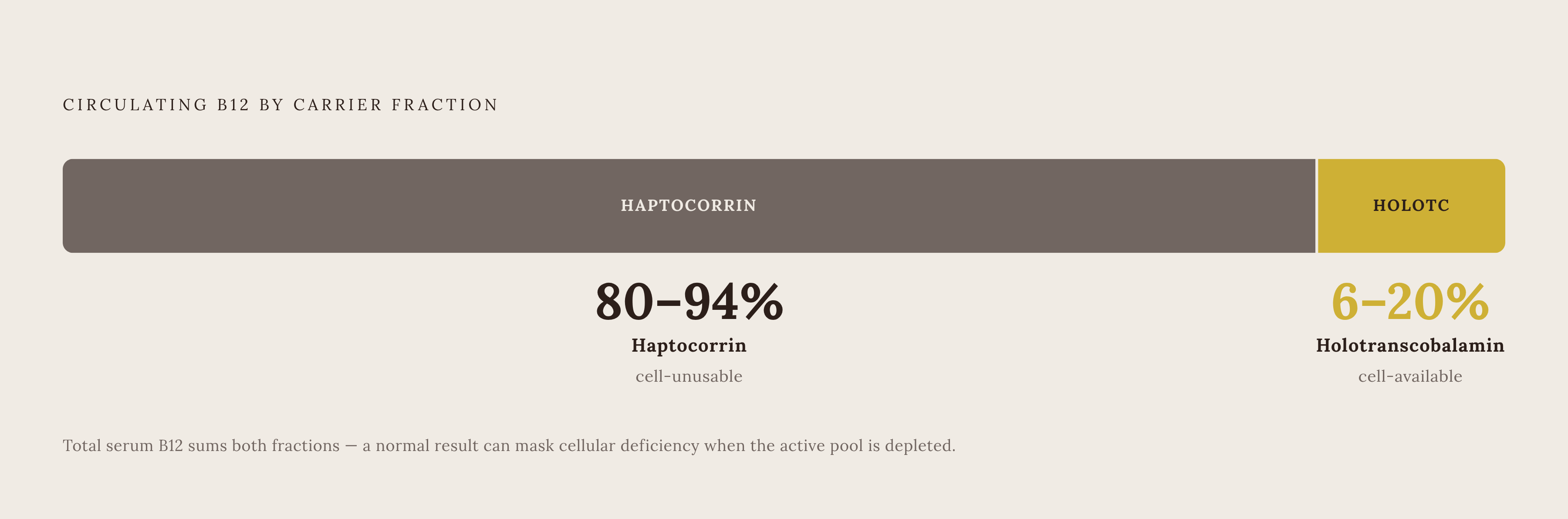
B12 doesn't float free in the bloodstream. It hitches a ride on one of two carrier proteins: haptocorrin (HC) or transcobalamin (TC). That distinction matters more than almost anything else in this story.
Haptocorrin-bound B12 is, functionally, along for the ride and going nowhere. Cells can't pull B12 off haptocorrin and use it. Transcobalamin-bound B12, also called holotranscobalamin or HoloTC, is different: it's the only fraction cells can actually take up and put to work.
Somewhere between 80% and 94% of the B12 circulating in blood is bound to haptocorrin, the inert form, which surprises most people. Somewhere between 80% and 94% of the B12 circulating in blood is bound to haptocorrin, the inert form. Only 6% to 20% is riding on transcobalamin, the form that's actually usable. Picture a highway full of delivery trucks: most of them are empty, driving around with nothing to unload. Only a small fraction are carrying cargo to a destination. Total B12 counts every truck on the road. HoloTC counts only the ones making a delivery.
One more wrinkle: HoloTC has a shorter half-life in circulation than haptocorrin-bound B12. That means when B12 status starts to slip, the usable fraction drops first, and it drops faster. A test that only looks at the total truck count will miss that shift for a while.
What serum (total) B12 measures, and where it falls short
Standard serum B12 testing adds both fractions together. Active plus inactive, all bundled into a single number. Since the inactive haptocorrin-bound pool makes up the overwhelming majority of that number, total B12 is, in large part, a readout of B12 the body literally cannot use.
That's the core problem. A result can sit comfortably "in range" while cells are functionally starved for B12 at the intracellular level. Nothing about the number tells you which pool it's coming from.
A few things can inflate total B12 without improving anyone's actual cellular status:
- Elevated haptocorrin levels, which can occur in liver disease and certain other conditions
- High-dose supplementation, which can raise the total number in blood independent of cellular status
- Assay quirks: automated competitive binding assays typically use intrinsic factor, not an antibody, as the binding protein, and that choice introduces variability across different lab platforms
Low total B12 still counts for something. It's a legitimate red flag and supports clinical suspicion of deficiency. The trouble runs the other direction: a normal or high result does not rule deficiency out. Interpretation of an unexpectedly normal or elevated B12 level has been described in the literature as "marred by controversies," which is a diplomatic way of saying nobody's fully settled on what to do with it.
A 2022 study out of RKMSP Hospital in Kolkata (Dastidar & Sikder, published in BMC Research Notes, 100 participants) put numbers to the gap. Total B12 flagged 59% of the cohort as deficient. Active B12 flagged only 28.8%. That's not a small rounding error, and it cuts against the instinct that total B12 mostly under-counts deficiency. In this cohort, it over-identified it. Total B12 can miss real deficiency in one direction and manufacture false alarms in the other, which is exactly why it holds up poorly as a lone marker.
What holotranscobalamin (active B12) measures
Active B12 testing isolates the HoloTC fraction only, the transcobalamin-bound B12 that cells can actually pull in and use. Because that pool is small and turns over quickly, it reacts to changes in B12 status faster than the total number does.
So what does "faster" look like in practice? When intake or absorption drops, HoloTC falls first, ahead of total B12, ahead of other markers, and ahead of any symptom a person would notice or a doctor would flag. That timing is what makes active B12 an early-warning marker, not simply a more accurate version of the same test.
The Kolkata study quantified that advantage too. Active B12 came in with 82.35% sensitivity against total B12's 65%. Specificity favored active B12 as well, 46.6% versus 43.8%, though neither number there is especially strong on its own. Even the better test still misses plenty and still false-flags plenty. Active B12 is a meaningfully better first signal, not a verdict.
Research published in a peer-reviewed medical journal backs up a dual role for the test: useful as a primary diagnostic tool for someone with no prior history, and useful as a follow-up marker for someone already known to run low. That range of use is part of what makes it valuable, not just its accuracy on a single measurement.
The gray zone problem and the four-marker framework that resolves it
Neither test draws a clean line. Both produce a middle range where the result can't confirm deficiency and can't rule it out either, and that ambiguity is written directly into current UK guidance.
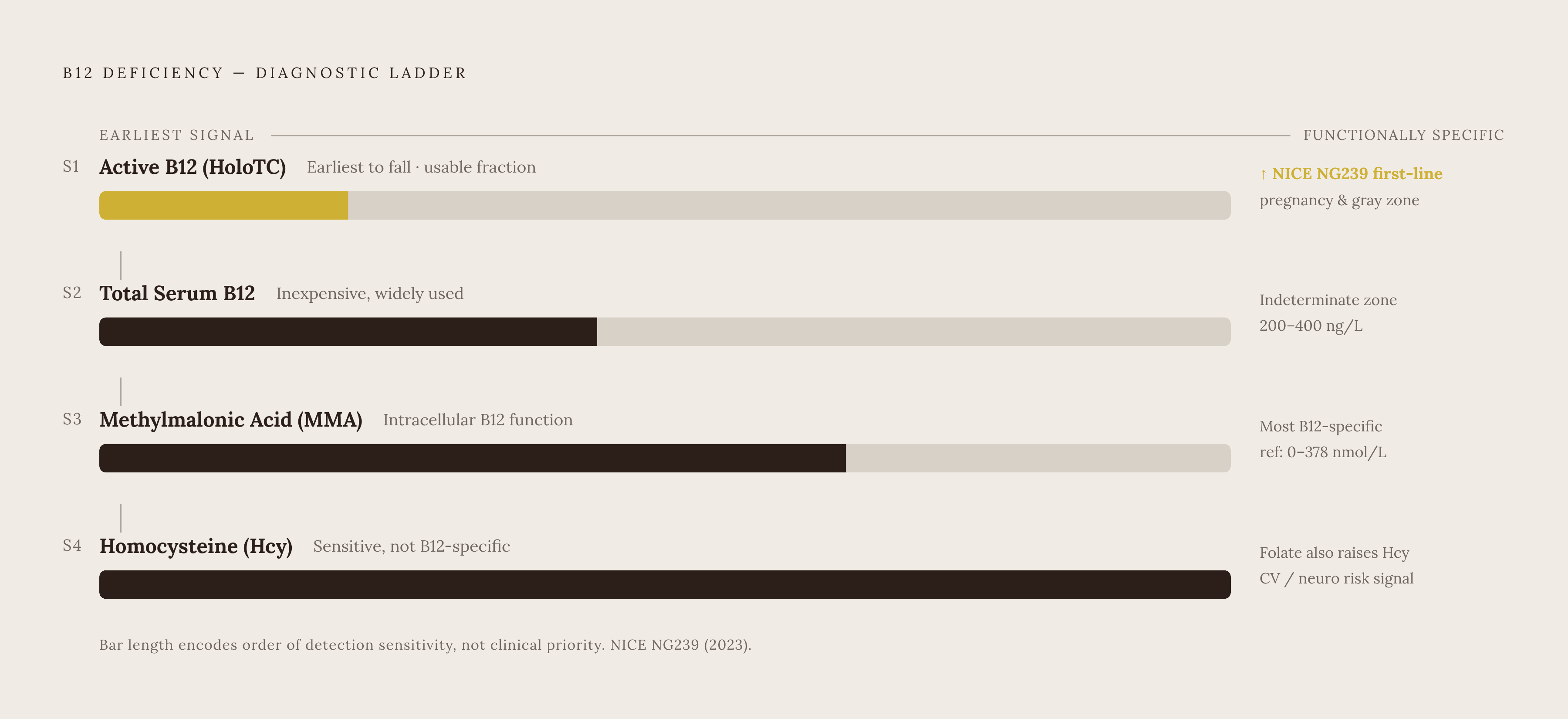
NICE NG239, published in March 2024, spells out the boundaries. Total B12 between 200 and 400 ng/L counts as indeterminate. Active B12 between 25 and 70 pmol/L falls into the same category. When a symptomatic patient lands in either zone, NICE recommends checking serum methylmalonic acid (MMA) next.
That recommendation points toward a broader framework, one built on four markers rather than one:
Total serum B12. Inexpensive, widely available, decent at catching overt deficiency. Weak as a standalone answer. Active B12 (HoloTC). Earliest signal of the four, since it isolates the usable fraction. NICE NG239 names it as the required first-line test during pregnancy specifically. Methylmalonic acid (MMA). A functional marker, it rises when B12 fails to reach the intracellular level where it's needed. It's the most B12-specific of the group, since folate deficiency doesn't confound it the way it confounds homocysteine. Labcorp's cascade testing model recommends checking MMA whenever total B12 is in the 200 to 400 ng/L borderline band, against a reference interval of 0 to 378 nmol/L. Homocysteine (Hcy). Rises with either B12 or folate deficiency, so it's sensitive but not specific to B12 alone. It also carries its own independent weight as a cardiovascular and neurological risk marker, separate from what it says about B12 status.
B12 acts as a coenzyme for two separate enzymatic reactions, and that biology explains what MMA and homocysteine each detect. B12 acts as a coenzyme for two separate enzymatic reactions: cytosolic methionine synthase, which keeps homocysteine from building up, and mitochondrial methylmalonyl-CoA mutase, which keeps MMA in check. When B12 can't get where it needs to go, one or both of those metabolites start accumulating, and that accumulation is what the functional tests actually detect. Because that rise can happen before serum B12 visibly drops, these markers are useful for catching subclinical deficiency, the kind that hasn't shown up on a standard panel yet.
NHANES, the large US population health survey, tracks B12 status at a national level using total B12 combined with MMA, which is itself a kind of real-world endorsement of the multi-marker approach over any single test.
But how confident should anyone be in a firm cutoff? NICE's own evidence review is candid about the limits here: no single diagnostic algorithm has been widely adopted across the field. It's an honest reflection of where the evidence currently stands. It's an honest reflection of where the evidence currently stands.
Who is most likely to have a misleading serum result
The gap between total and active B12 doesn't land evenly across the population. Certain groups run a much higher risk of a total B12 number that's actively misleading, usually because something in their physiology or medication list is pushing haptocorrin up or absorption down.
Adults over 50 are one clear group. Gastric acid production declines with age, and that acid is what releases B12 from food proteins in the first place. Absorption falls even when the diet supplies plenty of B12.
Metformin users deserve particular attention. Metformin interferes with B12 absorption through multiple distinct pathways, more than those affected by proton pump inhibitors (PPIs). Long-term metformin use has been linked to B12 deficiency rates as high as 50% in some sources. Combine metformin with a PPI, and the risk compounds: an FDA adverse event analysis covering 2004 through 2024 identified 552 qualifying reports tied to B12 deficiency, with metformin monotherapy alone accounting for 274 of them, and combination use appearing in a meaningful share of the remaining reports.
PPIs and H2-receptor antagonists are also associated with reduced B12 absorption, and combining them with metformin raises the overall risk further.
Vegans and strict vegetarians face a simpler problem: no animal products means no dietary B12 source. And anyone with a malabsorption condition, Crohn's disease, pernicious anemia, a history of gastrectomy including Roux-en-Y procedures, or an elevated MCV on a routine blood count, is working with a compromised absorption system regardless of diet.
Population data shows the scale of this. A 2025 outpatient cohort in Qatar (1,173 male hospital outpatients) found 13.2% frankly deficient and another 23.8% in the borderline range, for a combined 37.0% with some degree of suboptimal status. South Asian participants, who made up 74.1% of that sample, had a median B12 of 240 pmol/L. A separate 2025 study out of Iraq found 38.7% deficiency overall, climbing to 42.6% among the elderly and 41.4% among adults generally, while children sat much lower at 12.2%.
These are exactly the groups where a reassuring serum B12 result deserves the least trust. That doesn't make active B12 testing a nice-to-have for people at elevated risk. It makes it considerably more useful than the standard test for the people who need an accurate answer most.
What the 2024 NICE guideline changed
NICE NG239 went into effect March 6, 2024, and it's now the current UK standard for diagnosing B12 deficiency. It formally replaces the British Society for Haematology's 2014 guideline, and the BSH itself now points practitioners directly to NG239.
On first-line testing, the guidance gives some flexibility. Either total B12 or active B12 can serve as the initial test for most adults with suspected deficiency. Two exceptions stand out. During pregnancy, active B12 must be the first-line test, full stop, no flexibility there. And when recreational nitrous oxide use is the suspected cause, the guideline calls for plasma homocysteine or serum MMA instead of either B12 test. That pregnancy carve-out is telling. It signals real confidence, from the committee that wrote the guideline, in HoloTC's edge over total B12 in a context where getting it wrong carries real stakes.
What NG239 doesn't resolve is just as important to name. There's no gold-standard test, and the guideline says so directly in its own evidence review. No single diagnostic algorithm has emerged as the clear default. And accuracy for each marker varies by patient population in ways the evidence base hasn't fully mapped, the review specifically flags gaps for groups like women in the third trimester of pregnancy and people of Afro-Caribbean ethnicity, where the data was either absent or too thin to draw firm conclusions.
That honesty is a strength rather than a shortcoming. NG239 moves the field forward by validating active B12's role in specific, high-stakes situations, while being upfront that a clean, universal multi-marker algorithm still doesn't exist. One might argue that's a more useful guideline than one that pretends to certainty it doesn't have.
How to read your own B12 results
Anyone looking at a B12 lab report should ask a more specific question than "is this in range." Where does it fall relative to the gray zone, and are there symptoms in the picture at all?
A result in the borderline band, total B12 between 200 and 400 ng/L, or active B12 between 25 and 70 pmol/L under NICE NG239's definitions, isn't a green light just because it technically clears the lower cutoff. Paired with any symptoms, it's an argument for more testing, not less concern.
What symptoms should trigger that follow-up even when total B12 looks normal? Fatigue that doesn't track with sleep or workload, numbness or tingling in the hands or feet, trouble concentrating, mood shifts, or an elevated MCV appearing on a routine complete blood count. Any of those, paired with a borderline number, is reason enough to ask for more.
Specific situations where asking for active B12 by name makes sense:
- Pregnancy, where NICE NG239 requires it as the first-line test
- Long-term metformin or PPI use
- A vegan or largely plant-based diet
- Age over 50 with no functional B12 markers ever checked
- Any diagnosed malabsorption condition
MMA becomes the logical next step when a serum result is in the gray zone alongside symptoms, or when active B12 itself comes back indeterminate. Of the functional markers, it's the one most specific to B12 status. Homocysteine adds its own cardiovascular and neurological signal to the picture, but it shouldn't stand in as a B12-specific test on its own, given that folate deficiency moves it just as easily.
None of this requires a specialist referral or a fight with an insurance company to act on. Direct-access preventive testing lets people order active B12 and MMA as part of a proactive panel, without waiting for symptoms to escalate into a crisis first. Knowing which test to ask for, and why it matters, is a form of literacy any patient can build. It's a form of literacy any patient can build, and the payoff is a lab report that actually reflects what's happening inside the body, not just what's floating past it in the blood.
Sources
- Diagnostic reliability of serum active B12 (holo-transcobalamin) in true evaluation of vitamin B12 deficiency: Relevance in current perspective | BMC Research Notes | Springer Nature Link
- Diagnostic reliability of serum active B12 (holo-transcobalamin) in true evaluation of vitamin B12 deficiency: Relevance in current perspective
- Diagnostic reliability of serum active B12 (holo-transcobalamin) in true evaluation of vitamin B12 deficiency: Relevance in current perspective - PubMed
- nice.org.uk