Magnesium Deficiency and Why Serum Magnesium Misses It
Standard serum tests miss magnesium deficiency because they measure only 0.3% of the body's supply.

Roughly 2.4 billion people worldwide, about 31% of the global population, don't get enough magnesium. In one country studied, that number is even starker: 48% of that population fall short of the recommended intake, and a 2026 analysis of NHANES data, published in the Journal of Nutrition, found that 67.8% of adults surveyed may be living with chronic latent magnesium deficiency. Yet most of these people, if they've ever had their magnesium checked, were told it looked fine. That gap between what the blood test says and what's actually happening in tissue is the subject of this piece, and it comes down to a mechanism the body relies on to protect a number that, frankly, isn't the number that matters.
Where magnesium lives in the body, and why blood is the wrong place to look
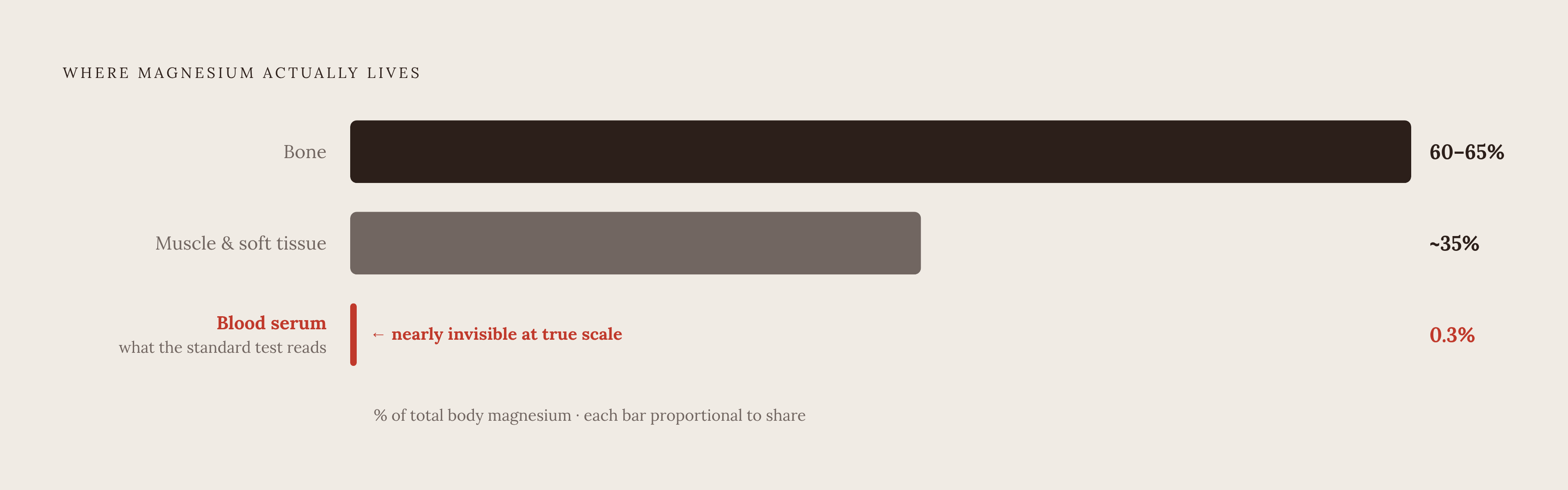
Magnesium is not a blood-dwelling mineral. Somewhere between 60% and 65% of the body's total supply is in bone. Another large share is packed into muscle tissue. The rest is scattered across organs and soft tissue, doing structural and enzymatic work.
Blood gets almost none of it. Less than 1% of total body magnesium circulates in blood at all, and serum, the liquid part of blood that a standard test measures, holds just 0.3% of it.
Sit with that for a second. A routine magnesium test looks at three-tenths of one percent of the mineral and uses it to draw conclusions about the other 99.7%. That's not a flaw in how the test is run. It's a structural limit built into what serum is.
Why would the body organize things this way? Magnesium is a structural and enzymatic mineral rather than a signaling molecule that needs to circulate and relay messages the way, say, a hormone does. It's a structural and enzymatic mineral. Its work happens inside cells and inside bone, not floating around in plasma. So when a lab draws blood and measures serum magnesium, it's sampling the smallest, least metabolically active compartment there is.
The homeostatic mechanism that keeps serum magnesium normal while tissues run low
Here's where it gets interesting, and where most of the confusion about "normal" results actually starts.
The body defends serum magnesium the same way it defends blood pH or serum calcium. These are tightly regulated numbers, and the body will go to real lengths to keep them inside a narrow range, even at a cost elsewhere. When magnesium intake drops or the body's demand for it rises, two things happen almost automatically: the kidneys ramp up reabsorption, pulling more magnesium back out of urine before it leaves the body, and bone and muscle start releasing their stored magnesium into the bloodstream to prop up serum levels.
The result is a serum number that can sit comfortably inside the reference range for months, sometimes years, while bone and muscle quietly hand over their reserves to keep that number looking fine. Research has described serum magnesium as a poor reflection of total body magnesium status, precisely because of this defense mechanism.
Think of it like a fuel gauge that doesn't move until the tank is almost dry. The needle stays near the middle right up until the engine sputters, because the system is drawing from a reserve tank you can't see. By the time serum magnesium actually falls below range, the depletion that produced it has already been building for a long time. It's been building for a long time.
That's exactly what the standard clinical test was built to catch: acute, dangerous hypomagnesemia in ICU patients or cardiac emergencies. It was never designed to flag the slow-burn depletion behind fatigue, muscle tension, restless sleep, or occasional heart palpitations. Asking it to do that job is asking a smoke detector to also measure air quality.
How badly serum testing misses deficiency, and who is most likely to be miscategorized
So how often does a normal serum result actually mean someone is fine? Not often enough. A 2008 review in the British Journal of Nutrition put the sensitivity of serum magnesium testing at somewhere between 50% and 75% for catching true deficiency. Flip that around: the test misses a quarter to half of people who are genuinely deficient.
Now put that alongside the 67.8% figure from earlier. If two-thirds of adults may be chronically depleted at the tissue level, and the standard test misses up to half of true cases, a huge number of people are walking around with a lab report that says "normal" and a body that's running short.
Some groups are especially likely to fall into that blind spot:
- People with type 2 diabetes, where hypomagnesemia is well documented and serum levels may not reflect the extent of depletion
- Long-term users of proton pump inhibitors, which the FDA flagged in 2011 for a hypomagnesemia risk tied to reduced activity of the TRPM6 and TRPM7 channels that absorb magnesium in the gut
- People on loop diuretics, which block a transporter called NKCC2 in the kidney and, in doing so, wipe out the electrical gradient that normally pulls magnesium back into the body
- People with Crohn's disease or celiac disease, where absorption is impaired further upstream, before magnesium ever gets a chance to enter circulation
- Long-term alcohol users, among whom magnesium insufficiency is commonly reported
In every one of these cases, the mechanism is the same: something is draining magnesium faster than usual, and the body's homeostatic defense is working overtime to mask it in serum. That's precisely the setting where a "normal" result is most likely to be wrong.
Even a better test, which the next section gets into, still can't see into bone, where most of the body's magnesium actually sits. No routine blood draw reaches that compartment.
What RBC magnesium measures and why it catches deficiency earlier than serum
Red blood cell magnesium testing looks inside the cells themselves rather than at the plasma surrounding them. That distinction matters more than it sounds like it should.
Red blood cells are living tissue. Their internal magnesium reflects the pool that's actually doing metabolic work: binding ATP, running enzyme systems, maintaining the electrical balance across the cell membrane. That's the same pool the body is protecting when it defends serum levels, but the body doesn't ransack it nearly as aggressively as it ransacks bone and muscle. Which means RBC magnesium tends to drop earlier in the depletion process than serum does, catching a problem while it's still forming rather than after it's finished.
There's a timing advantage built into the test, too. Red blood cells live for about 120 days, so RBC magnesium reflects an average of the past three to four months, not a single day's snapshot. It's a similar idea to how HbA1c reflects average blood sugar over time instead of a single glucose reading. That's a strength, because the result won't swing based on what someone ate or drank the night before a blood draw. It's also a limitation, because a sudden, recent drop in magnesium status will not be visible in the result right away.
Reference ranges vary by lab. Most of that country's labs use something like 4.2 to 6.8 mg/dL, while Quest Diagnostics uses 4.0 to 6.4 mg/dL. That difference matters if someone tracks results over time and switches labs partway through, since a number that looks like a drop might just be a different scale.
Getting the test isn't complicated. It has to be ordered specifically, as "Red Blood Cell Magnesium" or "Erythrocyte Magnesium," since it isn't part of a standard panel. Many clinicians default to serum simply because that's what shows up on the routine metabolic panel, not because serum is the more informative test. Direct-to-consumer lab testing has made RBC magnesium available without a physician referral in most states, for anyone who wants a more accurate baseline.
The real limitations of RBC testing that most sources gloss over
RBC magnesium is a real improvement over serum. It is not a complete picture, and pretending otherwise does readers a disservice.
Clinical research has noted that RBC magnesium doesn't correlate especially well with total body magnesium status either. It captures one compartment, and it does so earlier than serum does, but the largest compartment of all, bone, holds 60% to 65% of the body's magnesium and isn't reflected in any routine blood test, RBC or otherwise.
A handful of factors can distort the reading, too:
- Red blood cell age matters, since younger cells carry more magnesium than older ones. Someone recovering from anemia treatment, with a flood of new red blood cells, might get a result that reads artificially high.
- Hemolysis during the blood draw, where red blood cells rupture in the sample tube, can contaminate the reading before it ever reaches analysis.
- Very recent, rapid shifts in magnesium status may not be visible in the test yet, since mature red blood cells change slowly.
Add to that the lack of a standardized reference range across labs, and tracking a number over time gets messier than it should be.
The actual gold standard for whole-body magnesium status is something called the magnesium loading test, which involves an IV magnesium infusion followed by a 24-hour urine collection. How much magnesium the body retains versus excretes tells researchers a lot. But it's invasive, time-consuming, and largely confined to research settings, not something a primary care visit is going to order. No universally accepted gold standard for routine, real-world screening actually exists. That gap between what practice requires and what research validates exists and should not be glossed over.
None of this is an argument against RBC testing. It's an argument for using it with clear eyes: more signal than serum provides, not a complete map of the body's magnesium stores.
How to interpret RBC magnesium numbers: the difference between "normal" and replete
Reference ranges get built from population data, typically the great majority of everyone tested clustered around the middle. That sounds rigorous, until you remember that if a large chunk of the population is already insufficient, "normal" just means "typical," not "adequate." It's a known limitation of population-derived reference ranges when the population itself may be broadly insufficient.
One tiered framework breaks RBC magnesium results down like this:
- Below 4.2 mg/dL: overt deficiency, where aggressive repletion is typically recommended
- 4.2 to 5.1 mg/dL: subclinical insufficiency, a range some practitioners associate with low-grade symptoms
- 5.5 to 6.4 mg/dL: a functional optimal range cited by some functional medicine practitioners as a maintenance target
- Above 6.8 mg/dL: above the standard upper reference limit, worth reviewing current supplement dosing
Some practitioners consider anything below 5.0 mg/dL a sign of definite deficiency, even when the accompanying serum result reads completely normal. Others working in functional and longevity medicine aim for a tighter target, somewhere around 5.5 to 6.4 mg/dL. That range comes from practitioner consensus and clinical observation, not from randomized controlled trials tying it to hard outcomes, so it should be treated with that context rather than as settled science.
The 4.2 to 5.1 mg/dL band is where most of the actual decision-making happens. Nobody's in an emergency at that level. But the body isn't running at its best there either, and that's usually where cramping, restless sleep, or the occasional skipped heartbeat start making sense in hindsight.
Recovery isn't fast. Some symptoms may ease before tissue-level stores are fully rebuilt, and meaningful repletion generally requires consistent intake over time. RBC magnesium, given its 3-to-4-month averaging window, is the right marker to track that progress. Which raises an obvious follow-up: is a single serum result at a routine physical actually useful for any of this? Not particularly. A baseline RBC test, followed by a retest after several months of repletion, tells a far more complete story than one number pulled during an annual checkup ever could.
The Magnesium Depletion Score: when clinical risk factors do what blood tests can't
Since no blood test fully captures total body magnesium status, researchers built something else entirely: a scoring system based on risk factors rather than a lab value. Researchers developed the Magnesium Depletion Score, or MDS, which assigns points across four domains tied to how well the kidneys hold onto magnesium.
The scoring works like this:
- Current diuretic use: 1 point
- Current PPI use: 1 point
- eGFR (a measure of kidney function) between 60 and 90 mL/min/1.73 m²: 1 point; below 60: 2 points
- Alcohol intake above 1 drink a day for women, or 2 drinks a day for men: 1 point
Higher scores have been associated with greater risk of magnesium deficiency based on the studies used to validate the tool. And in head-to-head comparisons of predictive accuracy (measured by AUC, where higher means better at distinguishing deficient from non-deficient), MDS came out ahead of the blood tests it was compared against: 0.60 for MDS versus 0.53 for serum magnesium and 0.58 for urinary magnesium.
That's a genuinely strange result if you think about it. A checklist built from prescription history and a kidney function number outperforms the actual blood test at predicting deficiency. But it makes sense once you consider what each is measuring: MDS captures mechanism (why magnesium might be leaking out) while serum captures a defended number that resists showing the leak.
The practical use of MDS is triage rather than diagnosis. It's triage rather than diagnosis. Anyone scoring high, particularly people on PPIs or diuretics, or with reduced kidney function, should treat a normal serum result with real skepticism and consider RBC testing or a closer look at diet, regardless of what the standard panel says.
Why the downstream risks of undetected magnesium insufficiency make accurate testing matter
Why does any of this matter beyond a number on a lab report? Because magnesium intake tracks with some fairly serious downstream outcomes.
A meta-analysis pooling 40 prospective cohort studies, covering more than one million participants and published in BMC Medicine, found that every additional 100 mg of dietary magnesium per day was associated with a 22% reduction in heart failure risk, a 7% reduction in stroke risk, a 19% reduction in type 2 diabetes risk, and a 10% reduction in all-cause mortality.
Those numbers deserve a careful read, not a triumphant one. This is association data drawn from dietary intake patterns, not a randomized trial testing whether popping a supplement lowers anyone's stroke risk. Correlation across a cohort of a million people is not the same claim as causation in an individual body. But taken together with the mechanism described earlier in this piece, magnesium's role in ATP function, enzyme activity, and the electrical stability of cells, the direction of the evidence is hard to wave off. A mineral that's structurally involved in how the heart, blood vessels, and metabolic system function shouldn't be expected to run low without consequence.
That's the case for taking testing seriously in the first place. Not because a single number needs fixing, but because the gap between what serum says and what tissue actually holds is exactly the kind of gap where real risk hides in plain sight, dressed up as a normal lab result.