ALT and AST Liver Enzyme Results and What Elevation Means
Elevated liver enzymes signal cell damage, not how well your liver actually works.
ALT and AST are the two enzymes doctors check most often to flag liver trouble, but neither one measures how well the liver is working. They're leak markers. When liver cells get damaged, these enzymes spill into the blood, and a lab picks up the spike. Reading them well means looking at more than one number: which enzyme is up, by how much, and what ratio they form together.
Calling ALT and AST "liver function tests" is actually a mislabel that sticks around out of habit. Function means something specific in medicine: can the liver make proteins, clear toxins, produce clotting factors? That's measured by INR, albumin, and bilirubin. ALP and GGT flag a different problem, bile flow obstruction. ALT and AST measure neither. They measure injury, plain and simple, the biochemical residue of cells rupturing or leaking their contents.
The two enzymes also aren't interchangeable. ALT lives almost exclusively inside liver cells, which makes it the more liver-specific of the pair on a routine panel. AST shows up in the liver too, but also in heart muscle, skeletal muscle, kidneys, and red blood cells. So a runner who just tore through leg day can post an elevated AST with an ALT sitting right in the middle of normal, and that has nothing to do with the liver. Pair that same elevated AST with a rise in ALT, though, and the liver becomes the leading suspect.
Both numbers ride along on a comprehensive metabolic panel or a liver function test, and neither means much read alone. Bilirubin, ALP, albumin, GGT: these get pulled into the picture too. The real skill here isn't memorizing a cutoff. It's pattern recognition, matching up several values at once instead of reacting to one number in isolation.
Why the printed reference range on your lab report may not be the right benchmark
Standard lab cutoffs put ALT around 7 to 56 U/L for men and 7 to 45 U/L for women, with AST landing around 8 to 48 U/L. Those numbers shift some depending on which lab ran the test, since each facility calibrates its own equipment and reference population.
That reference population is where things get shaky. Decades ago, labs built these "normal" ranges from broad samples of people, and a fair number of those people had undiagnosed fatty liver disease without anyone knowing it. Their enzyme levels got baked into what counts as normal today. So the ceiling crept higher than it probably should sit.
Groups like the ACG and AASLD have pushed back on this. Their guidance puts true normal ALT closer to 29 to 33 U/L for men and 19 to 25 U/L for women, well under what most commercial labs still print. Plenty of academic liver centers already use these tighter numbers internally, even while the standard lab report keeps showing the old, wider range.
Picture an ALT reading of 42 U/L. Against a lab cutoff of 56, that looks fine, nothing flagged, nothing circled in red. But stack it against the specialist threshold and it sits above what a lean, metabolically healthy adult should show. Same number, two very different verdicts, depending on which yardstick gets used.
Sex and age shift where ALT tends to land, with premenopausal women running lower than men before that protection fades after menopause and levels start drifting upward. Estrogen seems to limit fat buildup in the liver, which is part of why premenopausal women tend to run lower ALT than men. That protection fades after menopause, and levels start drifting upward. Body weight plays a role as well: carrying more weight nudges baseline ALT higher, which can bury early fatty liver disease if a clinician leans only on the lab's printed cutoff.
If ALT sits above 30 U/L for six to twelve months running, that's chronic injury, and it deserves a full workup, not another shrug at the next annual physical. The trend across repeated tests tells you more than any single result ever will.
So check the reference range on your own report, sure. But treat "within range" and "optimal" as two different claims. They often aren't the same thing.
The AST/ALT ratio, the calculation most patients never hear about
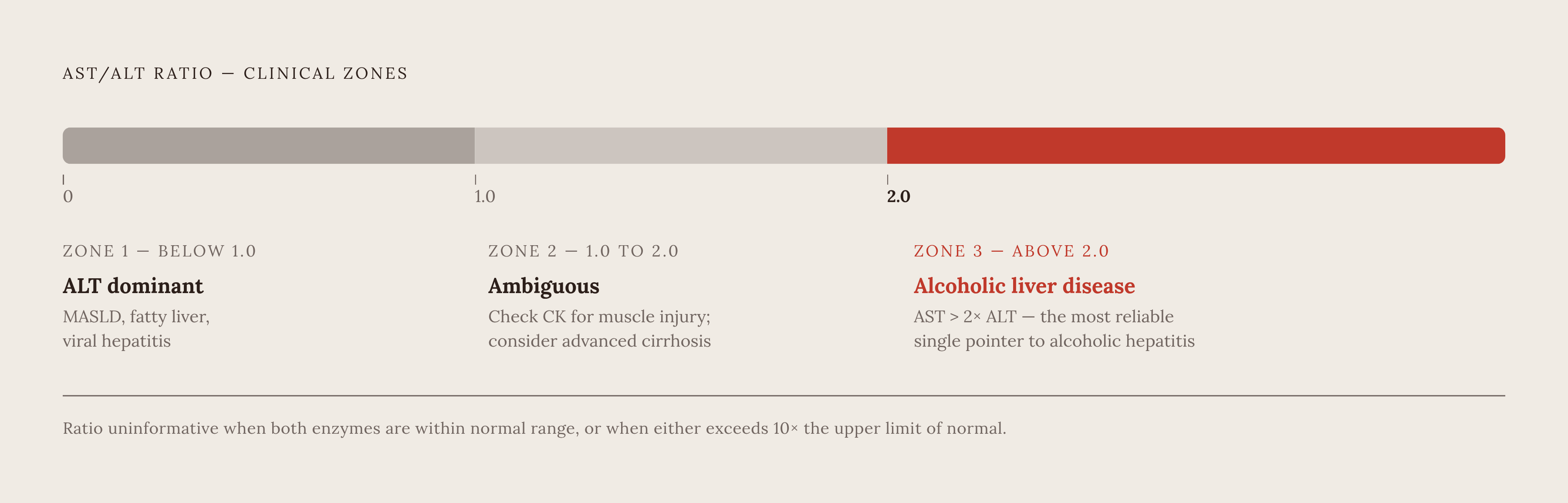
Divide AST by ALT. That's it, a two-second calculation that turns two isolated numbers into something with real interpretive weight.
Fernando De Ritis proposed this ratio back in 1957 to gauge how severe a case of viral hepatitis was. The use has spread well past that original purpose since then.
Three zones matter most:
- Ratio under 1.0 (ALT higher than AST): the typical pattern in MASLD, fatty liver disease, or viral hepatitis.
- Ratio over 2.0 (AST more than double ALT): the classic signature of alcoholic liver disease.
- Ratio between 1.0 and 2.0: murkier territory, needs clinical context. Consider muscle damage (check CK) or advanced cirrhosis from any underlying cause.
Why does the ratio move as fatty liver disease gets worse? As damage progresses, mitochondria inside liver cells start taking hits too, and that pushes out more AST relative to ALT. The ratio climbs as the disease climbs.
The reach of this number goes beyond the liver, too. Research has found a link between liver enzymes and cardiovascular mortality, and within that data, the AST/ALT ratio on its own predicted cardiovascular death (hazard ratio 2.20, 95% CI 1.60 to 3.04). That's not a small effect. The ALT/AST ratio also tracks with insulin resistance, metabolic syndrome, ApoB, and PAI-1 (a marker tied to impaired clot breakdown) in middle-aged women, tying simple liver markers to values cardiologists watch closely.
Two limits state plainly here. When both AST and ALT are comfortably inside the normal range, the ratio is still mathematically correct, but it stops meaning anything clinically. And once either enzyme climbs past ten times the upper limit of normal, the ratio takes a back seat: the raw magnitude and the overall clinical picture carry more weight than any division problem at that point.
How the magnitude of elevation narrows the field of possible causes
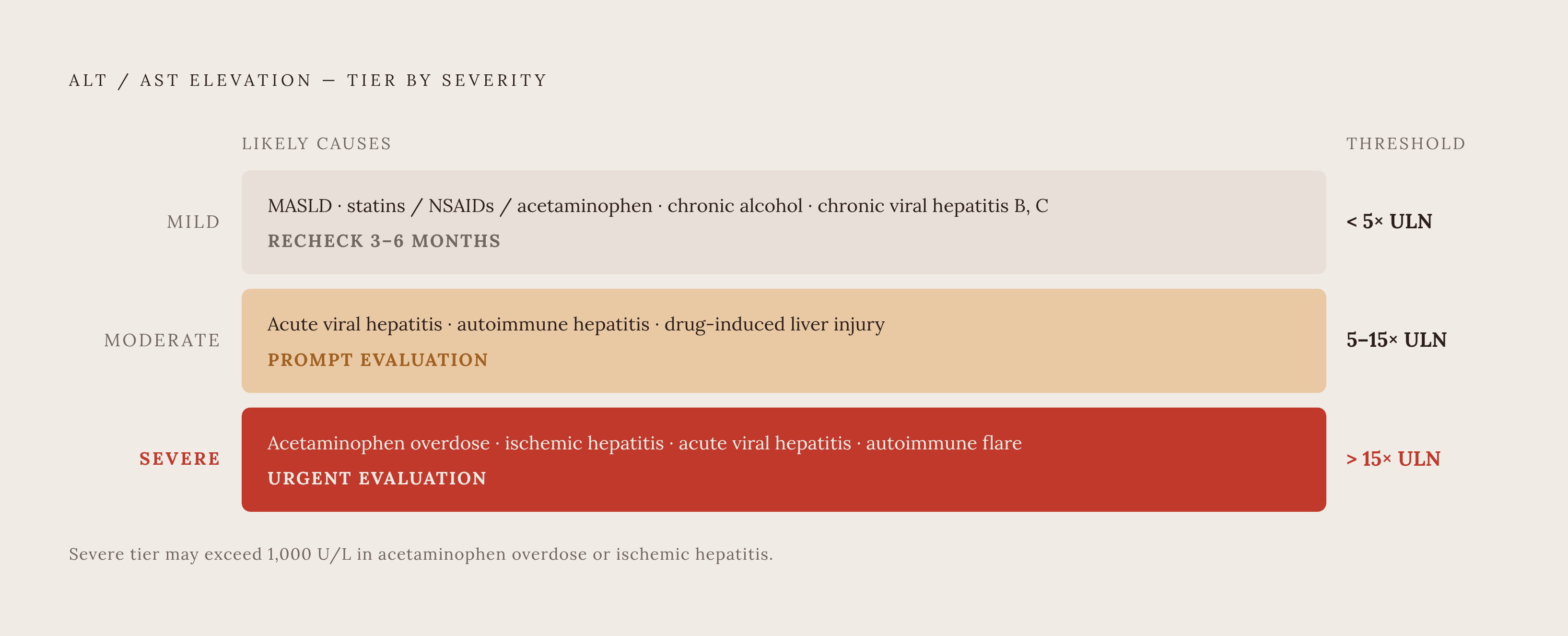
The size of an elevation gets measured against the upper limit of normal (ULN), not as some fixed absolute number, since the ULN itself moves depending on the lab.
Mild elevation, under 5 times ULN, appears most often in routine bloodwork. The usual suspects: MASLD or other metabolic liver disease (where ALT typically runs ahead of AST), medications like statins, NSAIDs, acetaminophen, or certain supplements, chronic alcohol use, and chronic viral hepatitis B or C. The standard next move is to address whatever's modifiable and recheck the numbers in three to six months.
Moderate elevation, 5 to 15 times ULN, narrows the list considerably. Think acute viral hepatitis (A, B, or C), autoimmune hepatitis, drug-induced liver injury, or acute fatty liver. This range calls for prompt evaluation, not a wait-and-see approach.
Severe elevation, above 15 times ULN and sometimes climbing past 1,000 U/L, points to a short list of serious causes: acute viral hepatitis, acetaminophen overdose or toxin exposure (certain mushrooms fall into this category), ischemic hepatitis (sometimes called shock liver), or an autoimmune flare. This level needs urgent evaluation, full stop.
The exact ALT or AST number doesn't line up neatly with how much damage the liver has actually sustained, and it doesn't predict prognosis well either. A moderate number doesn't guarantee moderate damage. A mild number doesn't rule out something serious that it can still cause without revealing.
One more distinction matters here. If ALP rises out of proportion to ALT and AST, that points toward bile duct obstruction rather than damaged liver cells, a cholestatic pattern instead of a hepatocellular one. Checking GGT settles the question: if GGT comes back normal, that elevated ALP probably originated in bone, not liver.
The most common cause of mild elevation: MASLD and why its enzymes mislead
MASLD, metabolic dysfunction-associated steatotic liver disease, replaced the older term NAFLD as the standard label in 2023. The name changed, but the scale of the problem didn't shrink: an estimated 38% of adults currently live with MASLD, along with 7 to 14% of children and adolescents, and projections put adult prevalence above 55% by 2040.
ALT does a poor job tracking how severe MASLD actually is. Its level doesn't correlate well with the degree of tissue damage on biopsy, and it can read completely normal even when the disease has advanced quite far.
Roughly a quarter of American adults carry some degree of hepatic steatosis, often showing a mildly to moderately elevated ALT alongside an AST/ALT ratio under 1.0. That's the classic mild-elevation pattern: ALT running ahead of AST, ratio below 1.0, elevation on the milder end. But that pattern alone can't tell you whether steatohepatitis or early fibrosis has already set in and produced it.
As MASLD advances toward cirrhosis, that ratio can flip and climb above 1.0. That flip is a signal the disease has progressed, not proof that drinking suddenly entered the picture.
A metabolic thread runs through this too. ALT elevation tracks with a higher risk of developing type 2 diabetes, and this holds even when ALT sits within the normal range, predicting diabetes risk on top of baseline weight or glucose numbers. That's a strong case for watching these numbers proactively, even when a single report comes back looking fine.
When normal enzymes do not mean a healthy liver
ALT and AST only rise when liver cells are actively leaking their contents into the bloodstream. A liver can carry real, measurable damage without ever triggering that leak, which means normal enzymes don't close the case.
Research on biopsy-confirmed MASLD patients (Mofrad et al., published in Hepatology in 2003) found that a meaningful share of people with completely normal ALT already had steatohepatitis or measurable scarring on biopsy. Fat sitting in the liver doesn't automatically cause the kind of cell injury that spikes ALT.
Cirrhosis plays the same trick. Once scar tissue has replaced enough working liver, there simply aren't as many functional hepatocytes left to leak enzymes under stress. ALT and AST can sit comfortably within normal range even in advanced, compensated cirrhosis. A falling platelet count often appears as an earlier warning sign than any enzyme value does.
That's the uncomfortable irony in decompensated cirrhosis: so few working liver cells remain that ALT can look almost reassuringly normal. It isn't reassuring. It's misleading.
Liver cancer follows a similar script. Early hepatocellular carcinoma frequently produces no change at all in ALT, AST, or ALP. That's exactly why clinical guidelines call for twice-yearly ultrasound, sometimes paired with an AFP blood test, for anyone with cirrhosis or chronic hepatitis. Enzyme monitoring alone won't catch it.
So what actually shows what the liver can still do, rather than whether it's inflamed right now? Albumin (normal range roughly 3.5 to 5.0 g/dL, with low levels signaling lost production capacity), bilirubin (normal roughly 0.1 to 1.2 mg/dL), platelet count, and INR. A normal liver panel is good news, but it's not the final word. The real value comes from tracking these numbers over time and pairing enzyme results with synthetic function markers and imaging wherever risk factors exist.
Other causes of elevation worth ruling out before attributing results to the liver
Exercise gets overlooked more than almost anything else on this list. A hard run or a heavy lifting session can raise AST, and to a lesser degree ALT, for 24 to 72 hours or longer, with AST usually climbing more because it is also found in skeletal muscle. Blood drawn the morning after leg day can throw off a falsely elevated AST. The fix is simple: retest after a rest week before chasing anything further. If AST is up without a matching rise in ALT, checking creatine kinase (CK) confirms whether muscle, not liver, is the source.
Medications come next, and statins are the textbook example. Roughly 1 to 3% of statin users see a mild, temporary ALT bump, typically early in treatment, and it rarely requires stopping the drug. NSAIDs, acetaminophen (dose matters here), certain antibiotics, antifungals, and antiepileptics can all cause similar bumps.
Supplements deserve more attention than they usually get. Cases of herb- and supplement-induced liver injury reported to the US Drug-Induced Liver Injury Network climbed from 7% of all drug-induced liver injury cases in 2005 to 20% by 2014. Named culprits include green tea extract (the compound EGCG carries hepatotoxicity risk, especially past 800 mg), kava, high-dose turmeric, black cohosh, and garcinia cambogia. Risk climbs further when someone stacks several supplements together or mixes them with prescription drugs.
Alcohol shows a particular order of operations. Alcohol use can raise GGT and AST, often before ALT climbs significantly. The classic AST/ALT ratio above 2.0 does not become visible until drinking has become habitual and heavy. Light social drinking rarely pushes ALT past the reference range, though it can still keep the liver from reaching its optimal state if it's already under metabolic strain from other factors.
A few more names apply here. Hypothyroidism can cause a mild AST/ALT bump, which is reason enough to check a thyroid panel when liver enzymes come back unexplained. Hemolysis, red blood cells breaking down during sample handling, can artificially inflate AST; that's a lab-handling issue, not a disease signal. And once the common explanations get ruled out, a short list of less common conditions deserves a look: Wilson's disease, hereditary hemochromatosis (which can show mild elevation early on), autoimmune hepatitis, alpha-1 antitrypsin deficiency, celiac disease, and viral hepatitis B and C, screened with surface antigen and antibody tests.
Reading your results in practice, what each combination of findings suggests you do next
Mild elevation, under 5 times ULN, with ALT higher than AST and a ratio under 1.0: this points most often to MASLD, medication effects, or lifestyle factors. Reasonable first steps include cutting back on alcohol, dropping any supplement that might be implicated, and giving recent intense exercise time to clear out of the bloodstream, then rechecking in three to six months. If ALT stays above 30 U/L for six to twelve months despite these changes, that calls for a full evaluation, regardless of whether the lab's printed range still calls it normal.
Elevated AST without a matching rise in ALT points away from the liver more often than toward it. Checking CK settles whether muscle damage explains the number. A recent workout, a fall, even an intramuscular injection can all push AST up on its own.
Ratio above 2.0, with AST clearly outpacing ALT: this is the pattern most associated with alcohol-related liver injury, and it warrants an honest look at drinking habits alongside a GGT check, since GGT is sensitive to alcohol and tends to stay elevated with ongoing use.
Moderate to severe elevation, above 5 times ULN, in either enzyme: this isn't a wait-and-recheck situation. It calls for prompt medical evaluation, ideally including a review of recent medications and supplements, viral hepatitis screening, and imaging where appropriate.
Normal enzymes paired with known risk factors, obesity, type 2 diabetes, heavy past alcohol use, or a family history of liver disease: normal ALT and AST shouldn't be read as a clean bill of health here. Albumin, bilirubin, platelet count, and INR round out the picture, and imaging may warrant a discussion with a doctor even when the enzyme panel looks unremarkable.
None of these numbers work in isolation, and that's really the whole point. ALT and AST are a starting signal, not a diagnosis. Reading them well means asking which enzyme moved, by how much, in what ratio, and what else on the panel backs up or contradicts the story they seem to tell.