When Supplement Use Distorts Nutrient Lab Results
High-dose biotin supplements can mask heart attacks and mimic thyroid disease on blood tests.
Blood tests are supposed to measure biology. Increasingly, they measure biology plus whatever supplement someone swallowed that morning. Roughly 4 in 10 people who get blood tests may have their results skewed by something they're taking, according to an April 2026 estimate from Optimal DX. That number matters because an estimated 70% of medical decisions in the US get made off lab results, per MDLinx. When the input is wrong, the decision built on top of it inherits that error.
None of this means supplements are the problem. Most people take them for good reasons: closing a nutritional gap, supporting hair and nail growth, managing cholesterol, recovering faster after a workout. The trouble isn't that these compounds are dangerous. It's that once they're circulating in blood, they can make a healthy person look sick, a sick person look fine, or a treated condition look untreated. And the timing is bad: proactive testing keeps growing, more people are checking their own biomarkers more often, and supplement use keeps climbing right alongside it. Those two curves are now colliding directly inside the lab.
Two mechanisms explain almost every version of this conflict. Once you can tell them apart, you can actually interrogate a confusing lab result instead of treating it as a mystery.
The two mechanisms that explain almost every supplement-lab conflict
The first is analytical interference, sometimes called assay interference. The supplement molecule physically messes with the chemistry of the test itself. It has nothing to do with the patient's actual biology, and everything to do with what happens in the tube or on the analyzer. The body might be perfectly healthy. The test just can't see that clearly anymore.
The second is genuine physiological change that misleads. Here, the supplement really does alter a biomarker inside the body. The number on the page is accurate. That number implies something specific. A real change in one marker can mask a real condition elsewhere, or it can mimic a disease pattern that isn't actually present.
Why does the difference matter in practice? Because the fix is completely different depending on which one is happening. Analytical interference: stop the supplement, wait, retest. The biology never changed, so once the interfering molecule clears out, the number resets. Physiological distortion is harder. Sometimes a clinician needs to understand exactly what the supplement does to the body and mentally subtract that effect from the disease signal. Sometimes the honest answer is that a different test, one immune to the supplement's effect, is the only way to get a clean read.
The single biggest source of analytical interference runs through something called biotin-streptavidin immunoassays, a testing platform used across hormone panels, cardiac markers, and fertility tests. Excess biotin in the blood floods the streptavidin binding sites the test relies on, before the test's own biotin-linked reagents get a chance to bind. Depending on how the specific assay is built, that pushes the result artificially high or artificially low. That mechanism matters because biotin alone accounts for a disproportionate share of the confusion clinicians run into.
Biotin: the supplement that can make a healthy thyroid look diseased and a heart attack look like nothing
Biotin is everywhere. It's in multivitamins, prenatal vitamins, B-complex formulas, and it's the headline ingredient in nearly every supplement marketed for hair, skin, and nail growth. That last category is where the dosing gets genuinely alarming.
The recommended daily intake of biotin is 0.03 milligrams, or 30 micrograms. Many of those hair-skin-nails supplements contain up to 650 times that amount, according to FDA figures cited by MDLinx and Harvard Health. Popular megadose formulas run in the 5,000 to 10,000 microgram range. To be fair, doses up to 1 milligram a day appear unlikely to cause test interference. But 5 milligrams or more starts affecting immunoassays, per Optimal DX's September 2026 data, and plenty of consumer products sail well past that line without anyone reading the label closely.
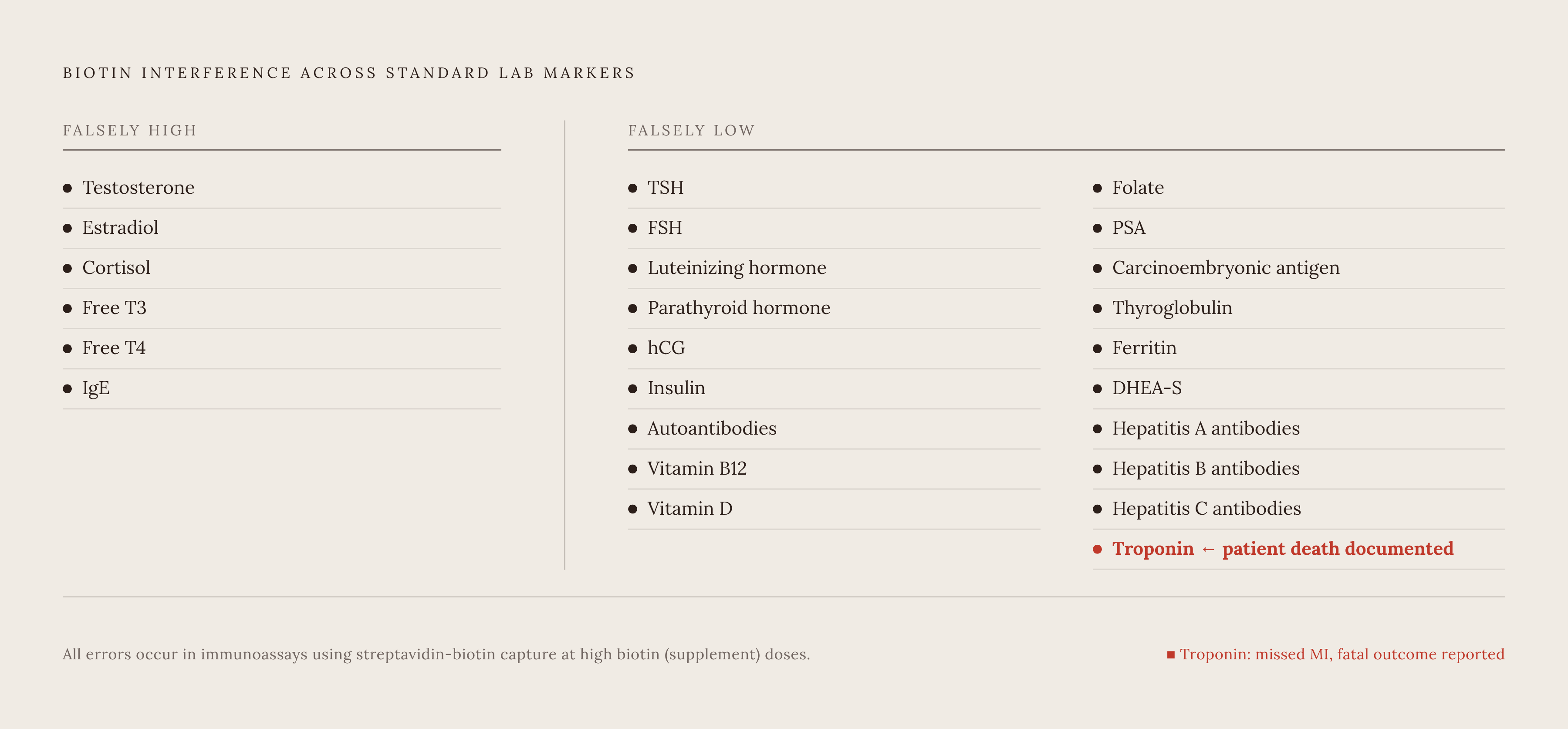
What does that interference actually look like on a thyroid panel? Biotin causes falsely elevated free T3 and free T4, paired with falsely suppressed TSH. That combination mimics Graves' disease, an overactive thyroid, in someone whose thyroid is working completely normally. It gets worse: biotin can also inflate the immunoglobulin markers doctors use to actually diagnose Graves', compounding a false pattern with false confirmation. A 2026 case report described a patient on levothyroxine whose dose was repeatedly adjusted over several months based on TSH readings that were being distorted by biotin interference. The immunoassay measuring her TSH turned out to be the thing that was broken, not her thyroid.
Troponin is where this becomes a genuine safety issue, not just an inconvenience. Troponin is the primary marker used to diagnose a heart attack, and it's measured with a "sandwich" assay, a format biotin can push toward a falsely low reading. The FDA issued a formal safety warning about this exact interference, and the agency has documented a case where a patient taking high levels of biotin died after a troponin test came back falsely low, according to Harvard Health's reporting. A heart attack that reads as nothing on paper is about as serious as lab error gets.
And troponin and thyroid markers are just the tests that get the headlines. Biotin's fingerprints appear across a long list of panels, per MDLinx: falsely high testosterone, estradiol, cortisol, free T3, free T4, and IgE; falsely low TSH, FSH, luteinizing hormone, parathyroid hormone, hCG, insulin, autoantibodies, vitamin B12, vitamin D, folate, PSA, carcinoembryonic antigen, thyroglobulin, ferritin, DHEA-S, and hepatitis A, B, and C antibodies. That's not a niche problem confined to one panel. That's most of what a routine wellness workup touches.
So how many doctors actually catch this? According to MDLinx, 62.5% of physicians knew biotin could interfere with thyroid tests, and 58.7% knew about the cardiac marker risk. But only 7% knew it could throw off pregnancy or vitamin D testing. Fewer than 3% knew it could affect HIV and hepatitis results. And 19.5% were flatly convinced biotin didn't interfere with testing at all. That study oversampled dermatologists, who prescribe biotin often and would reasonably be expected to know more about it than average. Broader physician awareness is likely lower still.
Biotin's half-life in blood is around 2 hours, so it clears fast on paper. But serum levels as low as 10 to 50 nanograms per milliliter can still throw off a test, and interference can linger for days after the last dose. Different assays trip at wildly different concentrations too, some as low as 5 ng/mL, others not until 10,000 ng/mL. There's no single "safe" cutoff to memorize here. The specific assay matters as much as the dose.
Other supplements that corrupt test chemistry: creatine, vitamin C, and calcium
Biotin isn't the only molecule capable of jamming test chemistry. Three other common supplements do it through completely different pathways, and each one has a name worth knowing.
Creatine monohydrate, one of the most widely used performance supplements on the market, gets metabolized into creatinine, the exact compound labs use to estimate kidney filtration through eGFR. A 2025 systematic review and meta-analysis in BMC Nephrology, pooling 21 studies, found creatine supplementation produced a statistically significant rise in serum creatinine (mean difference of 0.07 µmol/L, p = 0.03), with the effect strongest in studies that only followed subjects for a week or less. A second 2025 meta-analysis, covering 26 studies and 1,036 participants, found a mean creatinine increase of 0.14 mg/dL and a creatinine-based GFR drop of 10.75 mL/min. Here's the part that matters: alternative kidney filtration estimates not dependent on creatinine showed no corresponding change. That's the tell. This is a metabolic artifact, not kidney damage. But if a clinician doesn't know a patient is supplementing creatine, elevated creatinine and a depressed eGFR can trigger an unnecessary nephrology referral. The fix is simple: ask for a kidney filtration estimate that isn't creatinine-based.
Vitamin C works differently. High doses react directly with the testing chemicals inside glucose meters, producing falsely elevated blood sugar readings. That's a real problem for anyone managing diabetes with a continuous glucose monitor or a standard meter, and it can matter for anyone getting fasting glucose checked at all, since an apparently high reading can trigger medication changes nobody actually needed. Separately, vitamin C above 250 mg a day can throw off stool tests used for colorectal cancer screening, according to Harvard Health, citing the American Cancer Society.
Calcium interferes somewhere else entirely: bone density scans. Taking a calcium supplement in the 24 hours before a bone density scan can make bone appear denser than it really is, a direct artifact of the imaging chemistry rather than any change in bone itself. Kaiser Permanente now advises patients to skip calcium supplements for at least a full day before a scan.
What ties these three together? In every case, the supplement adds a specific molecule, a creatinine precursor, ascorbate, calcium ions, that either mimics or physically disrupts the exact signal the test is built to detect. None of it reflects the body's health actually changing. It's chemistry getting in its own way.
Supplements that change biomarkers but still mislead clinicians
This category is trickier, because nothing here is a lab error. These are accurate measurements of a body a supplement has genuinely changed. The distortion isn't chemical, it's interpretive: the number is right, but what it seems to say about the underlying health picture is misleading.
Fish oil is the clearest example. Omega-3 supplementation produces real, measurable drops in triglycerides (down 18%), VLDL ApoB (down 20%), and hepatic secretion of VLDL ApoB (down 29%) compared with placebo in people with dyslipidemia. So what's the catch? A patient who starts fish oil before ever getting a baseline lipid panel can look like they have a better cardiovascular risk profile than they actually started with, which makes it nearly impossible for a clinician to establish a true baseline or measure whether some other intervention is actually working. The overall lipid picture a clinician sees may not reflect the patient's true baseline if supplementation began before any reference values were established.
Vitamin D is a different kind of timing problem. Vitamin D supplements raise 25(OH)D, the exact biomarker being tested, which is the intended effect and not interference at all. But it takes 8 to 12 weeks for 25(OH)D to stabilize after starting supplementation. Test too early, and the number reflects a moving target rather than a steady state. A large weekly dose, 50,000 IU for example, taken right before a blood draw can produce a temporary spike that overstates someone's actual average level; daily dosing tends to produce steadier numbers. So the vitamin D number can reflect a moving target even before any assay-level interference is considered.
Zinc and copper tell a quieter but equally real story. High-dose zinc suppresses copper absorption in the gut, a documented physiological interaction. Sustained high-dose zinc without copper co-supplementation leads to copper deficiency, which can cause anemia and a weakened immune response, the very thing the zinc was probably taken to prevent. Serum copper and ceruloplasmin, the markers used to assess someone's nutritional status, get depressed by zinc use, and a clinician unaware of that zinc intake can read a real deficiency as adequate nutrition. Popular immune-support zinc doses, 50 to 100 mg a day, sit right in the range where this occurs. A reasonable guideline: anyone supplementing 15 to 30 mg of zinc daily should pair it with 1 to 2 mg of copper.
Calcium interferes with iron here as well. Calcium blocks both heme and non-heme iron absorption in the gut, and taking a calcium supplement alongside iron in the same meal can cut iron absorption by up to 62 percent. Picture a patient being treated for iron-deficiency anemia whose ferritin just won't climb. The natural read is treatment failure. The actual cause might be a calcium supplement taken at breakfast with the iron pill, quietly canceling out the treatment before it can work.
Folic acid raises a subtler concern. High-dose folic acid supplementation can interact with B12 status in ways that complicate standard blood count interpretation, since normalized counts on a CBC do not always capture what is happening at the level of B12 itself.
The markers most commonly distorted and what a misleading result actually looks like
Pulling all of this together by marker makes the pattern easier to hold onto. Each one below has a known distorting supplement (or class), a direction of error, and a resulting clinical impression that doesn't match reality.
TSH, free T3, free T4: biotin drives falsely low TSH alongside falsely high T3 and T4, a pattern that mimics hyperthyroidism in someone whose thyroid is fine. Other physiological factors can also shift TSH, which can obscure a real thyroid problem underneath a seemingly normal number. Other hormonal influences can make Total T4 appear elevated even when the free hormone level, the part that actually matters, hasn't changed at all.
Troponin: biotin can push this falsely low, and that's arguably the most dangerous distortion covered here. The FDA's documented case of a patient who died after a falsely low troponin reading, tied to high biotin intake, is the clearest illustration of what's actually at stake when interference meets an acute cardiac presentation.
Serum creatinine and eGFR: creatine supplementation raises creatinine and drags creatinine-based eGFR down, with no true kidney dysfunction behind it. Cystatin C-based eGFR is unaffected by creatine and is the test to request when there's any doubt.
Fasting glucose: high-dose vitamin C reacts with the chemistry inside glucose meters, producing falsely elevated readings that can look like poor glycemic control when nothing in the body has actually changed. Anyone managing diabetes should rule out that distortion before adjusting medication based on a single high number.
None of these markers are unreliable on their own. What makes them misleading is context nobody asked for: what was taken, how much, and how recently. A lab value is never just a number. It's a number plus everything circulating in the bloodstream at the moment the needle went in, and increasingly, that second part includes a shelf's worth of supplements nobody thought to mention.