Chronic Elevated CRP Versus Acute Infection CRP Spike
Same molecule, two wildly different clinical meanings.

A lab report showing "elevated CRP" can mean two almost opposite things, and the number by itself won't tell which one applies. C-reactive protein is a single molecule, made by the liver, that can climb to extreme heights within a day or two during a bacterial infection, or sit only slightly above normal for years during a slow-burning metabolic condition. Same protein, same organ making it, wildly different meanings depending on what triggered the response.
These two patterns don't resolve on the same timeline, don't look the same clinically, and don't carry the same consequences, and because the molecule itself is identical either way, a lab number alone tells you almost nothing without knowing which assay was run or what the person's body was doing at the time of the draw. Understanding which pattern is showing up on a given lab slip is the whole task ahead, and it starts with understanding how the acute version actually behaves inside the body.
How the acute spike works inside the body during an infection
Picture a bacterial infection taking hold. The immune system detects it and signals the liver, and within hours, the liver starts dumping CRP into the bloodstream. That CRP then goes to work directly: it binds to damaged cells and to the pathogens themselves, activates the complement system, and tags debris so the rest of the immune system knows what to clear out.
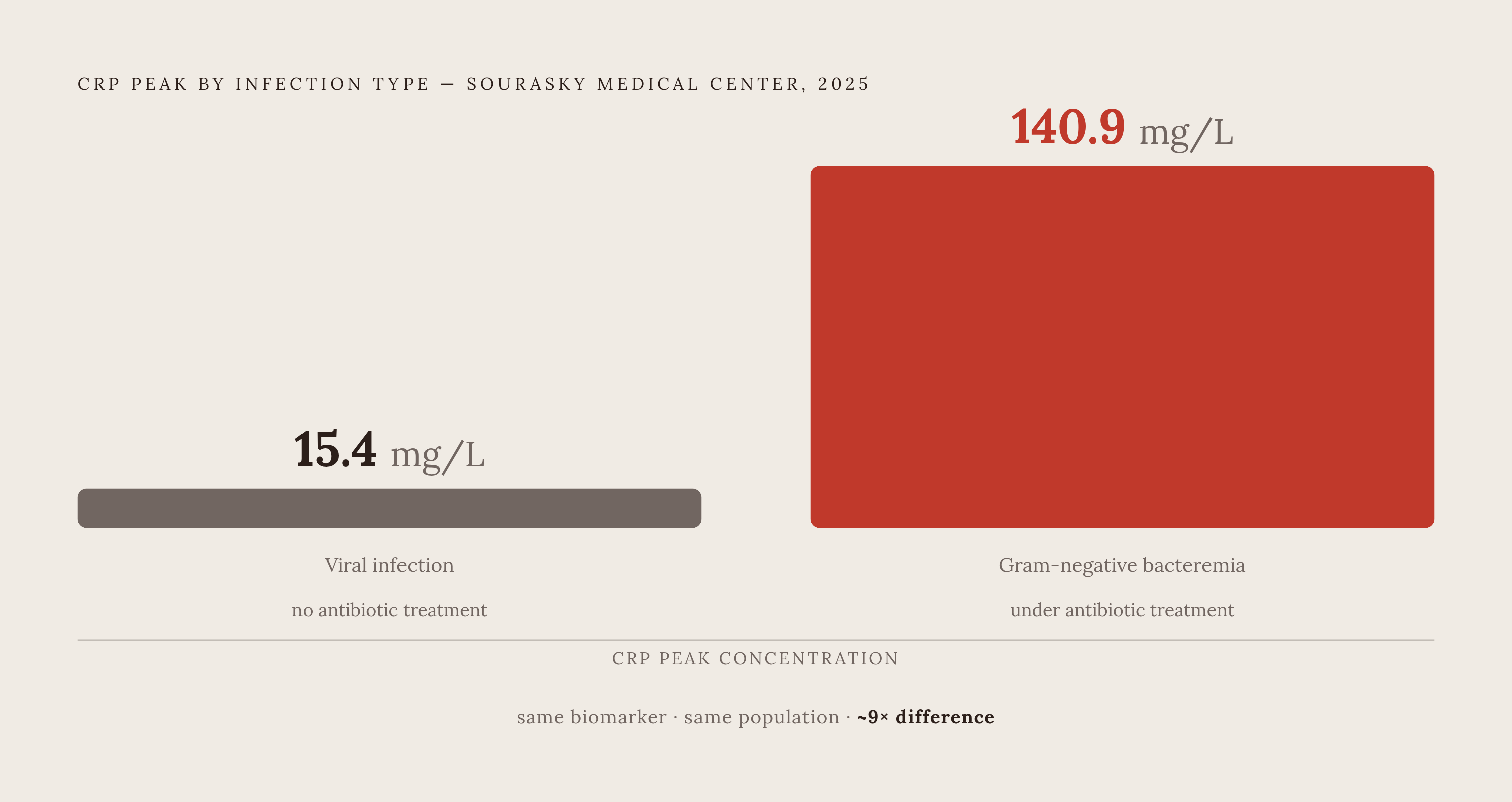
The shape of the rise matters most for interpreting a result, not just its ceiling. Bacterial infections, particularly Gram-negative bacteremia, produce the steepest, fastest climbs. A 2025 study out of Tel Aviv Sourasky Medical Center, published in the journal Infection, tracked CRP trajectories across infection types in hospitalized patients and found a stark split: viral infections without antibiotic treatment topped out around a peak CRP of 15.4 mg/L, while Gram-negative bacteremia under antibiotic treatment peaked near 140.9 mg/L. That's almost a tenfold gap, from the same biomarker, in the same hospital population.
So the acute spike, properly read, is actually good news in a narrow sense. It means the immune system noticed the threat and mounted a full response. In an uncomplicated infection, CRP should fall back toward normal within days to weeks once the underlying illness resolves. That expected arc is what makes the acute pattern useful to track over time, not just at a single peak.
But what if it doesn't come back down? A CRP level that stays high well after the infection has cleared signals that something else is still driving inflammation. It's a signal that something else is still driving inflammation, and it calls for follow-up rather than a shrug. The acute pattern is supposed to have an endpoint. When it doesn't, that absence of resolution is itself the finding.
How the two assays differ
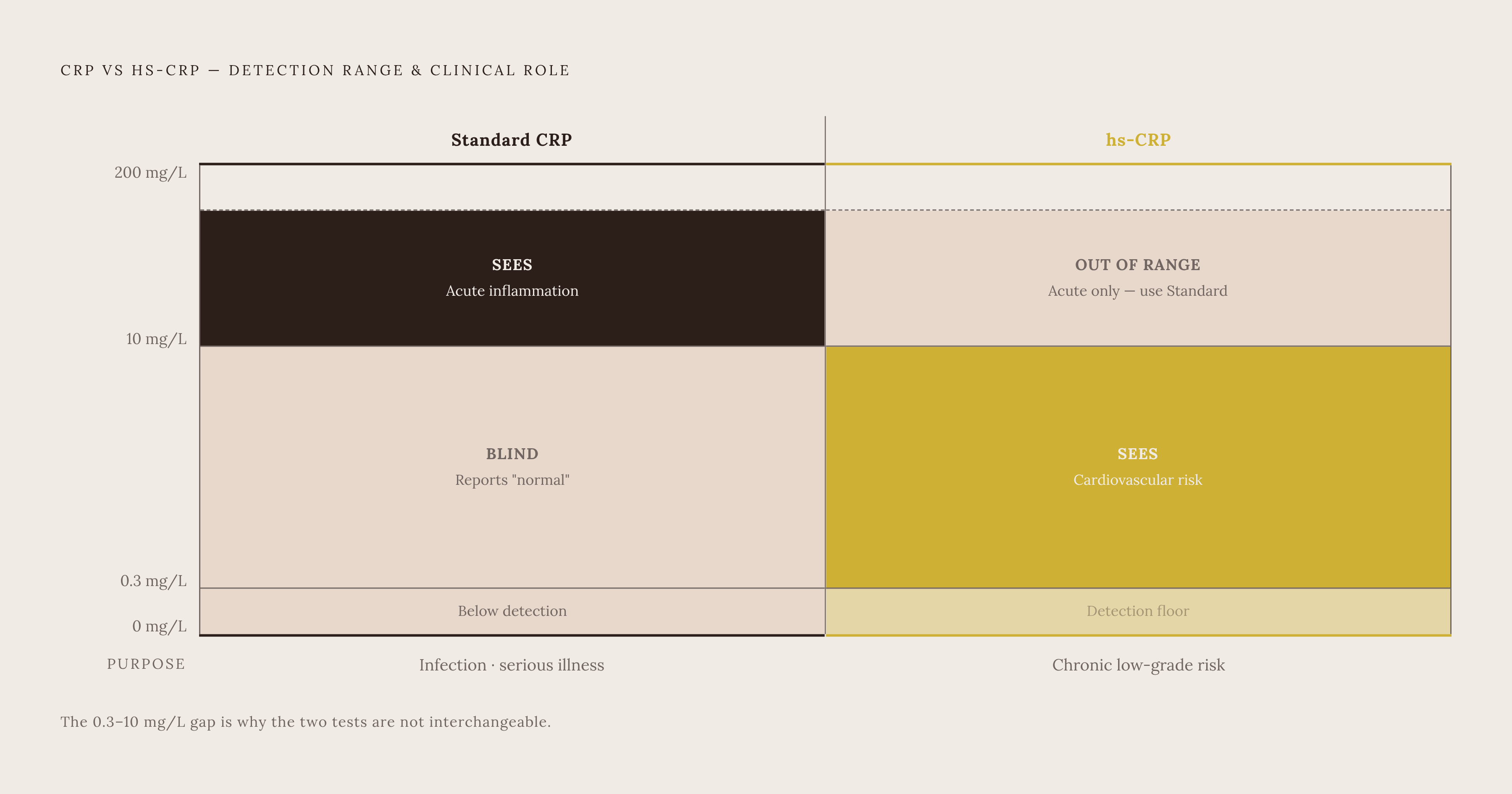
There are two versions of this test, and they're not interchangeable. Standard CRP and high-sensitivity CRP, or hs-CRP, measure the exact same protein, but they're calibrated for completely different concentration ranges, and the thresholds from one don't map onto the other.
Standard CRP exists to catch significant, acute inflammation, the kind driving levels well above 10 mg/L. It's built for exactly the infection scenario described above: something is clearly wrong, and the question is how wrong. What it can't resolve is anything happening at the lower end of the scale. It's the wrong tool for tracking cardiovascular or metabolic risk.
Hs-CRP does the opposite job. It's engineered specifically to detect chronic, low-grade inflammation in the 0.3 to 10 mg/L range, which happens to be exactly the range a standard CRP test would either report as "normal" or fail to detect at all. That gap creates a genuinely common, avoidable mix-up: someone gets a standard CRP during a routine physical, gets told the number looks fine, and walks away with a false sense of clarity. Their hs-CRP, run on the same blood sample, might tell an entirely different story, one the standard assay was never built to see.
None of this reflects a mistake on anyone's part so much as a mismatch between tool and question. Ordering hs-CRP instead of standard CRP is what makes cardiovascular risk assessment possible in the first place, because the standard version simply lacks the resolution to catch the elevations that matter for long-term risk. Knowing that distinction exists is, in itself, useful information for anyone reviewing their own labs.
What chronic low-grade elevation reflects in the body
Chronic low-grade inflammation appears far more often in the general population than the dramatic acute spike, and it rarely produces any obvious symptom. That silence is why it deserves attention.
The causes here are metabolic and behavioral rather than bacteria or viruses. Excess adipose tissue, especially visceral fat, releases inflammatory cytokines that keep stimulating CRP production on an ongoing basis, and smoking, a sedentary routine, poor sleep, and chronic stress each independently push hs-CRP upward through overlapping pathways. Obesity and metabolic syndrome tend to lock this into a loop: fat cells produce inflammatory signals, those signals raise CRP, and the resulting inflammation feeds insulin resistance, which in turn deepens the metabolic disruption that started the cycle.
Chronic elevation is not a cosmetic biomarker issue, a number nudged slightly out of range. Chronic elevation primes changes across the innate immune system, energy metabolism, thyroid hormone regulation, apolipoproteins, and even gut flora, so the consequences reach well past any single organ. Researchers use the term "inflammaging" for this, the idea that chronic low-grade inflammation is a central driver of biological aging itself, tying elevated hs-CRP to the progression of cardiovascular disease, type 2 diabetes, cognitive decline, dementia, frailty, sarcopenia, and cancer. This is a systemic condition, playing out across multiple organ systems at once.
Chronically Elevated hs-CRP as a Stronger Cardiovascular Risk Signal
The evidence for treating chronic hs-CRP elevation as a serious, independent risk factor has gotten considerably stronger, and the clinical world hasn't fully caught up. What stands out is that this held even at hs-CRP levels most clinicians wouldn't flag as alarming.
The sharper finding sits in a narrower population, patients already on high-intensity statin therapy, where low-grade systemic inflammation as measured by hs-CRP proves a more powerful determinant of recurrent cardiovascular events, cardiovascular death, and all-cause mortality than LDL-cholesterol. That's a specific claim about people already being treated aggressively for lipids, limited to that population rather than a claim that inflammation outranks cholesterol for every adult walking into a clinic. The scope matters, but so does the force of the finding within it.
Guidelines are catching up unevenly. The 2025 ACC Scientific Statement, published in JACC, pushes hs-CRP from an optional add-on toward a standard part of cardiovascular risk assessment, calling for broad screening alongside targeted management of inflammation in prevention and clinical care. That's a real shift from the 2019 ACC/AHA guideline, which treated CRP cautiously, as a tiebreaker for patients already sitting in an intermediate risk category. European guidelines, meanwhile, still advise against routine hs-CRP screening for primary prevention. The disagreement really comes down to how much CRP adds on top of the risk calculators clinicians already use.
That question has a clear answer in one specific group. Patients who look well-controlled by conventional numbers, LDL at goal, blood pressure managed, can still be carrying real residual inflammatory risk that those same conventional numbers can't reveal. That's precisely the population current guidelines are least equipped to catch by any other means.
CANTOS, COLCOT, and LoDoCo2: Inflammation as a Modifiable Target
Knowing that inflammation predicts risk is one thing. Knowing that treating it changes outcomes is another, and that's where the trial evidence turns a biomarker discussion into something more actionable. The CANTOS trial was the first major demonstration that a therapy targeting inflammation directly, rather than cholesterol, could meaningfully reduce vascular events, establishing inflammation as a causal pathway rather than a passive marker sitting alongside the real disease process.
Two colchicine trials followed and reinforced the same conclusion from different angles. COLCOT enrolled a large group of patients shortly after a heart attack, nearly all of them already on statins, and low-dose colchicine produced a significant reduction in the trial's composite cardiovascular endpoint over a median follow-up of close to two years. On the basis of the LoDoCo2 trial, alongside the COLCOT trial as supportive evidence, low-dose colchicine became the first FDA-approved anti-inflammatory agent for this cardiovascular indication.
A follow-up analysis from the CLEAR-Outcomes trial pointed the same direction again: hs-CRP outpredicted hyperlipidemia as a marker of future cardiovascular events and death. And the question of what to do for patients who can't tolerate statins at all is still being actively studied. The ongoing LODOCO STINT trial, registered under ClinicalTrials.gov identifier NCT06874192 and run out of Virginia Commonwealth University, is testing whether low-dose colchicine can serve statin-intolerant patients, a group that currently has no validated anti-inflammatory option of its own.
Put together, these trials mark a real turning point. Inflammation moved from something doctors observed and noted to something they can actually intervene on, with trial data behind the intervention.
What lifestyle and diet changes reliably move hs-CRP
If inflammation is modifiable, the next question is what actually moves it, and here the evidence splits pretty cleanly between the behavioral changes that work and the supplements that get marketed as if they do. On the strong-evidence side: Mediterranean-style eating patterns, weight loss, regular aerobic exercise, better sleep, and quitting smoking, and these effects appear to stack rather than compete. A 2025 meta-analysis of randomized trials involving 3,476 participants found that Mediterranean diets produced significant reductions in hs-CRP compared with control diets. Weight loss shows a dose-response relationship too: hs-CRP drops in a fairly predictable way per kilogram lost, which gives a specific, trackable target rather than the vague instruction to just "lose weight."
Why does that specificity matter so much? Because it turns an abstract goal into something measurable on a follow-up blood draw, which is a very different experience than being told to eat better and hoping the number cooperates.
The weaker evidence sits with the supplements most heavily marketed as anti-inflammatory. Curcumin is a common example: despite the marketing, a systematic review of randomized trials found no significant overall effect on either CRP or hs-CRP. Omega-3 fatty acids fare a bit better but only in specific groups. A 2025 dose-response meta-analysis found reductions among people with existing cardiometabolic conditions, but not among participants classified as overweight or with obesity as a group. The interventions with real evidence behind them address the root drivers directly, excess fat, inactivity, poor sleep, smoking, instead of attempting to suppress the inflammatory signal from the outside.
For context, not as a treatment plan: patients already on statins whose hs-CRP stays above 2 mg/L despite controlled LDL have evidence supporting a higher-intensity statin dose, and bempedoic acid has shown reductions in both LDL and hs-CRP among patients with obesity. That's a clinical conversation, not a self-directed one, and the pharmacological options exist alongside the lifestyle ones.
How to read your own CRP result
The first question when looking at an actual CRP number on a lab report is which assay was run and under what circumstances. It's which assay was run, and under what circumstances. A standard CRP drawn during an acute illness is answering a completely different question than an hs-CRP drawn on an otherwise ordinary day when nothing feels wrong.
If it's a standard CRP taken during or right after an illness, a high number is expected. The thing worth tracking is whether it comes back down after recovery, not how high it peaked. If instead it's an hs-CRP drawn between illnesses, when feeling well, different thresholds apply: below 1 mg/L reads as low cardiovascular risk, 1 to 3 mg/L as moderate, and above 3 mg/L calls for a closer look at the upstream drivers, weight, sleep, activity levels, smoking, and metabolic markers.
One reading in isolation carries less weight than a pattern across several. And even a confirmed elevation doesn't diagnose a cause on its own. Hs-CRP confirms that inflammation is present somewhere and prompts further investigation into what's driving it, which is a conversation for a clinician to work through rather than something to self-diagnose from a single number.
Access to the right test has gotten more transparent, at least. Hs-CRP ordered directly through a direct-to-consumer lab on the Quest or LabCorp network costs a fraction of what a hospital charges for the identical test, Quest Health lists it at $65.00, and third-party ordering services offer it for substantially less. Route the same test through insurance and get denied, which UnitedHealthcare, Aetna, Cigna, Anthem, and Medicare commonly do for screening hs-CRP, and the bill for that identical test can run into the hundreds of dollars. Knowing that gap exists ahead of time is useful information.
None of this works as a one-time check. The value comes from ordering hs-CRP specifically, rather than standard CRP, and testing while healthy rather than only when symptoms appear. Repeated over time, that pattern is what turns a single number into a personal baseline, one that can catch a slow-building risk years before it turns into a diagnosis.
Sources
- Characterizing CRP dynamics during acute infections | Infection | Springer Nature Link
- Characterizing CRP dynamics during acute infections - PMC
- High-sensitivity C-reactive Protein in Atherosclerotic Cardiovascular Disease: To Measure or Not to Measure? - PMC
- Inflammation and Cardiovascular Disease: 2025 ACC Scientific Statement: A Report of the American College of Cardiology | JACC
- Hs-CRP as a biomarker for atherosclerosis progression and cardiovascular risk: a systematic review - PMC
- CRP (C-Reactive Protein) Revisited: An Old Yet New Biomarker of Acute and Chronic Inflammation - PMC
- Antiinflammatory Therapy with Canakinumab for Atherosclerotic Disease | New England Journal of Medicine
- Time-to-treatment initiation of colchicine and cardiovascular outcomes after myocardial infarction in the Colchicine Cardiovascular Outcomes Trial (COLCOT) | European Heart Journal | Oxford Academic