HDL Functionality Versus HDL Cholesterol Number
What HDL particles actually do matters far more than their cholesterol count.
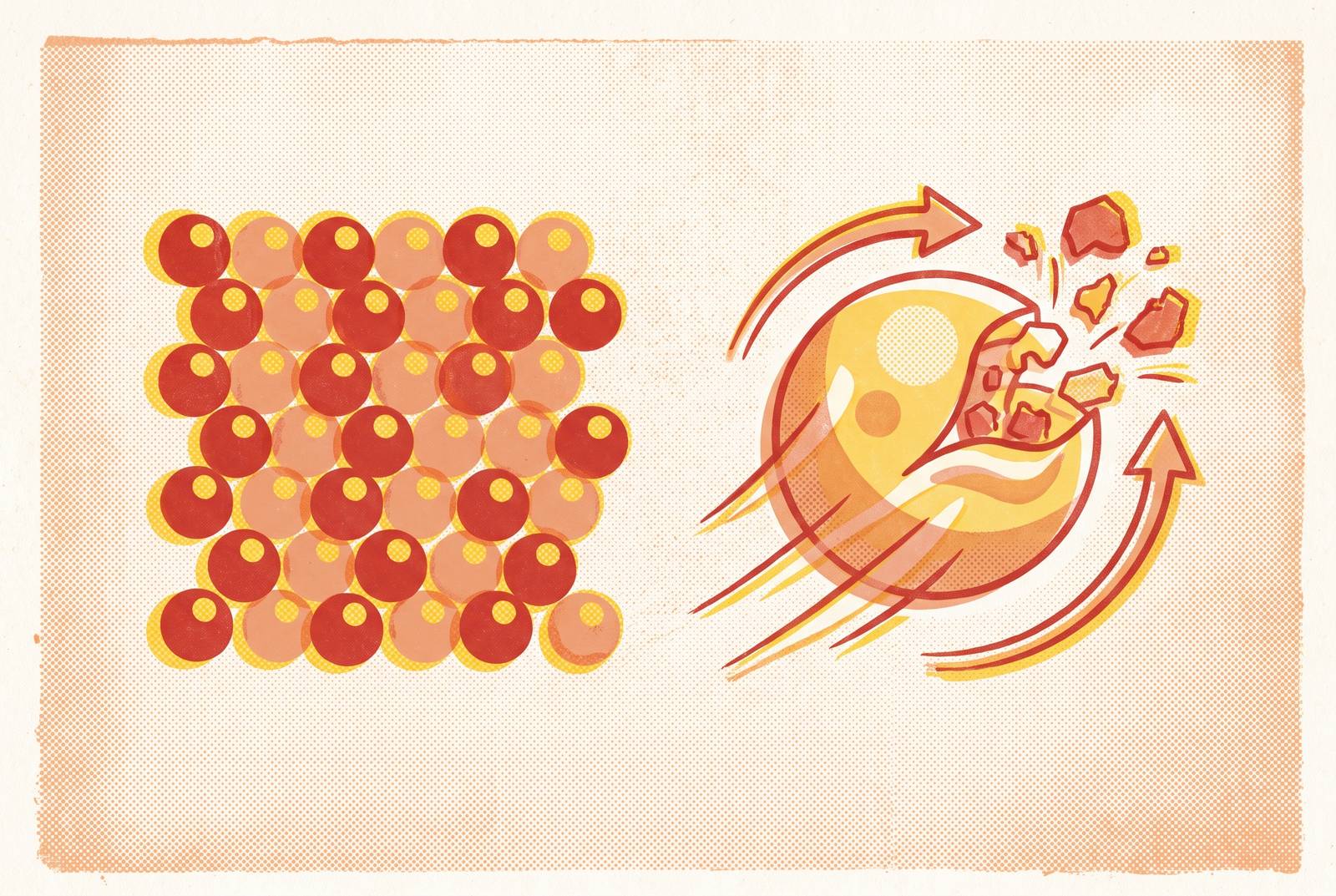
A standard lipid panel reports one number for HDL: the mass of cholesterol riding inside those particles at the moment of the blood draw. That number says nothing about what the particles are actually doing once they're out in the bloodstream. HDL's real job runs through several separate mechanisms: pulling cholesterol out of macrophages sitting in artery walls, calming vascular inflammation, helping repair the lining of blood vessels, and acting as an antioxidant. A cholesterol concentration reading catches none of that work. HDL is cardioprotective through reverse cholesterol transport and anti-inflammatory action, and the functionality of the particle, not its concentration, is what drives protection against atherosclerosis.
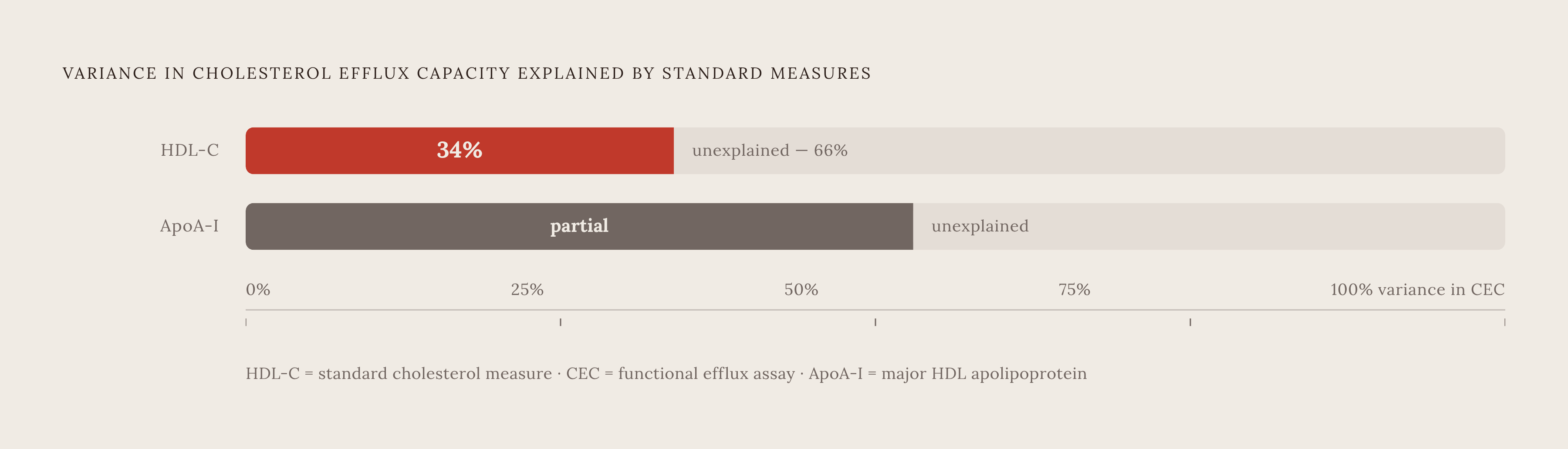
The specific process worth understanding is cholesterol efflux capacity, usually shortened to CEC. CEC is the ability of an HDL particle to pull cholesterol out of a macrophage, and that pull is the first and most critical step of reverse cholesterol transport. Research backs this up directly: HDL-C accounts for only 34% of the variance in CEC across individuals. ApoA-I, the main structural protein that makes up HDL particles, does a bit better but still only explains a portion of that variance. Neither the cholesterol mass nor the primary protein predicts how well the particle actually functions.
That gap matters because it's the foundation for everything that follows in HDL science. A lipid panel hands a patient a mass measurement and lets them assume it's a performance measurement. Those are two different things, measured two different ways, and the rest of this piece traces what happens when that distinction gets ignored.
High HDL-C and cardiovascular risk
Higher HDL-C has long tracked with lower cardiovascular risk in population studies, but tracking together and causing one another are not the same claim, and newer evidence draws that line explicitly. Mendelian randomization studies, which test cause and effect by exploiting natural genetic variation across large populations, have failed to confirm that raising HDL-C itself lowers cardiovascular risk. That failure undercuts the entire rationale for treating the number as a target. Ahmed & Bowden (2024) and another review both cite these failures as the turning point that redirected scientific attention toward HDL functionality.
The data gets stranger at the extremes. An HDL-C above 90 mg/dL in women, or above 70 mg/dL in men, tracks with higher rates of both cardiovascular and non-cardiovascular mortality. A separate retrospective study found elevated 10-year risk of major adverse cardiac events in men with HDL-C above 90 mg/dL. Why would a number assumed to be protective turn harmful once it climbs high enough? One answer comes from the CANHEART analysis, which found that low HDL-C independently predicts higher risk of cardiovascular death, cancer death, and non-cardiovascular death alike. HDL-C's association looked similar across all of those unrelated causes of death, which suggests it functions as a marker of overall health rather than a cause specific to heart disease.
That distinction creates a real trap at the clinical level. A patient with an HDL-C of 65 mg/dL might feel reassured by that number while carrying HDL particles too impaired to carry out reverse cholesterol transport. Meanwhile a patient with an HDL-C of 42 mg/dL, a number low enough to trigger concern on a standard panel, might have highly functional particles doing what they're supposed to do. The number alone can't tell these two patients apart, even though their underlying biology points in opposite directions.
The drug trial failures that proved the number was the wrong target
Observational data can only suggest so much. The clearest evidence that HDL-C was the wrong target came from pharmacology, where entire drug classes were built around raising that one number, and the results of those trials settled the question. Niacin raises HDL-C substantially. CETP inhibitors, a drug class that includes torcetrapib, dalcetrapib, and evacetrapib, raised HDL-C even more dramatically. Neither drug class reduced cardiovascular events in their intervention trials. Torcetrapib did worse than nothing: it increased cardiovascular events and mortality through off-target effects. Hussain et al. (2025) and Ahmed & Bowden (2024) both cite these trials as the evidence that shifted scientific consensus away from HDL-C as a target.
Clinical guidelines have caught up with that evidence. The current consensus favors lowering apoB-containing lipoproteins directly, while using lifestyle strategies to improve how HDL functions rather than how much cholesterol it's carrying. That's a real shift in what doctors are told to chase.
One nuance belongs here because it sets up a problem patients run into later. Statins, the most widely prescribed cholesterol drugs on the market, actually decrease or blunt changes in CEC. Vigorous exercise and certain dietary changes move CEC in the opposite direction, increasing it. A patient taking a statin who also wants to improve the functional side of their HDL biology can't assume the statin is handling that for them. The drug does real work on LDL and apoB. It isn't doing the same work on HDL function.
Three conditions that convert functional HDL into dysfunctional HDL
Obesity, type 2 diabetes, and chronic inflammation each damage HDL function through their own distinct pathways, and all three can leave the HDL-C number looking completely normal while the biology falls apart. The thread connecting them is simple: inflammation degrades how HDL particles work, and the standard lipid panel has no way of detecting that damage.
Start with obesity and metabolic syndrome. Inflammation of adipose tissue drives a state of low-grade chronic inflammation, and obesity-induced inflammatory signaling specifically downregulates ABCA1 and SR-BI, the cellular transporters that enable cholesterol efflux, impairing the ability of HDL to remove cholesterol from cells. Researchers have directly observed this damage in obese subjects, who show HDL with measurably lower antioxidant and anti-inflammatory properties.
Type 2 diabetes works through a different mechanism but lands in the same place. High blood sugar, oxidative stress, and inflammation combine to chemically alter HDL particles through glycation, oxidation, and carbamylation, and those alterations appear to be the main driver of HDL dysfunction in diabetic patients. The damage runs in two directions at once: HDL loses its capacity to promote cholesterol efflux, and it also stops protecting the lining of blood vessels.
Chronic systemic inflammation, even outside of obesity or diabetes, reshapes the composition of HDL particles during both acute and long-term inflammatory states. That reshaping weakens HDL's anti-inflammatory and antioxidant functions and directly impairs cholesterol efflux capacity.
A person's HDL-C number could appear stable or even rise on paper while the underlying biology is worsening. That makes the number least reliable in exactly the people who most need an accurate read on their cardiovascular risk: those carrying obesity, diabetes, or chronic inflammation.
CEC data and cardiovascular risk
If HDL-C doesn't predict risk reliably, does cholesterol efflux capacity do better? Population-based studies consistently show that cholesterol efflux capacity predicts cardiovascular events independently of HDL-C concentration, including in people whose HDL-C appears normal or high.
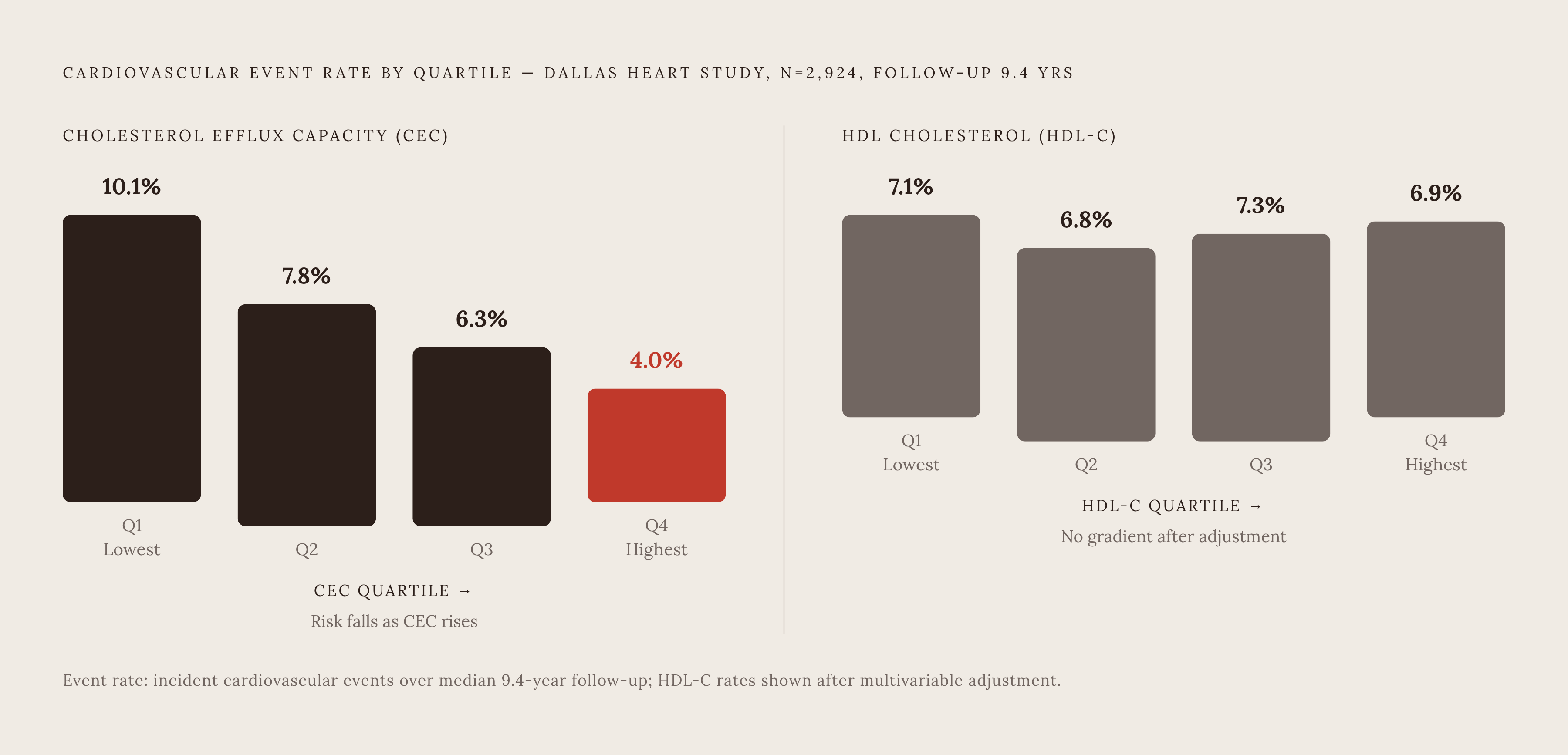
The clearest demonstration comes from the Dallas Heart Study, which followed 2,924 adults free of cardiovascular disease at the start, tracking them for roughly 9.4 years. CEC moved inversely with cardiovascular events across that follow-up period: higher efflux capacity, fewer events. Baseline HDL-C showed no such relationship once the analysis adjusted for other factors. People in the top quartile of CEC carried substantially lower cardiovascular risk than people in the bottom quartile. That's a study designed specifically to pit the two measures against each other, and CEC won.
CEC's value doesn't stop at that one study. It adds predictive power for atherosclerotic cardiovascular disease beyond what traditional lipid numbers capture, and that holds in both low-risk and high-risk groups, independent of HDL-C concentration. HDL particle number, often called HDL-P, tells a similar story. When researchers compared cholesterol efflux, HDL-C, and ApoA-I concentration against HDL-P, the particle count came out as the strongest inverse predictor of incident cardiovascular disease among the group.
This matters even for patients already doing everything right on paper. Statin therapy cuts cardiovascular events substantially, yet a large share of patients treated down to their LDL-C targets still go on to have events. HDL functionality stands as a leading candidate explanation for that remaining, unexplained risk. That makes it clinically relevant even to someone whose LDL-C and HDL-C both look fine on paper. If CEC carries that much predictive weight, the obvious next question is why a patient can't just ask for it at a lab.
CEC as a clinical test (and what to use instead)
CEC cannot currently be ordered as a routine clinical test. The measurement has no single standardized assay, methods vary from lab to lab and study to study, and it remains a research tool rather than something deployed in clinics today. That's a real limitation.
There is movement in that direction. An international research team has translated high-field NMR spectroscopy down to low-field, more affordable benchtop systems for analyzing lipoproteins, which points toward broader clinical access to functional lipid testing down the road. That's a near-future development, not something available to order today.
ApoA-I is the main structural protein of HDL, broadly available through clinical labs, with standardization work ongoing across the field. Cholesterol efflux capacity and ApoA-I often get used together to evaluate both the quantity and functionality of HDL particles, and ApoA-I is the most practical functional stand-in available to most patients today.
HDL particle number, or HDL-P, gets measured through NMR LipoProfile testing, which uses nuclear magnetic resonance to count and size lipoprotein particles directly instead of weighing the cholesterol cargo they carry. In the comparison described above, HDL-P outperformed both HDL-C and ApoA-I as a predictor of incident cardiovascular disease. The NMR LipoProfile is available direct-access without a doctor's order, at a listed sale price of $95.
ApoB rounds out the picture, and current clinical guidelines have already shifted toward apoB-driven risk reduction as the primary lipid target rather than LDL-C or HDL-C. ApoB is standardized, widely covered by insurance, and captures the burden of atherogenic particles in a way neither LDL-C nor HDL-C manages on its own.
Patients who want access to this fuller picture don't need to wait for a referral. A preventive testing platform offering direct access to ApoA-I, ApoB, and NMR particle panels, without needing a doctor's order and with prices listed up front, gives proactive patients a way to see past the standard annual physical and into the biology the lipid panel misses.
Lifestyle changes that improve HDL function (not just the number)
The drug trials already answered the biggest question in this story: raising HDL-C pharmacologically did not produce protection. The lifestyle interventions that hold up under scrutiny improve how HDL functions, not just how much cholesterol it's carrying.
Exercise leads that list. Aerobic training, particularly high-intensity interval training sustained over time, improves the ability of HDL particles to pull cholesterol out of cells, and it stands as one of the best-supported functional interventions available. This is a mechanism that moves the biology CEC is built to measure, not just a number on a follow-up panel.
Diet quality, independent of macronutrient ratios, shapes HDL function: monounsaturated and polyunsaturated fats, particularly the omega-3s found in fish, along with antioxidant-rich foods, track with improved HDL function, and that effect is most visible in people who already carry cardiovascular risk factors. Antioxidant-rich eating patterns improved HDL function in both healthy people and people at high cardiovascular risk. Fish oil deserves its own mention: a trial in young, healthy adults found that fish oil supplementation increased HDL's cholesterol efflux capacity directly.
The statin caveat from earlier belongs here too, because it changes how a patient should think about combining treatment with lifestyle work. Statins blunt or reduce changes in CEC. A patient on statin therapy who wants to improve HDL biology should understand the statin isn't covering that ground.
The number on a lipid panel was never built to answer the question that matters most: whether HDL is actually doing its job. Patients who understand the distinction between concentration and function, and who know which tests get closer to measuring function, are working with a clearer picture of their own cardiovascular risk than the standard panel can offer alone.
Sources
- Role of HDL function and LDL atherogenicity on cardiovascular risk: A comprehensive examination
- HDL Function Versus Small Dense LDL: Cardiovascular Benefits and Implications
- Assessing High-Density Lipoprotein: Shifting Focus from Quantity to Quality in Cardiovascular Disease Risk Assessment
- CANHEART: Is HDL cholesterol a cardiovascular specific risk factor? - PMC
- HDL particle number and size as predictors of cardiovascular disease - PMC
- Dysfunctional High-Density Lipoprotein Cholesterol and Coronary Artery Disease: A Narrative Review