Preventive Cardiovascular Testing for Women Under 50
Women under 50 face undiagnosed cardiovascular risk standard tests routinely miss.

More women die worldwide from cardiovascular disease than from any other cause, including every form of cancer combined. Most women under 50 do not think of themselves as candidates for it, and that mismatch between fact and self-perception is the starting point for this entire discussion.
Why Cardiovascular Disease Kills More Women Than Any Other Cause
Heart disease has a reputation problem. Most people picture a cardiac patient as a man in his sixties clutching his chest. That image isn't wrong, but it's incomplete in a way that costs lives. Cardiovascular disease is the leading cause of death among women globally, and no other cause comes close.
The system meant to catch this risk early has its own blind spots. Women are less likely than men to receive diagnostic imaging, less likely to get percutaneous coronary intervention, and less likely to be started on statin therapy, even when their clinical indicators look just as serious as a man's, a difference in who gets referred rather than in biology at the referral stage.
What makes the picture more urgent is the direction it's moving. Heart attack rates and cardiovascular mortality have been climbing among younger women, even as women remain underrepresented in the clinical trials that generate treatment evidence. That's a double bind: the population most in need of better data is the one the data covers least, right as the problem grows.
Part of this comes down to perception on both sides of the exam table. Younger women often don't see themselves as cardiac patients, and clinicians often make that same assumption. The result is a quiet pattern of routing younger women away from the tests and interventions that would catch disease while it's still manageable. That pattern sets up the next question: why does standard screening miss this group so consistently?
How CVD in women under 50 differs biologically from the classic presentation (and why standard risk tools weren't built for it)
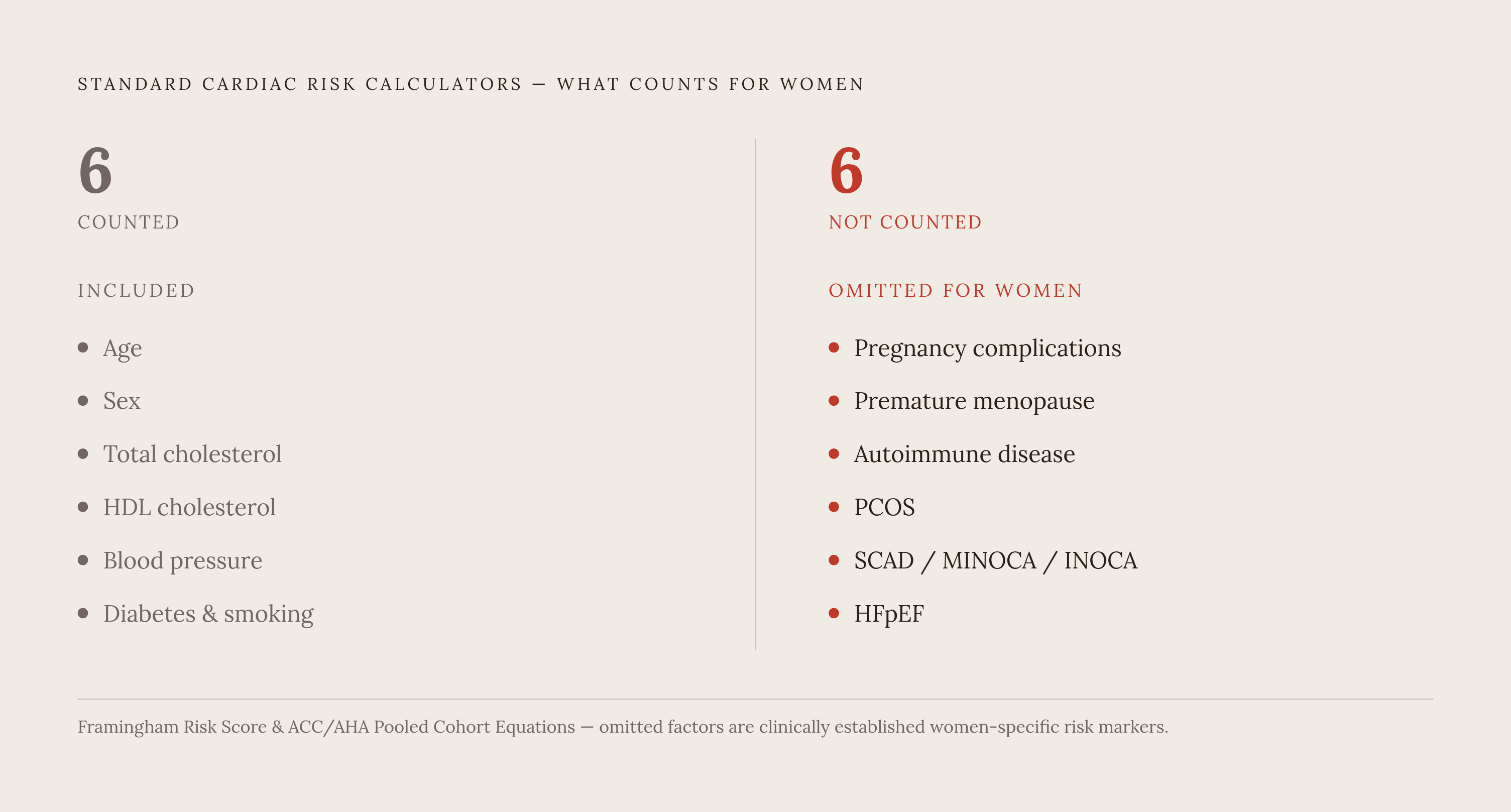
These tools weren't built with this population in mind. The Framingham Risk Score and the ACC/AHA Atherosclerotic Cardiovascular Disease Risk Score run on a fixed set of inputs: age, sex, cholesterol, blood pressure, diabetes status, smoking. Female-specific risk factors don't enter into the core equations. The 2019 ACC/AHA Primary Prevention Guideline does recommend considering certain risk-enhancing factors specific to women alongside the score, but that's just a supplementary nudge, not a structural fix. A woman with real cardiovascular exposure can still score "low risk" on the calculator and walk out with no further workup.
What exactly gets left out? Pregnancy complications, premature menopause, and autoimmune disease all contribute to cardiovascular risk over the long term. The 2025 European Society of Cardiology guidelines went so far as to formally recognize pregnancy complications as an early indicator of lifetime cardiovascular risk. That's a meaningful shift in how the cardiology field thinks about risk timelines for women, treating a pregnancy at age 28 as a data point that matters at age 55.
The disease itself also presents differently. Conditions like ischemia with non-obstructive coronary arteries (INOCA), myocardial infarction with non-obstructive coronary arteries (MINOCA), spontaneous coronary artery dissection (SCAD), and heart failure with preserved ejection fraction (HFpEF) are now recognized as distinct clinical entities, and all of them occur disproportionately in women. The trouble is that standard diagnostic pathways, including cardiac catheterization, were built just to find blocked arteries. These conditions don't always present that way, so delays in diagnosis follow almost by default.
The numbers make this concrete. In the Young Women and Myocardial Infarction study, which looked at women under 50 hospitalized for heart attack, SCAD accounted for 16% of cases, making it the second most common cause after atherosclerosis. Autoimmune disease appeared in a notable share of these younger MI patients too. None of that profile would be flagged by a standard lipid panel or a Framingham score calculation.
Add it up: no widely used risk tool, including the Framingham Risk Score and the ACC/AHA ASCVD calculator, accounts for female-specific risk factors in a way that's become part of routine clinical standard of care. The gap isn't filled by anything currently in standard practice. The gap matters because it raises the next question: what should actually be tested.
What a standard lipid panel misses and which biomarkers capture cardiovascular risk in younger women
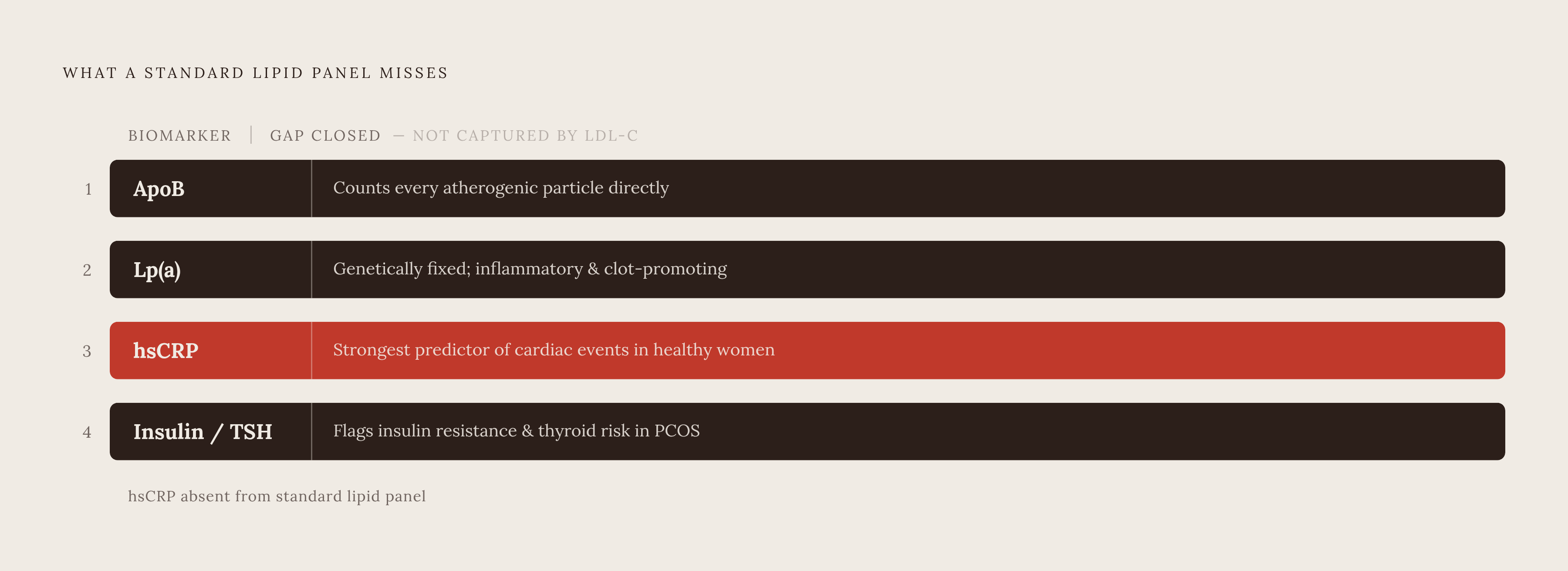
A standard lipid panel centers on LDL-C, which measures how much cholesterol is packed into particles, not how many particles are actually circulating. A woman can have completely normal LDL-C and still carry a high number of atherogenic particles, particularly if she has metabolic syndrome, insulin resistance, or a family history of early heart disease. The panel that most women get at an annual physical simply isn't built to catch this.
ApoB solves that specific problem. It counts the atherogenic particles directly, rather than estimating their cholesterol content. If LDL-C looks normal but ApoB is elevated, you have real particle burden that the standard panel never saw. ApoB hasn't fully replaced LDL-C in clinical practice because most statin trials over the past several decades were designed around LDL-C as the endpoint, so the treatment evidence base was built on a measure that may be less precise than ApoB. Guidelines move slowly when the trial data they rely on was generated using an older marker. That lag doesn't mean ApoB is unproven. For younger women whose absolute risk scores already look reassuringly low on a standard calculator, particle number can reveal risk that the LDL-C cutoff alone would miss.
Lp(a) adds a different kind of information. It's a cholesterol-carrying particle with added inflammatory and clot-promoting properties, and its level is set almost entirely by genetics rather than diet, exercise, or weight. Testing for it means knowing, once and ideally early, whether a woman is carrying a fixed genetic risk, so that every other modifiable factor, blood pressure, blood sugar, inflammation, gets managed more aggressively to compensate.
hsCRP, or high-sensitivity C-reactive protein, measures inflammation rather than lipid content. In landmark research on healthy women, hsCRP turned out to be one of the strongest predictors of future cardiovascular events, which matters enormously for a population where particle burden might look unremarkable while inflammatory activity is already elevated. hsCRP also connects directly back to the female-specific risk factors already discussed: autoimmune disease and pregnancy complications both drive the kind of chronic, low-grade inflammation that hsCRP is designed to pick up.
Sex-specific patterns in these biomarkers stay under-researched, and clinical practice hasn't fully built them in yet. That's precisely why direct access to this kind of testing matters more for women, not less. Waiting for the guidelines to catch up means waiting through the years when early detection would have done the most good.
PCOS and thyroid dysfunction as compounding cardiovascular risk pathways that standard screening ignores
Most clinical settings treat polycystic ovary syndrome as a fertility issue, but its cardiovascular footprint deserves just as much attention. PCOS drives insulin resistance and, often, obesity, and both of those conditions trigger chronic low-grade inflammation, measurable through a panel of elevated inflammatory markers. That inflammatory signature overlaps directly with the biomarker pattern you see in early cardiovascular disease. A diagnosis of PCOS is, in effect, a cardiovascular risk marker hiding inside a reproductive diagnosis.
Thyroid function adds another layer. Subclinical hypothyroidism in women who also have PCOS is linked to impaired glucose tolerance, higher fasting glucose, higher total cholesterol, and elevated triglycerides. You get a full cardiometabolic risk profile, and it would go completely undetected without thyroid testing run alongside a standard metabolic panel. A lipid panel alone wouldn't catch any of it.
The two conditions together are worse than either alone. Women who have both PCOS and thyroid disease show more severe metabolic abnormalities than women with PCOS by itself, along with a higher risk of type 2 diabetes and, to a lesser degree, cardiovascular complications such as heart failure. The combination compounds rather than simply adding up.
This fits a broader pattern: risk-enhancing conditions specific to women, including gynecological disorders, tend to get left out of existing cardiovascular risk tools. PCOS is a textbook case. It's common, it's biologically significant for heart health, and it barely registers in standard risk scoring.
The practical consequence is simple to state. A woman with PCOS who comes in for cardiovascular screening needs insulin, fasting glucose, TSH, and inflammatory markers checked alongside a lipid panel. Leaving any of those out leaves the actual risk profile incomplete.
Why Testing Before Symptoms Appear Changes the Trajectory
Atherosclerosis builds quietly. Plaque accumulates in arteries over years without producing any symptoms at all, and by the time chest pain or shortness of breath shows up, the cheapest and most effective window for intervention, the one where diet, exercise, and early medication can change the outcome, has often already closed. A heart attack often serves as someone's first actual signal only because no one looked for the earlier ones.
But what if more testing just means more worry over nothing? That concern deserves a direct answer rather than a dismissal. Testing people who have no symptoms and no elevated risk can generate anxiety over results that don't mean much, trigger a cascade of follow-up testing, and run up costs without delivering real health benefit. That's a legitimate concern about cost and benefit, not something to wave away.
The resolution lies in specificity, not volume. Testing ApoB, Lp(a), hsCRP, fasting insulin, and TSH where indicated, markers with established predictive value specifically in women, is a different proposition than ordering an exhaustive, unfocused lab panel. The goal is closing a known gap created by female-specific risk factors, not maximizing the number of line items on a lab report.
One might argue that identifying risk early solves the problem. It doesn't, not completely, because the system downstream of diagnosis has its own gaps. Fewer women take part in cardiac rehabilitation, because referral bias, socioeconomic barriers, and programs that weren't designed with women's schedules or needs in mind get in the way. So even when risk gets caught early, the system meant to act on it doesn't always respond equally. That raises an important question: if post-diagnosis care is uneven, doesn't that make early, pre-event testing even more valuable, since it gives a woman more time to manage risk on her own terms before she has to rely on a system that may underserve her?
Accessing Testing Without Overpaying
Access to these specific tests has changed. Direct-to-consumer lab testing now lets women order ApoB, Lp(a), hsCRP, fasting insulin, and TSH without going through their own doctor first. A network-affiliated physician still issues the requisition through the testing platform, which satisfies the legal requirement, though access is restricted in a handful of states, including New York, New Jersey, and Rhode Island. You can get the tests that standard screening routinely skips direct-pay, often for a fraction of what the same tests cost when billed through insurance.
Most of these direct-pay services route samples through the same national reference laboratory networks used in traditional clinical care, so results for routine tests are broadly comparable across providers. Reference ranges, calibration methods, and lab procedures can still differ between Quest and LabCorp, and for some of the more specialized tests, results from one network aren't necessarily interchangeable with the other. Price differences between platforms mostly reflect markup, not test quality, and because most direct-pay labs post their pricing online, you can compare costs before ordering in just a few minutes.
The real risk lies in interpretation. Biomarker results need clinical context to mean anything useful, so a mildly elevated hsCRP or a borderline ApoB number can look frightening on paper if you don't know the relevant population reference ranges or the other clinical factors that shift what a given number means for you.
The relevant professional body supports direct-to-consumer testing access but sets a clear bar for it: testing should happen only through certified laboratories, and the information provided alongside results should clearly explain clinical indications, what the results mean, and what they cost. Reputable direct-pay platforms meet that bar. Anyone using this route should expect that standard, and treat its absence as a reason to look elsewhere.
The Omega-3 Evidence for Women
Omega-3 fatty acids, specifically EPA and DHA, are the most studied supplement in cardiovascular prevention, and the evidence is still genuinely mixed. Large clinical trials using standard doses haven't shown that omega-3 supplementation can prevent cardiovascular disease. Trials using higher doses or more purified formulations have shown more encouraging results, which suggests dose and formulation matter as much as the broad category of "fish oil."
A more specific finding matters directly for women. Circulating levels of EPA and docosapentaenoic acid, but not DHA, are linked to lower risk of nonfatal heart attack among women specifically. A generic recommendation to "take fish oil" glosses right over that distinction, treating all three fatty acids as interchangeable when the data suggests they aren't, at least not for this outcome in this population.
A 2025 systematic review and meta-analysis revisited the dose-response relationship between omega-3 intake and cardiovascular outcomes, reinforcing a point that applies well beyond supplementation: the specific form and dose of an intervention determines whether it produces benefit, not just which broad category it falls into. A general approach misses what a targeted one catches, whether the subject is a lipid panel or a bottle of fish oil capsules.