Homocysteine Levels and Cardiovascular and Cognitive Risk
Elevated homocysteine reveals addressable nutritional problems linked to heart and brain damage.

Homocysteine links nutritional status to cardiovascular and cognitive risk, but its value is not a promise that lowering one number prevents disease. The case for testing is more precise. An elevated result can reveal an addressable problem, and understanding its cause helps distinguish targeted treatment from taking vitamins and hoping for protection.
Why homocysteine sits at the center of methylation and vascular biology
Homocysteine is a metabolic byproduct. It forms during the methionine cycle, and the body normally either recycles it back to methionine through remethylation or clears it through the transsulfuration pathway. Homocysteine accumulates when those routes cannot keep pace, making the blood level a useful signal of how well the system is working.
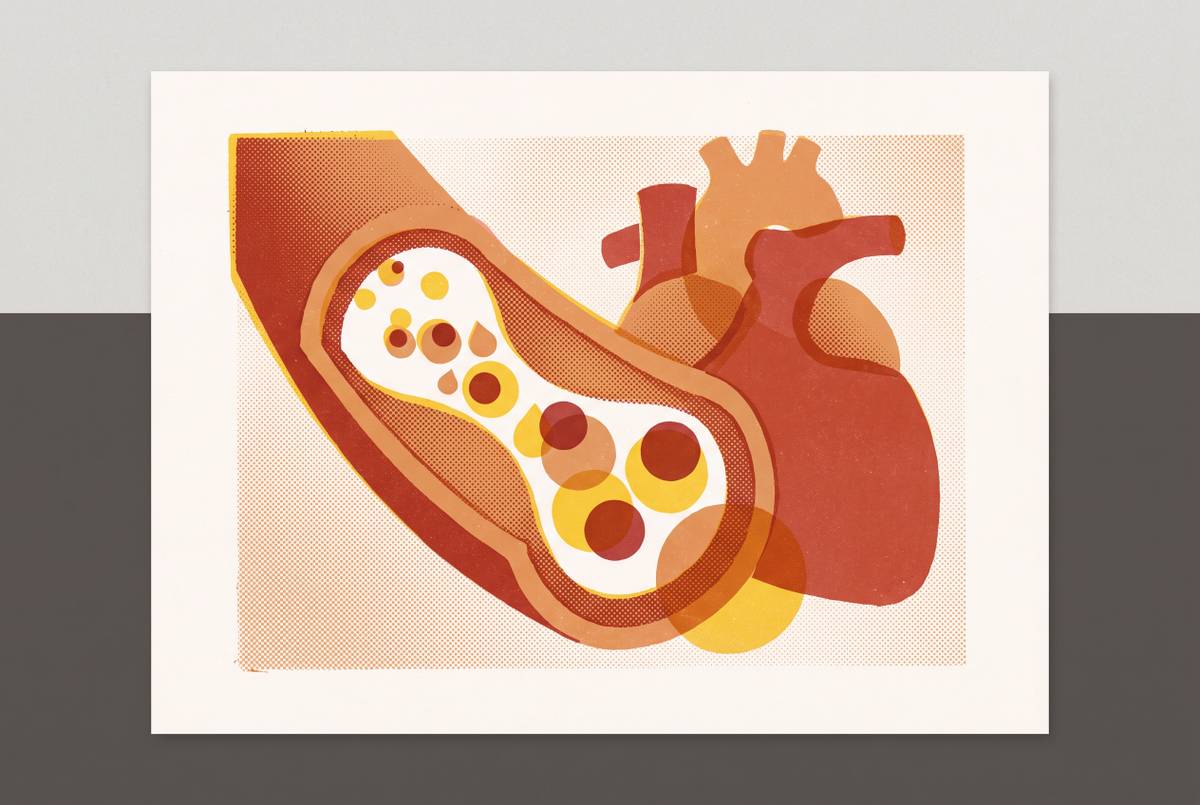
An excess can harm blood vessels through four connected mechanisms, namely endothelial damage, atherosclerosis, thrombogenicity and lipid dysregulation. Endothelial damage is harm to the lining that separates blood from arterial tissue, which makes it easier for plaque to form. Thrombogenicity means a greater tendency toward clot formation through increased platelet activation. Lipid dysregulation adds another burden by increasing cholesterol production independent of diet.
What drives homocysteine up — and why the usual suspects are nutritional, not genetic
A shortage of B vitamins or difficulty using them often drives homocysteine up. Folate, also called B9, B12 and B6 serve as cofactors in the pathways that recycle or clear homocysteine. If those vitamins are unavailable or poorly used, the pathways lose capacity. That makes nutritional status the first consideration when investigating an elevated result. It also makes many elevated results addressable.
What, then, does an MTHFR result tell you. The C677T and A1298C polymorphisms can reduce enzyme efficiency and increase susceptibility to elevated homocysteine. They do not guarantee it, because adequate methylfolate intake can compensate for reduced enzyme activity. Genotyping describes a predisposition, while homocysteine measures the functional result. Treating the gene result as the diagnosis can therefore distract from the more useful question of whether the blood level is actually elevated.
Other contributors can change that interpretation. Renal impairment and hypothyroidism can raise homocysteine, as can metformin use and methotrexate use. Alcohol, low intake of leafy greens and legumes, and processed red meat can also contribute. Nutrition is often the starting point, but it is not the only possible explanation.
How elevated homocysteine damages the heart — what the epidemiology and the 2025 research show
The cardiovascular pattern is a dose–response relationship, with higher homocysteine associated with greater risk. Huang et al. 2025 found a nonlinear positive association between homocysteine and cardiovascular disease in an NHANES-based cross-sectional study. Smaller rises at lower levels matter less, while the risk curve steepens as homocysteine climbs. Because the study was cross-sectional, however, it cannot establish that homocysteine caused the disease.
Wang et al. 2025 provides an important mortality finding in people who already had coronary heart disease. Its retrospective cohort of 660 CHD patients found that higher homocysteine was significantly associated with all-cause mortality after adjustment for common confounders. The association also held across multiple subgroups, including people without chronic kidney disease or atrial fibrillation. That makes it harder to dismiss the result as merely a reflection of those conditions. It shows an association, but it does not prove that lowering homocysteine would prevent those deaths.
Homocysteine induces inflammation and cell death in vessel walls, interferes with nitric oxide production and promotes reactive oxygen species accumulation. It also inhibits β-arrestin desensitization in G protein-coupled receptor signaling, amplifying platelet activation. Meanwhile, increased HMG-CoA reductase activity raises cholesterol production.
How elevated homocysteine accelerates brain aging and cognitive decline
The same metabolic problem also matters beyond the heart. An international consensus recognizes elevated homocysteine as a modifiable risk factor for cognitive decline, dementia and Alzheimer's disease. Its practical importance is that it can be measured and addressed before symptoms appear. A nutritional shortfall associated with vascular harm may therefore also matter for brain aging. That broadens the reason to investigate an elevated result.
Feng et al. 2025 linked genetically elevated homocysteine to changes in brain white matter that differed by sex and age. Those structural changes partly mediated the relationship with cognitive impairment, connecting the blood marker to measurable differences in brain structure. A 2025 study in Alzheimer's & Dementia adds a more specific concern. In amyloid-beta-positive individuals, homocysteine and p-tau217 contributed synergistically to temporal cortical thinning and cognitive impairment.
Trials in elderly people with cognitive impairment found that homocysteine-lowering B-vitamin treatment slowed whole and regional brain atrophy and cognitive decline. Slowing deterioration is not the same as reversing existing damage. Still, it is a meaningful outcome that goes beyond improving a blood test. Evidence that this benefit extends to preventing heart attacks is much less reassuring.
Why B-vitamin trials mostly failed to reduce heart attacks — and what that actually means
Large randomized trials of B vitamins have generally lowered homocysteine without reliably reducing myocardial infarction or cardiovascular mortality. This is the central limit on claims that supplementation protects the heart. A plausible mechanism and a strong association are not substitutes for better clinical outcomes. The distinction matters most when an improved laboratory result is presented as proof of prevention.
NORVIT found that lowering homocysteine did not translate into fewer myocardial infarctions or strokes. HOPE-2 found no reduction in cardiovascular mortality or myocardial infarction, although it produced a modest reduction in stroke. It also increased hospitalizations for unstable angina. Those findings argue against giving B vitamins broadly as a dependable way to prevent heart attacks.
One explanation is that many participants in these secondary prevention populations began with normal or borderline homocysteine. If the relevant problem is impaired B-vitamin status in a susceptible person, enrolling people without that problem may obscure a benefit. This supports studying targeted treatment in people with elevated baselines, impaired vitamin status or relevant genetic variants. It does not prove that who took part in the trials fully explains why they failed. Testing helps identify a treatment rationale, but it cannot guarantee an outcome.
The strongest exceptions concern stroke and cognition. The China Stroke Primary Prevention Trial (CSPPT) showed that treatment to lower homocysteine led to a meaningful drop in the risk of having a stroke. Cognitive trials also found slower brain atrophy and decline in people with elevated homocysteine and cognitive impairment. The useful distinction is between correcting a demonstrated problem and supplementing an unselected population.
What "normal" homocysteine actually means — and why the standard lab cutoff is too permissive
The conventional laboratory reference range is below 15 µmol/L, the clinical threshold for hyperhomocysteinemia. That cutoff comes from a population reference range, and cardiovascular and cognitive risk can still be present below it. The dose–response evidence does not suggest that risk suddenly switches on at 15 µmol/L. A result can therefore be inside the laboratory range without answering every question about risk. “Normal” is a reporting category.
Proactive and longevity-medicine frameworks use lower targets because links with risk are seen even below that standard cutoff. These frameworks describe risk rising from above 6–7 µmol/L, while functional medicine uses an optimal level below 7 µmol/L and an ideal target below 6 µmol/L. Those proposed targets should not be confused with trial-proven treatment thresholds for preventing heart attacks. Griffin Concierge Medical uses a less stringent target of below 10 µmol/L for cardiovascular panels. Because the targets differ, the reason for each needs to be clear, with no single target treated as a settled rule for everyone.
Consider a result of 11 µmol/L. The laboratory would call it normal, yet it sits above these tighter targets and could prompt assessment of vitamin status and other contributors. That is the practical gap between a reference range and an individualized interpretation. It is a reason to investigate the result in context and assess treatment needs individually.
How to test homocysteine correctly, what to order alongside it, and what a result actually tells you
Homocysteine testing gives a functional readout of the pathways that process it. Unlike MTHFR genotyping alone, it shows the combined result of nutritional status, genetic susceptibility and other contributors. A basic annual methylation panel that includes fasting homocysteine, serum folate and serum B12 is easy to order and pay for out of pocket. The measurement is therefore accessible without beginning with genetic testing.
How the sample is handled matters because red blood cells keep making homocysteine after the blood is drawn. The test calls for fasting and immediate cold processing. A delay or poorly handled sample can produce a falsely elevated reading, making a collection problem look like a metabolic problem. Asking the laboratory about its handling process before ordering is worthwhile. Interpretation starts with whether the number accurately reflects what was happening in the body.
Fasting serum folate and serum B12 assess nutritional context, while hsCRP adds inflammatory context and TSH helps assess a thyroid contribution. In a broader cardiovascular panel, ApoB captures particle count and blood glucose/HbA1c captures another dimension of cardiometabolic risk. These measures partly overlap, but none replaces the others.
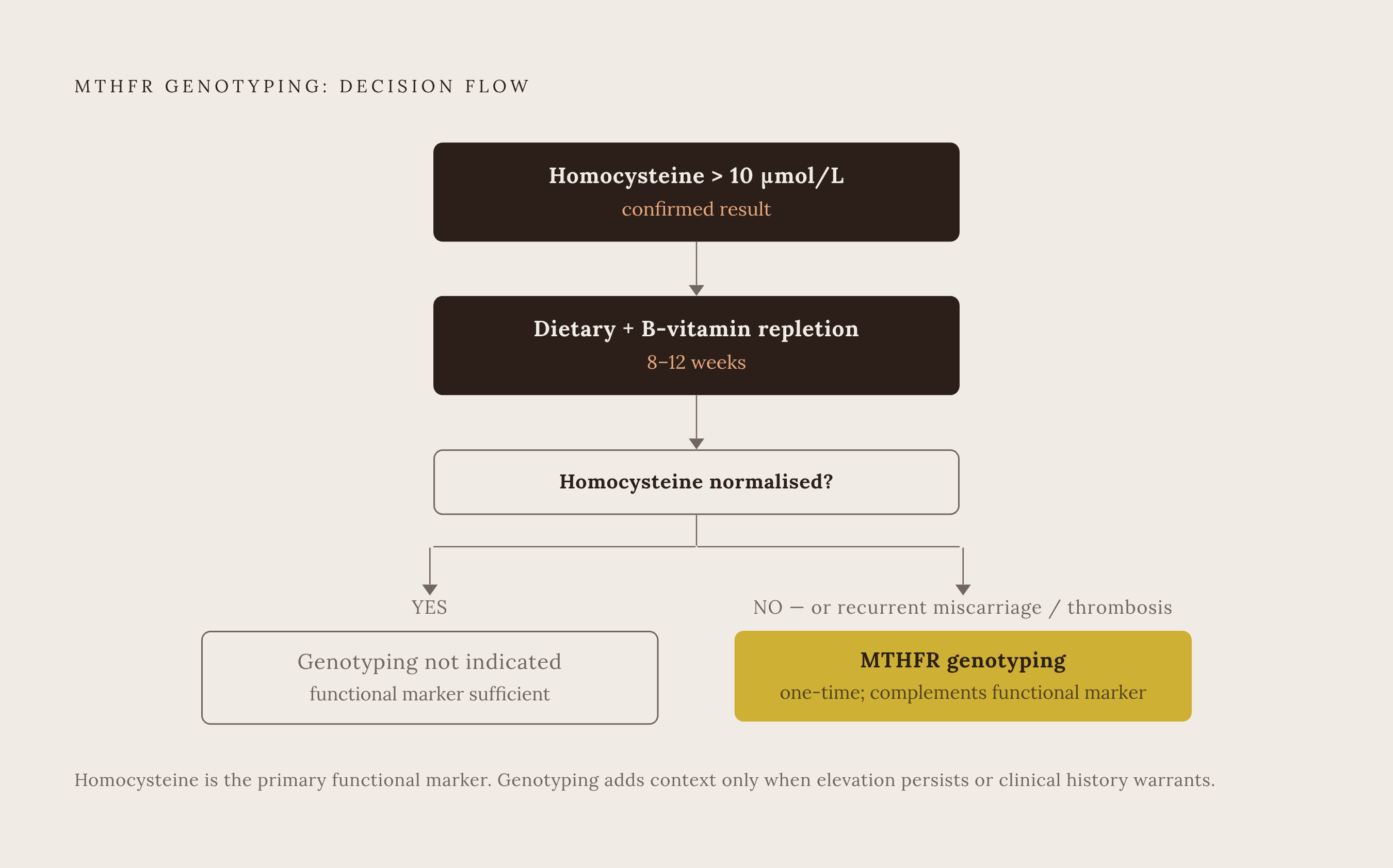
MTHFR genotyping has a narrower role. It may be appropriate if homocysteine remains above 10 µmol/L despite dietary improvement and B-vitamin supplementation, or if there is a history of recurrent miscarriage or thrombosis. The genetic result does not change and need only be measured once. Even then, it complements the functional marker.
What to do when homocysteine is elevated — interventions ranked by evidence
The first intervention is targeted B-vitamin repletion, with attention to active forms. These include methylcobalamin for B12, methylfolate / 5-MTHF for B9 and pyridoxal-5-phosphate for B6. Folic acid depends on MTHFR-related conversion, making reduced enzyme activity relevant to the choice of folate form. Active folate bypasses that limitation and works regardless of genetic variant status. The treatment aim is to correct the identified shortfall.
Targeted B-vitamin repletion generally normalizes homocysteine within 8–12 weeks. That interval provides a practical point for retesting and checking whether the intervention addressed the problem. A lower result shows a biochemical response, but it does not by itself prove that the risk of a heart attack or dementia has fallen. The strongest reason to treat an elevated level is still a likely cause that can be addressed.
Betaine, also called trimethylglycine or TMG, is a second-line option when homocysteine remains elevated despite B vitamins. It uses an alternative remethylation pathway and can lower homocysteine independently of the folate/B12 route. Typical doses are 1,000–3,000 mg daily, particularly when that route is insufficient or impaired by renal function. Persistent elevation also warrants assessment of other contributors alongside supplementation. If not already measured, hsCRP and TSH can add inflammatory and thyroid context.
Eating more leafy greens, legumes and eggs, with less alcohol and processed red meat, helps support treatment over time. These changes reinforce supplementation by addressing dietary methyl donors. Retesting then closes the loop between the suspected cause, the chosen intervention and the actual response. The case for proactive testing is that an addressable problem is easier to recognize and treat when the number is known.
Sources
- EDITED BY Krishna Misra, Indian Institute of Information Technology, India
- Homocysteine in the Cardiovascular Setting: What to Know, What to Do, and What Not to Do
- Homocysteine: Biochemistry, Molecular Biology, and Role in Disease 2021
- Homocysteine in the Cardiovascular Setting: What to Know, What to Do, and What Not to Do - PubMed
- Homocysteine Attack on Vascular Endothelium—Old and New Features
- Joint effects of elevated homocysteine levels and low ...
- Homocysteine, Cognitive Functions, and Degenerative Dementias: State of the Art
- Methionine, Homocysteine, and Methylation Levels Predict Cognitive Decline in Alzheimer's Disease - PMC