High-Sensitivity CRP and Chronic Vascular Inflammation
Elevated inflammatory markers reveal cardiovascular risk that cholesterol alone cannot predict.

High-sensitivity CRP testing reveals low-grade inflammation that standard CRP testing cannot reliably measure. Its value is that it exposes a source of cardiovascular risk that cholesterol results alone can miss. Understanding that signal, interpreting it in context, and measuring it before symptoms appear can make prevention better informed.
Why standard CRP misses the inflammation that drives atherosclerosis
CRP is CRP, but the tests used to measure it do not answer the same clinical question. The liver makes this protein in response to inflammatory signals called cytokines, principally IL-6. During acute infection or injury, CRP rises to levels that standard assays can measure well. The inflammation involved in atherosclerosis, however, can produce much lower circulating concentrations, below the range that standard assays reliably resolve.
The high-sensitivity assay closes that measurement gap by quantifying the low concentrations associated with chronic, subclinical inflammation. “High-sensitivity” describes the test’s ability to detect a smaller signal. Ordering standard CRP for cardiovascular risk assessment is therefore not simply choosing a cheaper version of the same test. It is choosing a test unsuited to the question, leaving this part of the risk invisible.
How low-grade vascular inflammation builds and why it stays hidden
Atherosclerosis is more than a plumbing problem in which deposits gradually narrow a pipe. It is a chronic inflammatory process that connects injury to the arterial lining, lipid deposition, plaque growth, and eventual plaque rupture and thrombosis. Inflammation contributes across that continuum rather than appearing only when something goes wrong at the end. This explains why a quiet inflammatory signal can matter long before a person feels ill.
The NLRP3 inflammasome activates and triggers the release of IL-1β, which drives IL-6, which in turn drives CRP synthesis in the liver. hsCRP measures the downstream output of that cascade, an indirect signal of activity within an artery. Visceral adipose tissue, the fat around abdominal organs, is one important upstream contributor to this signaling. This helps explain why people with abdominal adiposity also tend to have elevated hsCRP.
CRP also has biology that depends on its physical form. Circulating pentameric CRP, or pCRP, can pass through modified pCRP* to monomeric CRP, or mCRP, at activated or damaged membranes. Experimental evidence suggests that these forms may affect vascular cells, complement activation, and coagulation. Their causal and clinical significance in tissue remains unresolved, however. The clinical argument for measuring hsCRP rests on its value as a risk signal.
How well hsCRP actually predicts cardiovascular events across different patient groups
Elevated hsCRP predicts first cardiovascular events, recurrent events, and mortality, including when traditional risk factors are well controlled. Its usefulness therefore extends from apparently healthy adults to people with established cardiovascular disease. hsCRP can reveal risk that cholesterol testing leaves unexplained. The 2025 ACC Scientific Statement supports that added value. In people without established atherosclerotic cardiovascular disease, hsCRP improves prediction beyond traditional risk factors.
The most counterintuitive illustration is the person described as “SMuRFless but inflamed”. These individuals lack standard modifiable risk factors yet have elevated hsCRP. The 2025 ACC Scientific Statement reports that this group has clearly higher lifetime cardiovascular risk, showing that even people with normal lipids and blood pressure can be at risk. A reassuring conventional profile can therefore coexist with a meaningful inflammatory burden. hsCRP makes that mismatch visible.
The 2025 ACC Scientific Statement also highlights comparisons among LDL-C, hsCRP, and Lp(a) in which hsCRP showed the greatest magnitude of effect for predicting future cardiovascular events. Among people with known cardiovascular disease, hsCRP is at least as powerful a predictor of recurrent vascular events as LDL cholesterol. These findings show that risk can remain even when another source of risk is under control, which matters especially for people already being treated.
The residual inflammatory risk problem — and what the landmark trials proved about it
Residual inflammatory risk is the cardiovascular danger that persists despite optimal management of lipids and other traditional factors. The 2025 ACC Scientific Statement identifies hsCRP as a strong predictor of recurrent events even in statin-treated patients. Testing whether an intervention directed at inflammation reduces cardiovascular events without lowering cholesterol can establish whether treating inflammation will close that gap.
CANTOS supplied that test. It compared canakinumab, an IL-1β inhibitor, with placebo in patients who had experienced myocardial infarction and had elevated hsCRP. The trial reduced recurrent cardiovascular events independently of any change in lipid levels, providing direct evidence that inflammation was a causal driver. Benefit was confined to participants who achieved on-treatment hsCRP below 2 mg/L. That finding showed that hsCRP could help both to detect an inflammatory burden and to check how well treatment was working.
JUPITER approached the problem from primary prevention. It enrolled adults who had no cardiovascular disease and whose LDL-C was below 130 mg/dL but whose hsCRP was at or above 2.0 mg/L. Rosuvastatin 20 mg daily, compared with placebo, reduced the overall composite major cardiovascular event endpoint by 44%, with reductions in myocardial infarction and stroke. The trial showed that hsCRP identified a group that lipid screening alone could overlook. Because statins lower both LDL cholesterol and hsCRP, however, CANTOS supplied the clearer test of inflammation independent of lipid change.
CIRT provides the necessary counter-example. Its trial of methotrexate in several thousand participants did not reduce cardiovascular event rates and did not lower IL-1, IL-6, or hsCRP. Benefit depends on the pathway being affected.
Reading an hsCRP result — what the numbers actually mean in practice
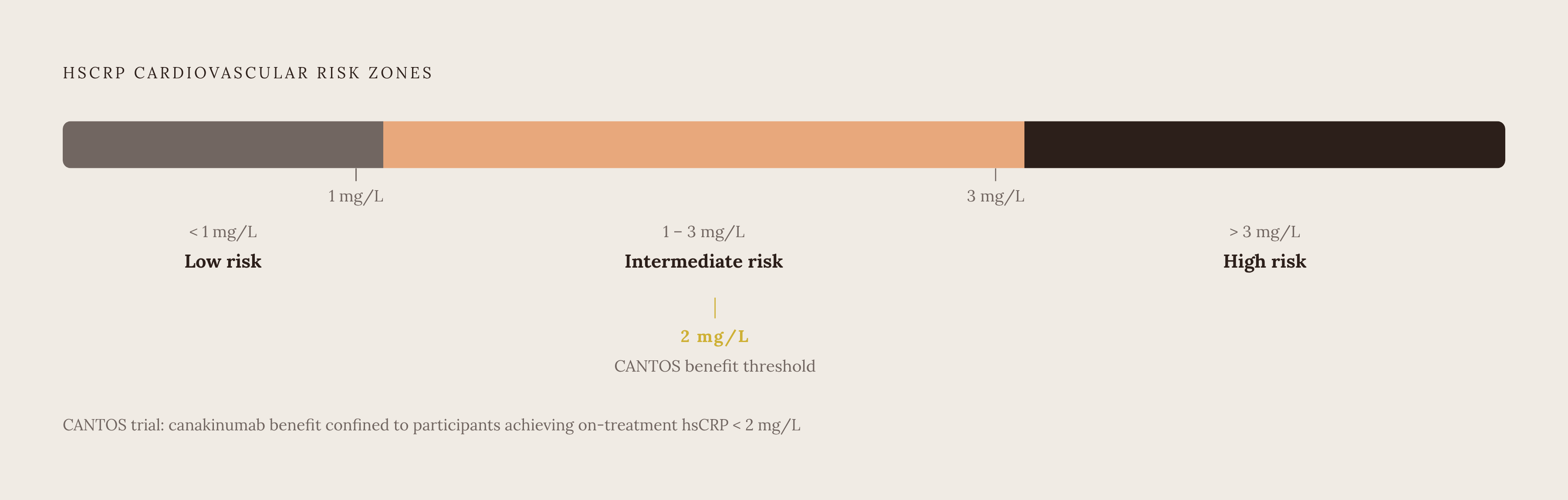
The usual hsCRP categories describe cardiovascular inflammatory risk. A result below 1 mg/L is considered low, 1–3 mg/L is intermediate, and above 3 mg/L is high. These thresholds come from decades of outcomes data, but their meaning still depends on the circumstances of the blood draw. A number can fall clearly within a category while failing to represent a person’s usual baseline.
The central caveat is that CRP is an acute-phase reactant. Infection, autoimmune flares, and other active inflammatory conditions can raise it sharply, masking or mimicking the chronic low-grade signal of interest. The 2025 ACC Scientific Statement allows a single measurement above 3 mg/L to identify elevated inflammatory risk in routine practice, provided the person is not acutely ill. For a reliable baseline, the practical rule is two measurements taken when the person is not acutely ill, with an elevated result confirmed on repeat. A high reading during or shortly after illness is not interpretable for cardiovascular risk purposes.
A further limitation is that hsCRP cannot locate the source of inflammation. Arterial inflammation, visceral adiposity, subclinical infection, periodontal disease, and autoimmunity can all contribute to an elevated result. This lack of specificity is a serious objection to treating the number as a standalone answer. It is not, however, a reason to dismiss a persistent elevation that carries predictive value. The result identifies risk and prompts investigation, while treatment decisions require clinical context.
The case for measuring hsCRP before symptoms appear, not after
Once the result can be interpreted thoughtfully, the next question is why to obtain it in someone who feels well. The answer lies in the timing of atherosclerosis. Its inflammatory process can remain clinically silent for years, while symptom-triggered care has little reason to look for it. Measuring hsCRP during that period brings an otherwise hidden signal into routine risk assessment. Waiting for a cardiac event shifts its role from prevention toward prognosis.
The 2025 ACC Scientific Statement grounds the case for routine measurement in the added predictive value of hsCRP beyond traditional risk factors. The 2025 American Society for Preventive Cardiology advocates universal screening of LDL-C, hsCRP, and Lp(a) together. That approach treats inflammation as part of cardiovascular assessment rather than a specialty concern investigated only after other results look abnormal. It also helps find people whose inflammatory risk is high even though they have no standard modifiable risk factors.
Early measurement gives time to establish whether an elevation persists, understand its context, and consider lifestyle or pharmacological intervention before further arterial damage accumulates. A baseline taken when healthy also gives later results a useful point of comparison. For that reason, hsCRP fits periodic, proactive health monitoring better than testing confined to visits for acute illness.
What actually lowers hsCRP — lifestyle interventions with real evidence behind them
hsCRP responds to behavioral change, so an elevated baseline need not remain a fixed label. The strongest evidence for lifestyle changes comes from those that reduce visceral adiposity and inflammation in the rest of the body. Aerobic exercise reduces hsCRP in healthy adults and in people with cardiovascular disease. Reductions are greater when BMI also decreases, linking exercise and weight change.
Higher adherence to a Mediterranean diet is associated with lower hsCRP. The PREDIMED pilot study observed reductions when the diet was supplemented with polyphenol-rich extra-virgin olive oil and no reductions when it was supplemented with nuts. That finding supports attention to the composition of the dietary pattern without proving that every Mediterranean-style change has the same effect. Increased fiber intake and lower saturated fat intake are also associated with lower hsCRP, with stronger evidence in normal-weight and overweight people than in those with obesity.
Weight loss has a biological rationale because adipose tissue contributes to the signaling cascade that raises CRP. Evidence from weight-loss interventions shows that CRP falls as weight is lost, with larger absolute changes in people who begin with higher levels. Smoking cessation also reduces systemic inflammation and is among the most impactful single-behavior changes for lowering hsCRP. These findings support changes people can make, though they cannot promise how much any one person’s hsCRP will fall.
Statins offer a separate, pharmacological example of hsCRP changing with treatment. They lower hsCRP independently of their lipid-lowering effect, which helps explain the importance of the JUPITER findings. That is not a lifestyle intervention or a reason to make prescribing decisions from a laboratory result alone. It reinforces the narrower point that hsCRP can serve as a treatment-response marker worth tracking over time.
What hsCRP testing costs and how to avoid overpaying for it
The first purchasing decision is to get the assay that measures inflammation relevant to cardiovascular risk. A lower price for standard CRP is not a saving if the test cannot reliably measure the relevant concentration range. The order needs to specify hsCRP. CPT code 86141 helps people compare prices for the same assay on different ordering platforms.
Direct-to-consumer and independent laboratory cash prices for hsCRP are meaningfully higher than those for standard CRP. Hospital outpatient laboratories usually charge much more for the same certified laboratory draw, often around $100 self-pay and frequently more. Comparing cash prices for the identical assay is therefore more useful than comparing test names that sound similar. The setting and billing structure can change the price without changing the question the test answers.
Checking an elevated reading and tracking how lifestyle changes affect it both take more tests, so the cost of each test adds up. How a testing platform sets its prices matters as much as the price it first lists. The aim is affordable access to a meaningful baseline and follow-up, so that a hidden risk signal can inform prevention before symptoms force the issue.
Sources
- Frontiers
- Inflammation and Cardiovascular Disease: 2025 ACC Scientific Statement: A Report of the American College of Cardiology
- Hs-CRP as a biomarker for atherosclerosis progression and cardiovascular risk: a systematic review - PMC
- Evolving strategies in cardiovascular disease prevention: 2025 American society for preventive cardiology highlights - ScienceDirect
- High-sensitivity C-reactive protein as a prognostic biomarker in cardiovascular diseases: implications for atherosclerosis, chronic kidney disease, and heart failure
- Inflammation in atherosclerotic cardiovascular disease: From diagnosis to treatment - Arnold - 2025 - European Journal of Clinical Investigation - Wiley Online Library
- Anti‐inflammatory therapy for atherosclerosis: interpreting divergent results from the CANTOS and CIRT clinical trials - Ridker - 2019 - Journal of Internal Medicine - Wiley Online Library