Lp(a) Elevated Levels and Inherited Cardiovascular Risk
A genetic marker missed by standard cholesterol tests reveals hidden heart disease risk.

Lp(a) is an inherited cardiovascular risk factor that can be elevated even when ordinary cholesterol results look normal. Because roughly 90% of its level is genetically determined, a single blood test can reveal risk that diet, fitness and a standard cholesterol panel cannot rule out. The value of knowing is practical, even without an approved Lp(a)-specific treatment, because it changes how seriously other heart risks need to be managed.
What Lp(a) is and why it differs from ordinary LDL cholesterol
Lipoprotein(a), usually shortened to Lp(a), consists of an LDL-like particle with an extra protein, apolipoprotein(a), attached to its apoB100 protein. That additional component makes it biologically different from ordinary LDL. Lp(a) promotes plaque formation in arteries, activates inflammation and interferes with fibrinolysis, the process that dissolves blood clots. These overlapping effects mean that it can both help plaques build up and make clots harder to clear. A standard cholesterol result does not capture that combination of risks.
The consequences also extend beyond one kind of heart disease. Lp(a) is an independent, causal risk factor for atherosclerotic cardiovascular disease, or ASCVD, and for calcific aortic stenosis, in which the aortic valve becomes calcified and narrowed. Published clinical data associate elevated Lp(a) with a 2–3-fold increased risk of myocardial infarction and aortic valve stenosis. Rubio-Serrano et al. (2023) also found an association with peripheral arterial disease, though not with a personal history of coronary or cardiovascular disease in that cohort. That distinction matters because a study of one patient group does not have to show every known association for the broader risk to be real.
Why Lp(a) levels are set almost entirely by inheritance, not lifestyle
Roughly 90% of an individual’s Lp(a) level is determined by the LPA gene. Diet, exercise and most medications therefore cannot meaningfully change it in the way they can change other cardiovascular risk factors.
Levels usually stay the same through adulthood, so one measurement gives a reliable picture of a person’s lifelong exposure. Exceptions exist, including kidney disease, liver disease, thyroid disease, pregnancy and menopause, which can shift levels. Women with borderline levels before menopause should retest afterward because hormonal changes can move them into a high-risk range. For most adults, however, this is not a marker that needs repeated tracking.
Inheritance also means that one person’s result can carry information for a family. A high level in one family member is a reason for cascade testing of first-degree relatives. Elevated Lp(a) in children and adolescents has been linearly associated with cardiovascular events in middle adulthood. Children with both elevated Lp(a) and elevated LDL-C face a more than fourfold increased risk of premature ASCVD.
How common elevated Lp(a) is, and why most people who have it don't know
Approximately one in five people globally has elevated Lp(a), yet the vast majority do not know it. The condition causes no symptoms and is absent from standard cholesterol panels. Someone can be attentive to preventive care without ever receiving an Lp(a) result.
Levels are usually highest in people of African ancestry, while South Asians have levels above those of Europeans and East Asians but below those of African ancestry. However, the relative increase in cardiovascular risk is similar across these groups. Different average levels do not make an elevated result harmless in any one group. An individual measurement remains more informative than an assumption based on ancestry.
SCAI 2026 Scientific Sessions data make the consequences of this hidden risk particularly clear. A pooled analysis of participants in three major NIH trials, ACCORD, PEACE and SPRINT, found elevated risks of cardiovascular death and stroke among people with high Lp(a). Those risks persisted even among people already receiving standard lipid-lowering treatment.
What the numbers on a test result actually mean, and where risk begins
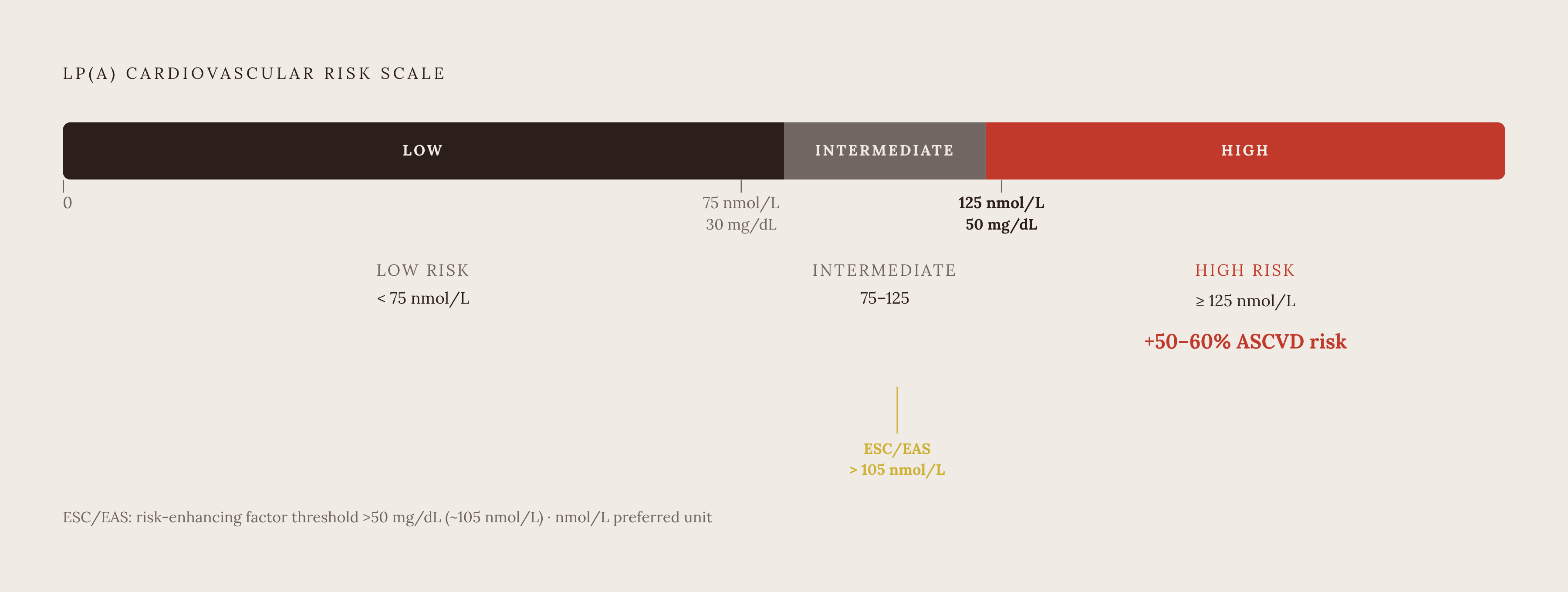
Lp(a) risk rises along a gradient. Clinical thresholds nevertheless help clinicians decide when a result should change prevention plans. The 2024 updated National Lipid Association guidelines classify levels below 75 nmol/L (30 mg/dL) as low risk, 75–125 nmol/L as intermediate, and ≥125 nmol/L (≥50 mg/dL) as high risk. The high-risk threshold is associated with a 50–60% increase in ASCVD risk. These categories describe only the risk from Lp(a), which is one part of someone’s cardiovascular health.
Results can be reported in nmol/L or mg/dL, and these units do not convert at a 1:1 ratio. Check which unit your result uses before comparing it with a guideline threshold.
The 2025 ESC/EAS Focused Update on Dyslipidaemias designates Lp(a) above 50 mg/dL (105 nmol/L) as a risk-enhancing factor. Its stated cut-point differs from the National Lipid Association’s, so the relevant guideline and unit both matter. In practice, a risk-enhancing result can help a clinician decide whether to intensify treatment, particularly when someone is near the threshold for starting preventive therapy.
The rest of the lipid picture still matters. High Lp(a) together with LDL-C ≥130 mg/dL is a particular cause for concern, and some of the added risk remains even when statins lower LDL-C. ApoB can help complete the picture because it captures the total burden of artery-damaging particles, including Lp(a) itself.
Who should get tested, and why the standard cholesterol panel won't tell you
The 2026 ACC/AHA Dyslipidemia Guideline recommends that every adult have their Lp(a) measured at least once in their lifetime. The 2025 ESC/EAS Focused Update on Dyslipidaemias likewise recommends measuring it at least once in adulthood. These recommendations make testing broader than a search for an explanation after an early heart attack. They take into account that inherited risk can be present before a person develops disease. A low result is reassuring about this exposure, while a high result can help guide prevention for years to come.
A study of millions of adults across six academic health systems in California covering 2013–2021 found that only 0.3% had ever had Lp(a) tested. The test must be ordered on its own, so an order for a cholesterol panel does not automatically include it. A clinician therefore needs to establish whether Lp(a) has actually been measured. Looking for a distinct result resolves that uncertainty.
Some histories make the conversation especially important. These include a personal history of heart attack, stroke or aortic valve disease, particularly at a young age, and premature cardiovascular disease in a parent or sibling. Diagnosed or suspected familial hypercholesterolemia, or LDL cholesterol that has not responded as expected to statin therapy, also supports testing. So does unexplained cardiovascular risk despite apparently normal cholesterol. A first-degree relative with known high Lp(a) is another clear reason to ask.
What to do when the result comes back elevated
A high result calls for a talk about how to lower total cardiovascular risk, rather than going straight to a prescription to lower Lp(a). A clinician usually first assesses whether LDL-C needs more intensive lowering. Statins leave Lp(a) unchanged or modestly raise it and clearly reduce ASCVD risk in people with high Lp(a). Those effects are separate, so an unchanged or slightly higher Lp(a) result does not mean the statin has failed at its purpose.
For high-risk patients who have not reached LDL targets on maximally tolerated statin plus ezetimibe, a clinician may consider a PCSK9 inhibitor. These medicines strongly lower LDL-C and also reduce Lp(a) by roughly 20–30%. That modest Lp(a) effect is different from having an approved treatment dedicated to this risk factor. Niacin also lowers Lp(a) modestly, but randomized outcome trials showed no cardiovascular benefit, so it is not recommended for Lp(a) management.
Lifestyle still has a role, but the goal needs to be clear. Diet and exercise are not a way to undo the inherited Lp(a) level. Instead, attention belongs on modifiable risks, including blood pressure, blood sugar and smoking, that can compound its effects. A clinician may also measure ApoB to get a clearer picture of the total particle burden or use coronary artery calcium scoring when it is still unclear how to manage the risks. For very high Lp(a) with established ASCVD, the discussion may also include apheresis or enrollment in investigational therapy trials in select cases.
Where the drug pipeline stands after the pelacarsen trial failure in September 2026
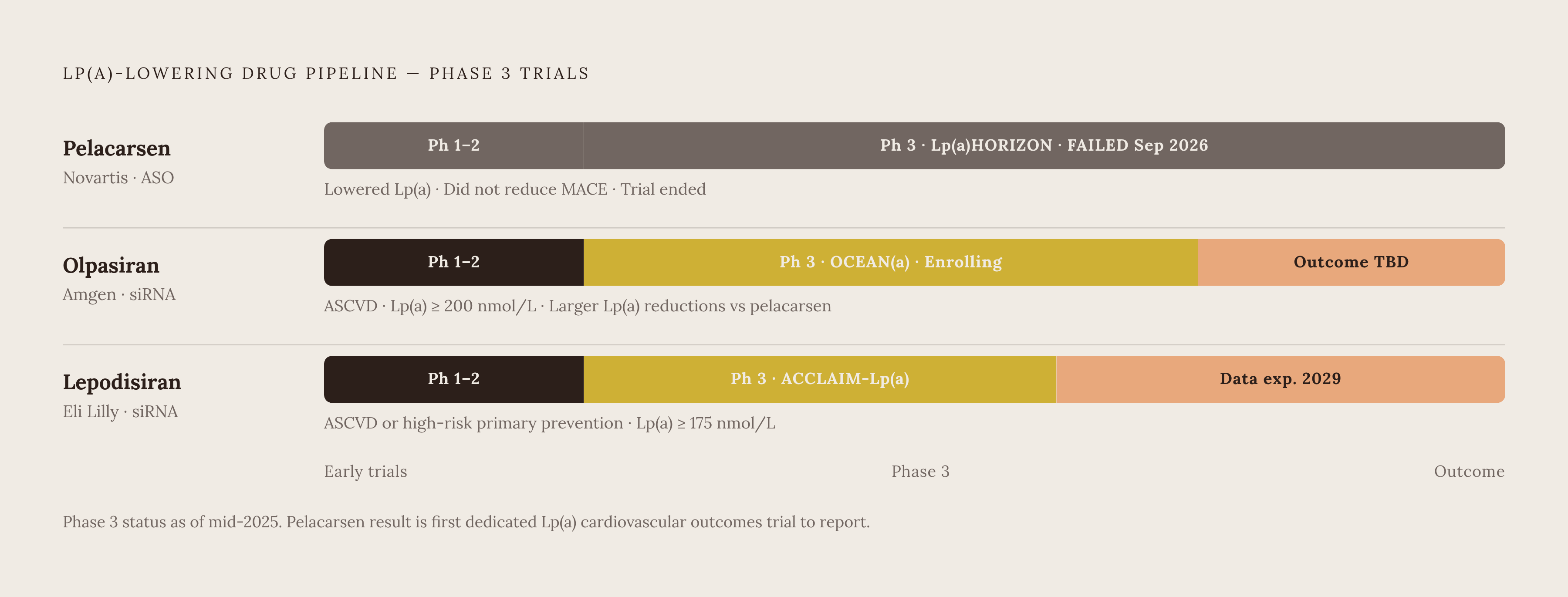
On September 4, 2026, Novartis said that pelacarsen lowered Lp(a) in the Lp(a)HORIZON trial but failed to reduce major adverse cardiovascular events. This was the first phase 3 trial of a dedicated Lp(a)-lowering therapy and involved patients with elevated Lp(a) and established ASCVD. The measured events included cardiovascular death, non-fatal myocardial infarction, non-fatal stroke and urgent coronary revascularization requiring hospitalization.
Pelacarsen is an antisense oligonucleotide targeting apolipoprotein(a) mRNA. Its trial exposes the central unanswered treatment question, which is whether deliberately lowering Lp(a) prevents events. The result cannot distinguish between failure of the treatment approach itself and limitations in potency or trial design. Other ways of lowering Lp(a) may still work despite this one negative trial.
Two larger siRNA trials are still running. Amgen’s olpasiran is in the phase 3 OCEAN(a) trial, enrolling patients with ASCVD and Lp(a) ≥200 nmol/L. Its phase 2 results showed that it lowered Lp(a) much more than pelacarsen did in its earlier program. Eli Lilly’s lepodisiran is in the phase 3 ACCLAIM-Lp(a) trial for participants with established ASCVD or high-risk primary prevention profiles and Lp(a) ≥175 nmol/L. Lilly expects to share data in 2029.
It is still unclear whether those larger drops will lead to fewer cardiovascular events. That uncertainty limits what clinicians can promise about directly treating Lp(a), but it does not remove the reason to measure it. Testing shows who needs closer care for their other risk factors now.
Why testing still matters even without an approved Lp(a)-specific treatment
A large individual participant data meta-analysis of seven placebo-controlled statin trials shows how much risk can remain. Patients treated with statins who had Lp(a) ≥50 mg/dL had a 43% higher relative risk of recurrent events than those with low Lp(a), even while the medication lowered LDL-C.
LDL, blood pressure and blood sugar can add to inherited risk in the years before a drug might be approved. A confirmed high result can also bring younger relatives into screening while there are still decades available for prevention. Testing is inexpensive, requires no referral and needs to be done only once in most adults. Its practical value is not merely naming a genetic vulnerability, but changing how the risks that can be treated are managed, with consequences for cardiovascular outcomes.
Sources
- [Lipoprotein(a) - the hereditary risk factor for cardiovascular disease] - PubMed
- Lipoprotein(a) Linked to Elevated Cardiovascular Risk Despite Standard Treatment
- Clinical characteristics associated with elevated levels of lipoprotein(a) in patients with vascular risk
- Burden of elevated lipoprotein(a) among patients with atherosclerotic cardiovascular disease: Evidence from a systematic literature review and feasibility assessment of meta-analysis
- Rethinking cardiovascular risk: The emerging role of lipoprotein(a) screening - ScienceDirect
- Lipoprotein(a) Testing Trends in the United States 2015-2024: An Analysis of 300 Million Individuals