ApoB as a Cardiovascular Risk Marker Beyond LDL Cholesterol
Counting artery-damaging particles directly beats estimating them from cholesterol mass alone.

A standard cholesterol test measures how much fat is packed inside your blood's particles. It does not count the particles themselves, and that gap explains why people with "normal" lipid panels still have heart attacks.
Why LDL cholesterol measures the wrong thing
Someone gets a lipid panel back from a routine physical. LDL looks fine. Doctor says nothing to worry about. Two years later, that same person is in the back of an ambulance having a heart attack nobody saw coming.
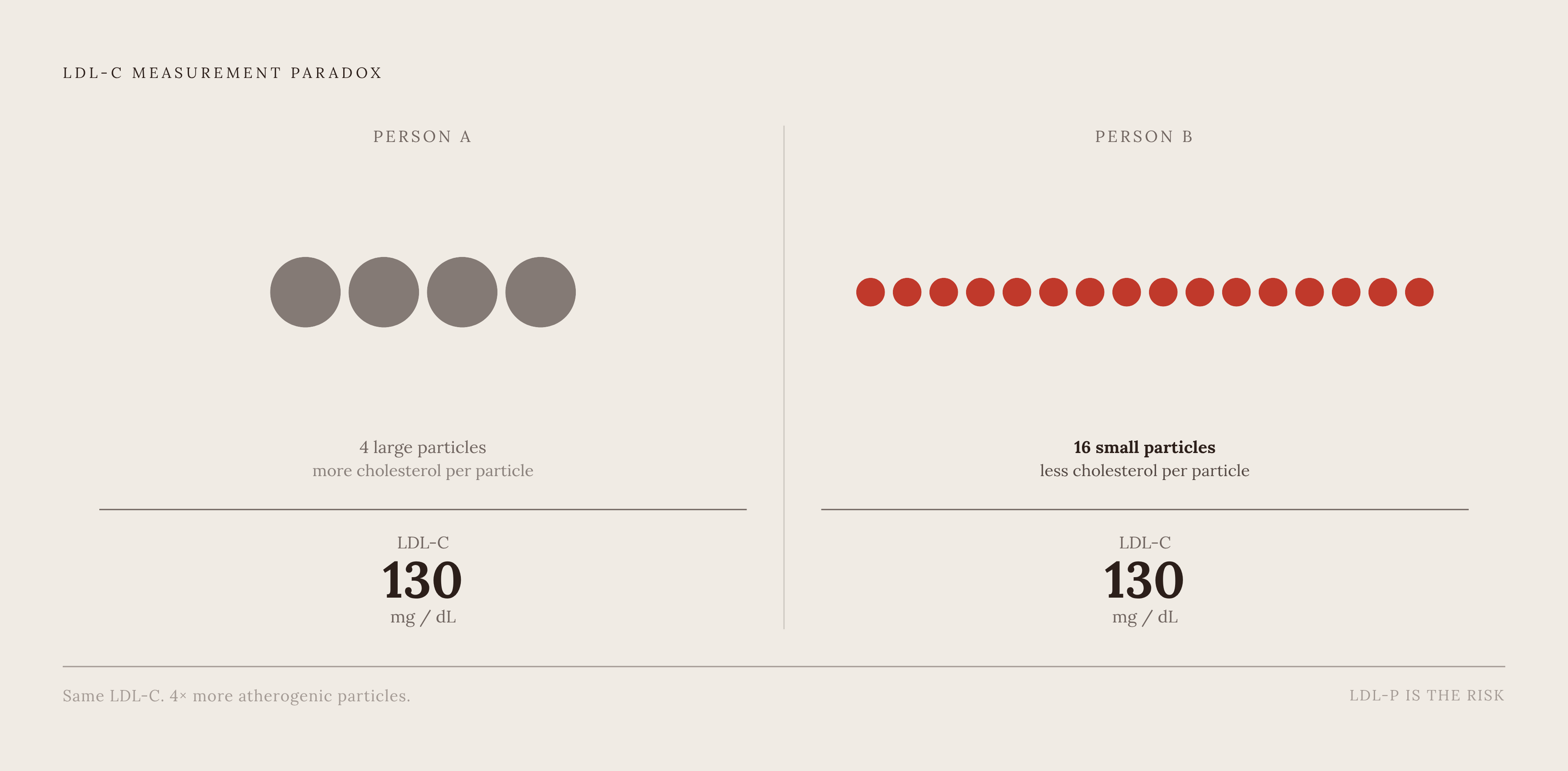
This happens because LDL cholesterol, the number on a standard panel, measures the mass of cholesterol riding inside a class of particles. It does not measure how many of those particles are floating around. Two people can post the identical LDL-C number and carry very different particle counts in their blood. One person might have fewer, larger particles, each stuffed with a lot of cholesterol. The other might have many more, smaller particles, each carrying less. The cholesterol mass can add up to look the same on paper. The second person is walking around with far more opportunities for arterial damage, and the test everyone trusts can't tell the two of them apart.
Every atherogenic particle, whether it's LDL, VLDL, IDL, or Lp(a), carries exactly one copy of a structural protein called ApoB100. The liver makes this protein and builds it into each particle, one per particle, no exceptions. Counting the ApoB molecules in a blood sample gives a direct count of the atherogenic particles themselves, rather than an estimate based on how much cargo they happen to be hauling that day. A 2026 review in Frontiers in Cardiovascular Medicine lays out this structural role: ApoB is the backbone of the particle, and the particle count is the thing that matters.
Cholesterol content varies a lot from one particle to the next, so numbers like LDL-C and non-HDL-C can't fully capture how many atherogenic particles are actually in circulation. The same Frontiers review states this directly. Non-HDL-C comes a little closer, because it adds up cholesterol across all the non-HDL particle types, not just LDL. But it still measures cargo, not particles, and that puts a ceiling on how precise it can ever be.
How atherosclerosis begins: the retention of ApoB-containing particles
Plaque doesn't start with cholesterol soaking into an artery wall like a stain. It starts when ApoB-containing particles get physically trapped beneath the lining of the artery, in a process researchers call subendothelial retention. That retention event kicks off the whole disease process. Since every one of those particles carries exactly one ApoB molecule, the math is direct: more particles circulating means more particles available to get stuck, regardless of how much cholesterol any single one happens to be carrying.
The particle doesn't just sit there passively once it's trapped. The Frontiers review notes that the phospholipids and ApoB protein inside these retained particles can turn proatherogenic after oxidative modification: the particle itself becomes biologically active inside the artery wall and drives the disease forward, not merely the cholesterol it happens to be holding.
ApoB100 also serves as the key that fits the LDL receptor lock, so it governs how cells pull these particles out of circulation and clear them from the blood. When the gene that codes for ApoB, called APOB, carries certain mutations, that clearance process can break down. The Frontiers review notes that some of these pathogenic variants are linked to cardiovascular disease showing up decades earlier than expected, along with a sharply elevated risk of death.
A clinical trial makes the particle-count argument better than any textbook passage could. A drug called evacetrapib drove LDL-C down by a wide margin, far more than it reduced ApoB. Yet it failed to cut cardiovascular events in the patients who took it. Moving cholesterol mass around without touching particle count bought nothing. That result reframes the question anyone should be asking about their own risk. How many particles are floating in the blood matters more than how much cholesterol is floating in it.
The populations most likely to be misclassified by LDL-C alone
The people most likely to get the wrong read from a standard lipid panel are those with metabolic syndrome, obesity, type 2 diabetes, or insulin resistance, a population that's large today and growing fast across the world.
Their lipid profile tends to look deceptively mild. Instead of a high LDL-C number, high triglycerides paired with low HDL-C typically appears in their lipid profile. That pattern can mask a high count of atherogenic particles that a standard panel never flags, while ApoB would catch it directly, because it's counting the particles rather than reading a cholesterol total that happens to look unremarkable.
Research on ApoB and blood sugar control extends this concern further. Studies increasingly tie ApoB to fasting glucose, insulin resistance, and HbA1c, so it sits inside a cluster of cardiometabolic problems that reaches well past cholesterol and dyslipidemia. An elevated ApoB reading, in other words, might be flagging broader metabolic trouble building in the background, not only cardiovascular risk sitting on its own.
People already taking statins make up a second group, since hitting an LDL-C target on a statin does not guarantee the risk has gone away. Residual risk can persist even after LDL-C looks controlled, and an elevated ApoB in that setting is a sign that atherogenic particle burden is still there, sitting untouched by the treatment that was supposed to handle it.
What the evidence shows when ApoB and LDL-C disagree
Discordance analysis is built for comparing two variables that usually move together but occasionally don't, so when ApoB and LDL-C point in opposite directions, it gives researchers their cleanest read on which marker actually predicts heart disease better.
A 2025 systematic review published in the Journal of Clinical Lipidology pulled together every available discordance study, and it covered hundreds of thousands of participants in total. ApoB beat LDL-C in every single study that compared the two head to head, and it beat non-HDL-C in most of them as well. The review's conclusion was direct: neither LDL-C nor non-HDL-C holds up as an adequate clinical stand-in for ApoB.
Long-running data backs this up. The ATTICA Study followed participants from 2002 to 2022, two decades of tracking, and found that elevated ApoB predicted long-term cardiovascular risk independently of non-HDL-C and Lp(a), though this held specifically when LDL-C was also elevated at the same time. Discordance analysis confirmed that ApoB was contributing real, independent predictive information rather than just echoing what LDL-C already showed.
This pattern holds across very different patient groups: healthy people being screened for the first time, people who already have coronary artery disease, and people already on statins. ApoB's edge appears in all three settings, which argues against the advantage being some quirk of one particular study's design.
A fair criticism deserves a fair answer. Because ApoB and LDL-C track closely together across the general population, some argue that switching to ApoB buys most people little benefit. The discordance research answers that directly: the benefit of ApoB concentrates almost entirely among the patients where the two markers disagree, the exact group a standard lipid panel gets wrong. That group is large enough to matter in clinical practice.
ApoB as a longevity marker, not just a cardiac risk score
ApoB's value doesn't stop at predicting a heart attack five or ten years out. It extends to death from any cause, which puts it in the conversation about living longer and staying healthier generally, not just avoiding one specific disease.
Mendelian randomization studies use naturally occurring genetic variation as a kind of built-in experiment to figure out cause and effect, and they point to higher ApoB as genuinely harmful to lifespan. These studies link elevated ApoB causally to coronary heart disease and type 2 diabetes. That causal link carries a hopeful implication: both lifestyle changes and medication that lower ApoB should, in theory, help prevent these diseases and extend life, beyond producing a better-looking lab report.
Large trial populations show the same pattern from another angle. Each step down in ApoB tracks with meaningfully lower odds of dying from any cause, and from cardiovascular causes specifically. That dose-response relationship, where lower ApoB consistently tracks with better outcomes, is what makes ApoB a target someone can actually act on, beyond a label that sorts people into risk categories.
This matters most for people who feel completely fine right now. ApoB is a forward-looking number for anyone who wants to see their trajectory early and make a decision about it years before any event forces the issue, even before something has already gone wrong.
How to read your ApoB number
Getting ApoB measured takes one blood draw, no fasting required, and the result comes back in mg/dL, the same units most people already recognize from a cholesterol panel.
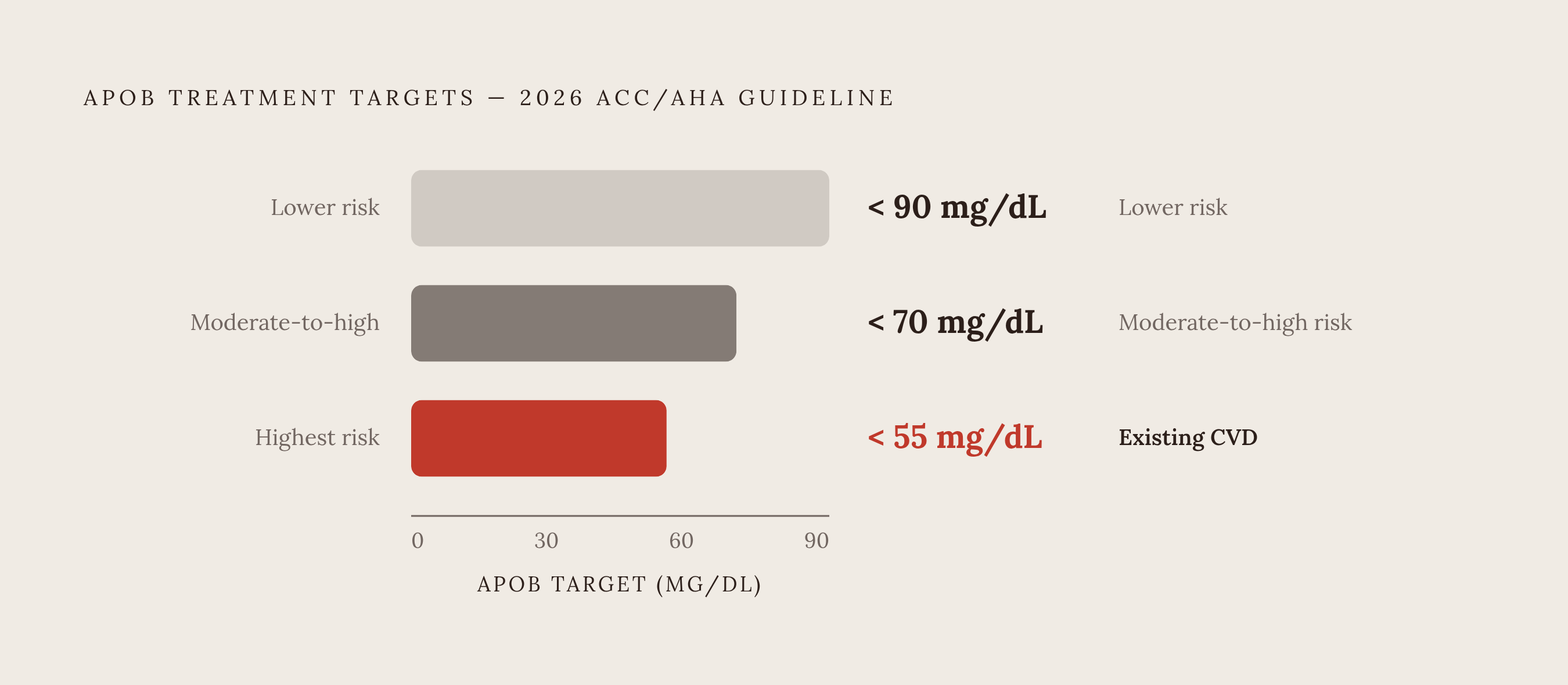
The 2026 ACC/AHA multisociety dyslipidemia guideline sets ApoB goals of under 55, 70, or 90 mg/dL, with the specific number depending on a patient's risk category. These goals apply to select patient groups, including those with existing cardiovascular disease, diabetes, CKM syndrome, or elevated triglycerides, and they kick in once primary LDL-C and non-HDL-C targets have already been met. This isn't a universal framework meant for every single patient. The thresholds were set to line up with corresponding LDL-C targets, which makes translating one number into the other more straightforward for clinicians.
The guideline still treats LDL-C and non-HDL-C as the primary targets of treatment, with ApoB brought in to sharpen risk assessment and guide therapy decisions. In select risk groups, particularly patients who may be carrying residual atherogenic particle burden despite already hitting their LDL-C goals, ApoB becomes an explicit treatment target in its own right. That's the honest, current state of where the guidelines stand, neither overstating ApoB's role nor understating the real discordance evidence behind it.
For patients who don't reach their targets on a statin alone, the 2026 guideline points toward adding non-statin therapies, including ezetimibe, bempedoic acid, or PCSK9 monoclonal antibodies, rather than settling for whatever risk is left over.
The clearest signal to watch for is disagreement between the two numbers. If your LDL-C looks well-controlled but your ApoB stays elevated, risk tracks more closely with the ApoB number, based on the discordance evidence covered earlier.
ApoB tells its fullest story alongside a few other markers: Lp(a), which flags inherited risk; a standard lipid panel; and hs-CRP, which flags inflammation. Pulled together from a single blood draw, those four pieces cover most of what drives cardiovascular risk.
What moves ApoB: lifestyle and pharmacological options
ApoB isn't a fixed number handed down by genetics alone. It responds to changes in daily habits and to medication, and the two routes work through different biological mechanisms, which gives most people real room to move the number regardless of where they're starting from.
On the diet side, a few changes consistently reduce ApoB: cutting saturated fat, pulling back on refined carbohydrates and added sugar, eating more omega-3-rich fatty fish, and adding more soluble fiber. One review of multiple clinical trials found that regular psyllium husk supplementation produced a meaningful drop in ApoB, with the trials involved running a median of eight weeks.
Exercise helps through a different channel. Moderate-intensity aerobic exercise sustained for at least 12 weeks lowers ApoB, and so does resistance training done three sessions a week, mainly because it improves insulin sensitivity and body composition. That lines up with the earlier point about ApoB's ties to metabolic health more broadly.
Medication adds a second, more powerful lever. Statins, including atorvastatin, rosuvastatin, simvastatin, and lovastatin, lower ApoB substantially in randomized controlled trials, with the exact amount depending on which drug and what dose. PCSK9 inhibitors, a newer drug class that includes alirocumab and evolocumab, push ApoB down even further than high-intensity statins can manage on their own. A 2026 meta-analysis found PCSK9 inhibitors produced a significantly larger average percent reduction in ApoB compared to high-intensity statin treatment alone.
The 2026 ACC/AHA guideline reflects this same treat-to-target logic, now applied to ApoB specifically: when a statin alone doesn't get LDL-C and non-HDL-C to target, clinicians may consider adding ezetimibe, bempedoic acid, or a PCSK9 inhibitor. Whatever combination of lifestyle changes or medication you end up using, a single ApoB reading only ever tells part of the story. Tracking the number over months and years is how a person actually finds out whether what they're doing is working.
Why insurance often does not cover ApoB screening
ApoB testing sits in an odd spot in insurance coverage, mostly because it hasn't been named a routine, universal screening target the way a standard lipid panel has. Guidelines still frame LDL-C and non-HDL-C as the primary numbers to treat toward, and they position ApoB as an add-on test for select risk groups. That more limited role in official guidance gives insurers less reason to treat it as a default covered test for everyone.
That leaves ApoB testing as something a patient may need to request directly, and sometimes pay for out of pocket, even when the clinical case for ordering it is strong. A single ApoB test costs far less than many other blood panels, so you can realistically pay out of pocket even without coverage.
A patient who fits into one of the higher-risk groups covered earlier, metabolic syndrome, type 2 diabetes, statin therapy with LDL-C at goal but lingering concern, has a straightforward case to bring to a doctor: ask specifically for ApoB alongside the standard panel, and ask what the result would change about the treatment plan. That conversation, grounded in the discordance evidence and the guideline's own language about residual risk, is often what turns a test from optional into something worth ordering.
Sources
- Frontiers
- ApoB, LDL-C, and non-HDL-C as markers of cardiovascular risk - ScienceDirect
- Concordance‐discordance between apolipoprotein B and lipid biomarkers in predicting 20‐year atherosclerotic cardiovascular disease risk: The ATTICA study (2002–2022)
- Apolipoprotein B and Glycemic Dysregulation: New Predictors of Type 2 Diabetes in High-Cardiovascular-Risk Populations
- 2026 ACC/AHA/AACVPR/ABC/ACPM/ADA/AGS/APhA/ASPC/NLA/PCNA Guideline on the Management of Dyslipidemia: A Report of the American College of Cardiology/American Heart Association Joint Committee on Clinical Practice Guidelines