ESR Versus CRP as Inflammation Markers
High-sensitivity CRP detects chronic inflammation that standard tests miss.

ESR and CRP both help assess inflammation, but how each test works determines which reading to rely on more. CRP responds quickly to inflammatory signals, while ESR shows slower changes in how blood cells settle. The useful comparison is therefore not simply which test is better, but which fits the question, when both add value, and why preventive testing calls for high-sensitivity CRP.
How ESR and CRP produce their readings through different biological mechanisms
CRP is a protein the liver makes in response to pro-inflammatory cytokines, primarily interleukin-6, or IL-6. These signals trigger a rapid response. CRP rises within hours of an infection or the start of inflammation, then returns to normal quickly after the inflammation resolves. Because production follows a specific molecular signal, its concentration tracks the inflammatory state closely and in near real time. The reading reflects the amount of a response protein, rather than a physical change used to infer inflammation.
ESR measures the rate at which red blood cells settle in a tube. It is an indirect proxy for inflammation. The settling rate depends on fibrinogen and other proteins that remain in the blood for different lengths of time, so ESR rises and falls more slowly than CRP.
Anemia, pregnancy, kidney disease, and abnormal antibody proteins can alter the result, making its meaning less straightforward. Its reference ranges shift with age and sex, with higher values in older adults and women, so a single universal cutoff can mislead. Readings can also vary because laboratories use different assays.
Why standard CRP is blind to the inflammation that matters most for long-term health
The version of the test changes what becomes visible. Standard CRP detects inflammation starting at 10 mg/L, so it is useful for acute illness but cannot detect levels below that threshold. High-sensitivity CRP, or hs-CRP, detects levels between 0.1 and 10 mg/L. It measures the same protein with the sensitivity needed to resolve a much smaller signal.
Low-grade chronic inflammation can persist for years before symptoms appear and is considered one of the central drivers of age-related disease. Scientists call this process “inflammaging,” linking it to problems ranging from arterial stiffness to cognitive decline. A person can feel completely well while this signal is present. Standard CRP is not designed to reveal that range, while ESR has no established role in detecting this pre-symptomatic chronic signal.
The Women’s Health Study, reported in August 2024, followed tens of thousands of women who were healthy at the start and showed why that distinction matters for health over time. A single baseline measurement of hs-CRP, LDL cholesterol, and lipoprotein(a) together predicted heart attacks, strokes, and cardiovascular deaths across three decades. Women in the highest fifth for hs-CRP had meaningfully higher risk than those in the lowest fifth. The combined measurements are central to the finding. It supports hs-CRP as part of cardiovascular risk assessment, rather than treating an inflammation reading as a complete picture of someone’s future health.
Where each marker actually performs well and where it falls short
For acute and general inflammation, CRP is usually the stronger first-line marker. Watson et al. (2019) studied more than a hundred thousand UK primary care patients in a prospective cohort and found that CRP had the highest overall diagnostic accuracy. Its performance for detecting infection was marginally superior. CRP is recommended over ESR for detecting acute-phase inflammation in patients whose condition has not yet been diagnosed. Its fast response is an advantage when the question concerns an active, changing process.
That advantage does not make ESR obsolete. ESR remains useful in diagnosing and monitoring rheumatoid arthritis, polymyalgia rheumatica, and giant cell arteritis, tasks that differ from detecting an acute infection. Queiro et al. (2025) found that ESR had broader correlations with disease impact and activity scores than CRP in axial spondyloarthritis, although both markers had low overall sensitivity. In that setting, ESR’s slower reading can better show how much the disease has affected someone over time. A feature that limits a test in one context can help it in another.
Neither marker, however, reliably tells a clinician where inflammation is occurring. In the emergency department, elevated ESR and CRP together can flag serious causes of back pain, including spinal epidural abscess, vertebral osteomyelitis, and malignancy, with high sensitivity. Yet normal results should not rule out these diagnoses in high-risk patients. The clinical picture still has to guide interpretation. A reassuring blood result cannot safely answer a question that the test is not reliable enough to settle.
Inflammatory bowel disease provides another important limit to the comparison. Both markers miss a substantial proportion of active intestinal inflammation in people with IBD, while fecal calprotectin is far more sensitive for gut-specific inflammation. Neither ESR nor CRP alone is reliable for monitoring digestive disease activity. The organ being assessed changes the choice.
When running both tests together is genuinely justified and when it is not
If the tests show different aspects of inflammation, why not always order both? The answer depends on what the second result adds. The Watson study found that adding a second test produced only a marginal improvement in diagnostic accuracy and did not meaningfully increase the ability to rule out disease. The improvement’s clinical significance was debatable. For most clinical purposes, this supports choosing the marker suited to the question.
A March 2026 peer-reviewed economic analysis reached a different conclusion about the value of combined testing at the health-system level. It found that an ESR-plus-CRP strategy was cost-effective, with net savings of $9.95 million a year for a representative hospital, mainly because it cut the costs that follow when cancer cases are misdiagnosed. Automated ESR has a very low reimbursement rate. Under that analysis, the small added cost was worthwhile relative to the diagnostic yield.
The disagreement is therefore narrower than it first appears. Both analyses found CRP to be the better marker per test, but they differ on how much the small gain in diagnostic accuracy is worth. What saves a hospital money may not be the best choice for an individual patient. For a proactive individual, combined testing is worth considering when a clinician suspects SLE, giant cell arteritis, or a possible orthopedic infection. Those are specific diagnostic reasons to seek complementary information, rather than reasons to make both tests a default part of general wellness screening.
Running both tests as a routine adds little to the ability to rule out disease, though some clinical questions can justify the extra result, and even a small gain may be worth the cost for a health system. These are different standards of value. The decision turns on whether the second test helps answer the actual diagnostic question.
What hs-CRP levels mean and how lifestyle interventions actually move them
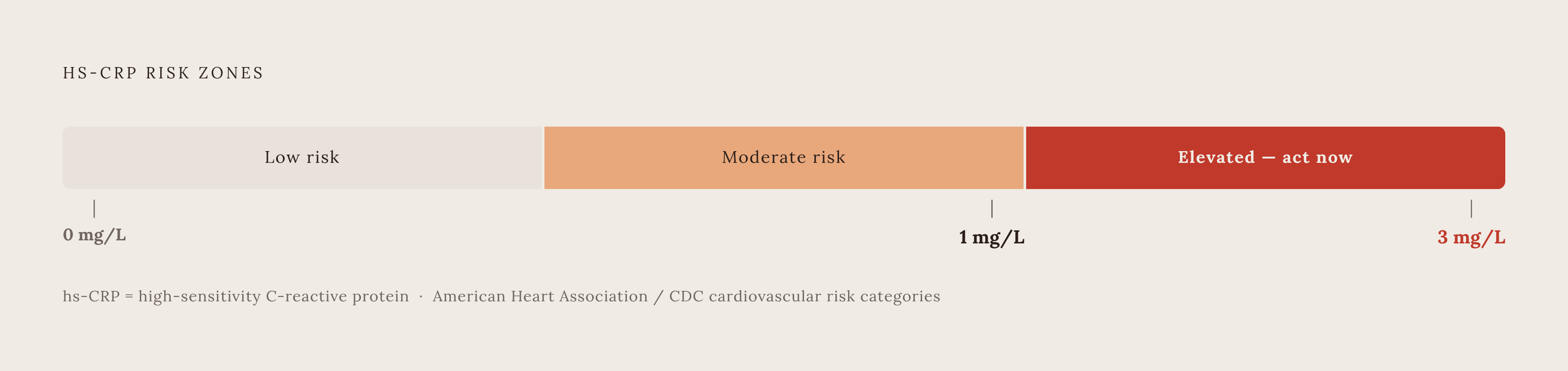
Once the purpose shifts from diagnosing illness to assessing longer-term risk, the practical question becomes what an hs-CRP result means and what can change it. A level below 1 mg/L is considered best, while 1–3 mg/L points to average or moderate cardiovascular risk. Above 3 mg/L is a warning signal warranting action. An elevated result is an early, modifiable signal rather than a prediction that a particular event will happen.
The ACC’s 2025 Scientific Statement lists changes in lifestyle that the evidence supports for people with elevated hs-CRP. They include at least the guideline-recommended amounts of moderate or intense exercise, a Mediterranean or DASH diet, weight loss, and smoking cessation. The emphasis is on patterns of daily life.
A 2025 meta-analysis of 33 randomized trials found that hs-CRP fell on average when people followed a Mediterranean diet, though the results differed from study to study. That variation limits promises about any individual’s response. The evidence is stronger for an overall dietary pattern than for a single food described as anti-inflammatory. This distinction changes the practical goal from adding one supposedly protective ingredient to following a broader way of eating.
A meta-analysis of 83 controlled trials found that exercise reduced CRP, with larger effects in studies where body fat or BMI also fell. The benefit is not just about movement itself. Fat loss appears to mediate part of exercise’s anti-inflammatory effect, which helps explain why changes in activity and body composition can be connected to changes in the marker. Exercise can help, but the finding does not promise that everyone will see the same drop.
A 2026 meta-analysis of randomized trials found that, overall, omega-3 and omega-6 supplementation had no significant effects on IL-6, CRP, or TNF-α, a result in tension with some smaller positive trials. It leaves an open question rather than a clear basis for endorsing or dismissing omega-3s. The distinction is important when deciding where confidence belongs, because the evidence for the lifestyle framework is stronger than the case for supplements as a reliable way to lower inflammatory markers.
How to access hs-CRP testing affordably and what to ask for
For cardiovascular and chronic inflammation risk assessment, choose hs-CRP over standard CRP or ESR. The distinction needs to be explicit. A clinician may otherwise order standard CRP by default, which will not reveal the low-grade signal sought for this purpose.
The venue can strongly influence what that request costs. Direct-to-consumer and independent laboratories offer cash-pay hs-CRP testing for roughly $35–55, while a hospital without insurance can charge substantially more for the same test. CRP is inexpensive to run. The sticker price largely reflects venue overhead and billing dynamics. ESR shows a similar pricing gap, with low public-insurance reimbursement, considerably higher provider charges, and lower direct-to-consumer prices, although a cheaper ESR does not make it a suitable substitute for preventive hs-CRP testing.
For a reader comparing options, total cost includes blood-draw fees and physician-order charges that sticker prices often leave out. This matters more when someone has the test more than once.
A single reading is also not enough to establish a baseline. Guidelines recommend two readings, with either their average or the lower value used, and tracking the response to lifestyle changes means retesting periodically. The aim is a reading that answers the right question and remains affordable enough to follow over time.
Sources
- Use of multiple inflammatory marker tests in primary care: using Clinical Practice Research Datalink to evaluate accuracy
- POTD: ESR and CRP in the ED — Maimonides Emergency Medicine Residency
- Tailoring Inflammatory Biomarker Assessment in Axial Spondyloarthritis: A Comparative Study of Erythrocyte Sedimentation Rate and C-Reactive Protein Across Disease Profiles
- Inflammatory Markers
- Fever Correlation with Erythrocyte Sedimentation Rate (ESR) and C-Reactive Protein (CRP) Concentrations in Patients with Isolated Polymyalgia Rheumatica (PMR): A Retrospective Comparison Study between Hospital and Out-of-Hospital Local Registries
- How age and sex affect the erythrocyte sedimentation rate and C-reactive protein in early rheumatoid arthritis
- Biomarkers for cardiovascular risk prediction: from pioneering to evidence-based use in clinical practice
- Prediction of cardiovascular disease risk using biomarkers in blood