Postprandial Glucose Spikes and Continuous Glucose Monitoring
Spikes hidden from standard tests may signal metabolic risk.
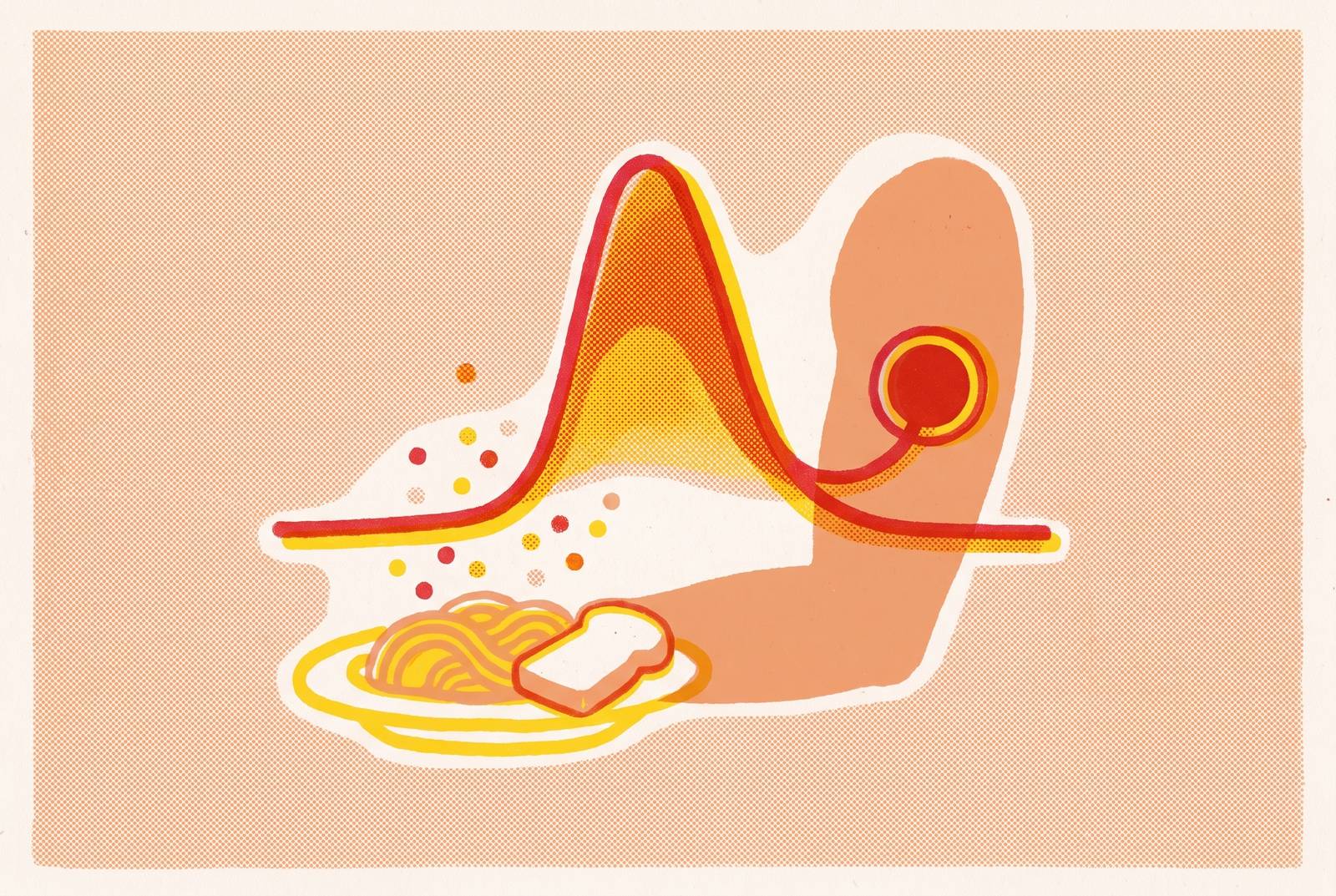
Postprandial glucose spikes are the rises in glucose that follow a meal. They can show that the body is under metabolic strain even when standard blood tests look normal. Continuous glucose monitoring makes those patterns visible in everyday life, giving people without diabetes a practical way to connect meals and habits with their own responses.
Why a standard glucose test can miss a real metabolic problem
Fasting glucose shows the level at one moment before food is eaten, while HbA1c shows roughly a 90-day average. Neither shows how high glucose climbs after lunch or how quickly it falls afterward. An average can hide a bumpy ride. Two people with similar average glucose can therefore have different daily patterns, including differences in the size and duration of their post-meal rises.
In one small study, 16 out of 20 people classified as normal on standard clinical tests still experienced severe post-meal spikes reaching into the prediabetic range for a meaningful fraction of the time. The sample does not establish how common this is across the population, and those excursions are not themselves a diabetes diagnosis. It does show why a reassuring lab result cannot describe the whole response to food. The missing signal is glucose variability, which is the rise and fall that a single reading or long-term average conceals.
What happens physiologically during and after a glucose spike
Postprandial glucose refers to glucose levels in the one-to-two-hour window after a meal. Carbohydrate from food raises blood glucose, and the pancreas releases insulin to help move that glucose into cells. Refined carbohydrates can produce a sharp rise followed by a surge of insulin. The response does not always stop in step. Even after the excess glucose clears, insulin can remain elevated, creating an overshoot that helps explain the energy crash and rebound hunger after a high-carbohydrate meal.
Insulin sensitivity changes with circadian rhythms, so midday and evening meals can produce larger, more prolonged responses. Food composition is only part of the explanation. Age also shapes the curve, with postprandial glucose increasing by 2 to 3.5 mg/dL per decade of life, reflecting reduced insulin sensitivity and progressive loss of muscle mass.
A Spain cohort also found lower late postprandial glucose in men than in women after main meals. Decreased estrogen around menopause was offered as a plausible contributor to insulin resistance in middle-aged women, rather than a proven explanation for every difference. BMI played a smaller part than age or sex. Research published in Nature Medicine shows more differences between people that reflect how their bodies work, including insulin resistance and beta cell dysfunction. The same meal can produce very different curves.
Why recurrent spikes — not just chronic high glucose — drive downstream harm
The concern is what happens when large excursions recur. Intermittent glucose elevations can provoke greater inflammatory and oxidative stress responses than consistently high glucose, which helps explain why an acceptable average may leave risk unrecognized. Peer-reviewed evidence in people without diabetes supports links with oxidative stress, inflammation, and endothelial dysfunction, which is impaired function of the lining of blood vessels. These are more than changes on a graph.
But is this mostly evidence from people with diabetes? Some of the broader literature is, but the non-diabetic evidence cannot be dismissed on that basis. The Spain study linked post-meal spikes with cardiovascular risk, inflammation, and metabolic impairment even when glucose was in ranges considered clinically normal. Postprandial glucose can predict cardiovascular disease independently in non-diabetic ranges and can be more predictive than HbA1c. The researchers said their findings “open the door to expanding the traditional management of blood glucose” beyond fixed cutoff points.
University of Liverpool research published in Diabetes, Obesity and Metabolism examined brain health using Mendelian randomization in a large UK Biobank cohort. It found an association between postprandial hyperglycemia and higher Alzheimer's disease risk, rather than the same association for fasting glucose or HbA1c. That result needs an important qualification, however. It was not replicated in an independent cohort. Overall brain shrinkage and white matter damage did not explain the higher risk in the UK Biobank sample, which suggests that subtler pathways may be at work but leaves those pathways unclear.
Chronically elevated or highly variable glucose promotes the formation of advanced glycation end-products, or AGEs, through a process that does not require enzymes. These compounds accelerate tissue aging. Insulin resistance, which large recurring excursions can both reflect and reinforce, precedes type 2 diabetes by a decade or more and is causally implicated in atherogenesis, hepatic steatosis, and hypertension. The TyG index, a proxy for insulin resistance, also correlates inversely with telomere length in large epidemiological datasets, though that association does not show that flattening spikes will lengthen telomeres.
Claims connecting spikes in non-diabetic people with cancer, poorer mental health, and disrupted sleep draw predominantly on grey literature rather than the firmer peer-reviewed vascular evidence. Broader quality-of-life effects are plausible, but remain less settled, while the brain-health finding also needs replication. Risk can develop below diagnostic thresholds, while the predictive value of an individual spike remains uncertain.
What continuous glucose monitoring actually shows that static tests cannot
Continuous glucose monitoring, or CGM, turns an isolated value into a curve across the day. That curve shows the rise after eating, the peak, the descent, and what happens between meals. A response that resolves quickly differs from one that stays elevated, even if both reach a similar height. Comparing meals also shows whether the rise in glucose lasts longer time after time when people eat later.
The Spain study collected more than 1.3 million real-world measurements from 514 non-diabetic adults over seven days. It examined the complete glucose curve in the six hours after each meal using functional data analysis, an approach that studies the shape of the response. This made individual patterns available for analysis. A traditional measurement taken at one point could miss an earlier peak or a later, prolonged elevation. The researchers supported CGM for identifying metabolic risk profiles and guiding personalized prevention even when HbA1c is normal.
Rather than asking only whether a food is high-glycemic, the question is how that food affects your glucose in the context of a particular meal and time of day. Repeated observations can show which meals produce sustained elevation and which resolve quickly. They can also reveal whether a change in timing or movement accompanies a different curve.
How CGM has moved from prescription device to consumer tool
Continuous glucose monitors have been sold without a prescription in the US since 2024. That change opened access to roughly 98 million adults with prediabetes, as well as people without diabetes who want more visibility into their metabolism. A doctor's order or referral is not required. Abbott Lingo is one over-the-counter option, with an entry-level biosensor covering two weeks and sold at Walmart and Amazon.
For someone seeking insight rather than ongoing monitoring, one sensor worn twice a year can serve as a periodic metabolic check-in. Because the supplied research does not give a purchase price, no reliable cost comparison can be made here. Readers should check prices when they buy and avoid assuming that a short experiment costs the same as year-round monitoring.
What the evidence actually supports for flattening the curve after meals
When skeletal muscle contracts, it moves GLUT4 glucose transporters to the cell surface through a pathway that works without insulin signaling, helping glucose enter muscle while it is being absorbed. Evidence from a 2025 systematic review and meta-analysis supports interrupting sitting about every 30 minutes or less with brief light-to-moderate walking or simple resistance exercise to acutely reduce postprandial glucose and insulin responses in adults with obesity. That population and the short-term outcome are important limits on the claim.
In Hata et al.'s 2025 randomized crossover trial in Scientific Reports, a 10-minute walk immediately after glucose intake produced essentially the same reduction in two-hour glucose area under the curve as a 30-minute walk started later. Area under the curve captures the response over time. Still, a trial after glucose intake does not establish that every ordinary meal or every person will respond identically.
Changing when meals are eaten can also help, because later meals can lead to higher glucose and insulin responses even when they use low-glycemic ingredients. Food order can also alter the response. Soluble fiber slows glucose entry into the bloodstream, while eating vegetables and protein before refined carbohydrates can blunt a spike by changing the rate at which the stomach empties.
Eating pace may be useful for the same reason. Imai et al.'s 2020 CGM-based randomized trial in Nutrients found that glucose area under the curve was about twice as high when people ate fast as when they ate slowly across several meals a day. The evidence supplied does not say how large the trial was or give grounds to treat it as a large study that settles the question. Eating more slowly costs nothing to try, but how much it will lower glucose cannot be promised.
Vinegar has evidence for reducing postprandial glucose in healthy adults and people with type 2 diabetes. Its form changes the result, however. Commercial vinegar tablets swallowed whole at mealtime were not as effective as liquid vinegar in young, healthy adults. The evidence supplied does not establish a universal effect size or an optimal regimen. Randomized findings and pooled evidence support trying these changes, but a lower glucose curve in the short term does not by itself prove that they prevent disease over time.
How to build a postprandial monitoring practice that is worth the effort
CGM should be used as a structured learning tool. Wear a two-week sensor during a representative period rather than a vacation or an unusual stretch of eating. Log meals, timing, sleep, and movement with the glucose data so that a curve has context. Patterns are more useful than isolated readings. Look for types of meals that keep glucose high time after time, rises that fall back quickly, and differences linked to when meals are eaten before choosing which habit to test.
To interpret those patterns, pair the sensor data with static biomarkers. Fasting insulin and HOMA-IR help show whether the pancreas is already working harder to manage baseline glucose, while HbA1c and fasting glucose remain conventional anchors. ApoB adds information about atherogenic particle burden. hs-CRP provides a measure of systemic inflammation, and the TyG index, derived from fasting triglycerides and glucose, offers another proxy for insulin resistance. Together, these measures place a visible glucose excursion within a broader metabolic and cardiovascular picture.
A glucose curve shows how the response changes over time, while a biomarker panel gives information about how the body works and its metabolic health over a longer period. Neither can prove that a given meal caused a later biomarker result. A periodic CGM experiment once or twice a year, paired with a targeted panel, can nevertheless reveal much more than an isolated reading. You do not need to monitor forever to learn which patterns recur, which habits change them, and what deserves closer attention.
Sources
- A Scoping Review of Glucose Spikes in People Without Diabetes: Comparing Insights from Grey Literature and Medical Research - Shira Avner, Timothy Robbins, 2025
- Postprandial Glucose Spikes, an Important Contributor to Cardiovascular Disease in Diabetes? - PMC
- Effect of Repetitive Glucose Spike and Hypoglycaemia on Atherosclerosis and Death Rate in Apo E-Deficient Mice
- Use of Continuous Glucose Monitoring in Non-diabetic Individuals for Cardiovascular Prevention: A Systematic Review of Its Impact on Guiding Lifestyle Interventions