DHEA-S Levels as a Longevity and Adrenal Marker
High DHEA-S predicts aging patterns, but raising it artificially may not extend lifespan.

DHEA-S works as both a longevity signal and an adrenal function test, and the two roles come from the same biochemistry. Understanding what drives its decline, what counts as a good number, and what the research does and doesn't support turns a single lab value into a real window on long-term health.
What DHEA-S Is
DHEA-S is the sulfated, stable storage form of DHEA. The adrenal cortex's zona reticularis makes almost all of it, which means a DHEA-S result tells you specifically about adrenal androgen output, not what the ovaries, testes, or fat tissue are doing elsewhere in the body.
Two things set it apart from other steroid hormones on a lab report. First is the half-life: DHEA-S sticks around in blood for roughly 10 to 20 hours, while plain DHEA breaks down in an hour or two. A single draw of DHEA-S gives a stable read on adrenal androgen status, not a snapshot that could look completely different an hour later. Second, DHEA-S doesn't rise and fall through the day the way cortisol does. There's no diurnal rhythm to work around, so the time of the blood draw doesn't matter much. That's a real convenience for anyone trying to get a useful number without scheduling around a 7 a.m. cortisol window.
None of that would matter much if DHEA-S just sat in the blood doing nothing, but it doesn't. Tissues throughout the body pull DHEA-S from circulation and convert it, as needed, into testosterone, DHT, estrone, and estradiol. Think of it less as a finished hormone and more as raw material the body keeps in reserve. In postmenopausal women, this reserve is the main source of sex hormones, since ovarian production has largely shut down. That single fact raises the stakes considerably: when the reservoir runs low in that population, the downstream hormone supply runs low with it.
The Predictable Age-Related Decline
Few biomarkers decline on as reliable a schedule as DHEA-S. Production peaks in the mid-20s, then slides by about 1 to 2% a year. By age 70, most people are at a small fraction of their peak levels. That decline occurs decades before any disease becomes apparent, making it a window into biological aging itself.
Part of that decline is written into a person's genes. A genome-wide association study found eight independent common genetic variants tied to DHEA-S levels, pointing to genes including SULT2A1, CYP2C9, and HHEX. That matters for how anyone should read their own number. Two people the same age can have different starting points for entirely heritable reasons, so comparing a result only against population averages misses something. Someone with a naturally lower baseline isn't failing some standard; someone whose levels are falling faster than peers of similar genetic stock may have something modifiable going on.
Low DHEA-S relative to a person's age appears repeatedly in epidemiological studies, alongside sarcopenia, osteoporosis, cognitive decline, weaker immune function, and higher all-cause mortality. That's a cluster of outcomes that reads like a checklist for accelerated aging. One likely mechanism ties these threads together: DHEA-S levels run inversely with IL-6, the inflammatory marker that climbs steadily as people get older. As DHEA-S falls, the chronic low-grade inflammation known as inflammaging tends to rise, and the two trends appear to move in step.
What the Longevity Research Shows
The observational link between DHEA-S and longevity is strong enough to take seriously, but it stops well short of proof that raising the hormone extends life. Older cohort studies have repeatedly tied higher natural DHEA-S to better survival, especially in men, along with sharper cognitive function and lower cardiovascular risk in both sexes. That's a consistent pattern across a lot of independent data, and it's the foundation for treating DHEA-S as a meaningful aging marker.
The complication comes from newer, more rigorous study designs. A 2026 study in npj Aging found that the link between DHEA-S and how healthy people felt appeared only in cross-sectional snapshots, and was stronger in women than in men. Longitudinal tracking of the same people over time didn't show DHEA-S predicting future health. That pattern fits a simpler explanation than "DHEA-S protects health": people who are already healthier for other reasons may simply maintain higher DHEA-S as a byproduct, not a cause.
A Mendelian randomization study pushes the caution further. By looking at people with a genetic predisposition toward higher DHEA-S rather than relying on a single measured snapshot, researchers found that genetically elevated DHEA-S was linked to shorter lifespan in men. That result runs against the simple assumption that higher is always better, and it means pushing DHEA-S upward through supplementation, particularly in men, isn't a straightforward win.
DHEA-S is a dependable marker of where someone sits on the aging curve, but whether it's a cause of good aging or just a marker of it remains unresolved. Tracking it over time is well supported by the evidence. Trying to force it higher through outside intervention is a much shakier bet, and the next question that follows naturally is what else the number is actually good for.
DHEA-S as an Adrenal Reserve Marker
DHEA-S does separate, practical work as a measure of adrenal reserve and a screen for how well the HPA axis is functioning. A study in The Journal of Clinical Endocrinology & Metabolism found that DHEA-S performs about as well as baseline cortisol for identifying adrenal insufficiency. Unlike a full ACTH stimulation test, it doesn't require an injection, a wait period, or special timing. Any standard lab draw will do.
In that same study population, adults who underwent cosyntropin stimulation testing showed that normal, age- and sex-adjusted DHEA-S levels caught intact HPA function with 87.1% sensitivity, with specificity running similarly high. That makes DHEA-S a genuinely useful first-pass screen in situations where a full stimulation test isn't practical or available.
A sharper example appears in patients with adrenal adenomas, the small growths sometimes found incidentally on imaging done for other reasons. Among these patients, those whose tumors were autonomously secreting cortisol had notably lower DHEA-S than those with non-functioning tumors. The mechanism is logical: an autonomously secreting tumor suppresses ACTH, and since ACTH also drives DHEA production, DHEA-S output falls along with it. A low DHEA-S found alongside an incidental adrenal mass is a real diagnostic clue pointing toward autonomous cortisol secretion, not just a stray lab value.
The same logic applies more broadly to chronic stress. When cortisol stays elevated or dysregulated over a long period while DHEA-S stays low, that pairing is a hallmark of HPA axis dysfunction. Under sustained stress, the adrenal glands favor cortisol production, pulling from the same shared pregnenolone pool that would otherwise feed DHEA synthesis. That tradeoff sets up the next layer of interpretation: looking at cortisol and DHEA-S together, not just one or the other.
The Cortisol-to-DHEA-S Ratio
Looking at cortisol and DHEA-S side by side captures something that neither number shows on its own: the balance of the body's stress response, and that balance tracks with real downstream biology, including immune strength and oxidative stress. Under normal conditions, DHEA-S circulates at levels well above cortisol. Sustained stress shifts that balance, as the body routes more of the shared pregnenolone supply toward cortisol and leaves less for DHEA.
A 2025 pilot study on Alzheimer's disease patients gives a concrete look at this ratio in action. Patients with Alzheimer's had both higher cortisol and a higher cortisol/DHEA-S ratio than controls. The overall difference in the ratio only trended toward significance across the full sample, but it reached clear statistical significance within the 65 to 75 age group specifically. That's a pilot study, not a definitive trial, but it points to the ratio carrying information about neurodegenerative risk in a specific window of later middle age that neither cortisol nor DHEA-S would flag on its own.
Immune function tells a similar story. A high cortisol/DHEA-S ratio is tied to reduced natural killer cell activity, the immune cells responsible for clearing infected or abnormal cells. Separately, higher DHEA-S on its own is linked to a lower risk of impaired NK cell activity in premenopausal women. Together, these findings suggest the ratio is tracking something close to immune resilience, not just a hormonal snapshot.
That has a direct, practical consequence for anyone getting tested. A DHEA-S result sitting comfortably inside the standard reference range can still mask a real imbalance if cortisol is running high at the same time. Ordering cortisol alongside DHEA-S, rather than either test alone, gives a far more complete read on what the adrenal glands are actually doing.
Reading a DHEA-S Result
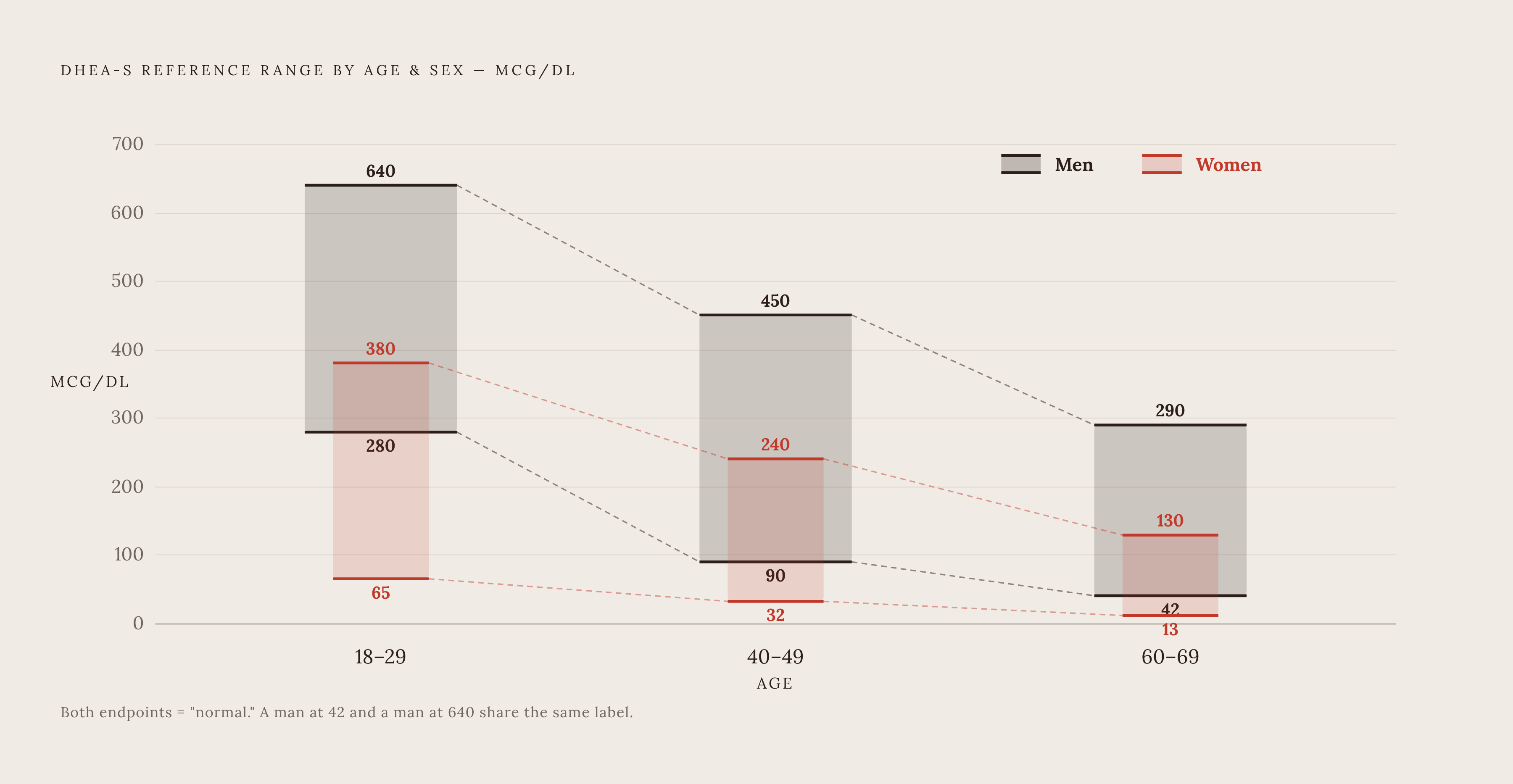
Standard reference ranges for DHEA-S are built from population averages at each age, and that design has a built-in weakness: a result can fall comfortably inside the normal range for someone's age while still reflecting a faster-than-ideal rate of adrenal aging. Ranges shift substantially with age and sex. For men between 18 and 29, the standard range runs from 280 to 640 mcg/dL; by ages 40 to 49, it drops to 90 to 450 mcg/dL; by ages 60 to 69, it falls further to 42 to 290 mcg/dL. Women follow the same downward slope at lower absolute numbers: 65 to 380 mcg/dL at ages 18 to 29, 32 to 240 mcg/dL at ages 40 to 49, and 13 to 130 mcg/dL at ages 60 to 69. Looking at that spread, a 65-year-old man and a 25-year-old man could post wildly different numbers and both be called "normal," which says a lot about how wide these ranges really are.
Functional medicine takes a different approach, aiming for levels closer to a younger, healthier physiological baseline. That framework puts the optimal functional range for men at 300 to 450 mcg/dL and for women at 150 to 300 mcg/dL. These figures are best treated as aspirational benchmarks for comparison, not hard thresholds that should trigger treatment by themselves. A result below that range isn't an automatic problem, and one inside it isn't an automatic clean bill of adrenal health.
Age brings its own complication to this picture. Normal DHEA-S values in older adults, especially past 60, run quite low to begin with, which means the standard reference range stops being a reliable gauge of HPA integrity at the older end of the age spectrum. A value that looks concerning by a 30-year-old's standard might just reflect ordinary aging in a 75-year-old, and separating the two requires more context than the number alone provides.
High results deserve as much attention as low ones. In women, DHEA-S above the expected range raises questions about PCOS, congenital adrenal hyperplasia, or other adrenal pathology, and should prompt further evaluation. In men, very high levels outside the context of supplementation are less common, but they still warrant a closer look.
Reading results over time is more useful than treating any single data point as definitive. One result places someone on the map at a given moment. A series of results across months or years shows the actual slope of decline for that specific person, measured against what's expected for their age and sex, and that trend line carries far more information than any single draw ever could.
What the Evidence Supports for Maintaining DHEA-S
Because trend line matters more than any single number, the natural next question is what actually moves it. Lifestyle changes that lower chronic stress, improve sleep, and support metabolic health all have a coherent, believable mechanism behind them for preserving DHEA-S over time. Supplementing with DHEA directly is a murkier story, with real trade-offs attached.
On the lifestyle side, the evidence lines up well. Chronic psychological stress and a dysregulated HPA axis are among the clearest drivers of low DHEA-S, which makes stress reduction and consistent, quality sleep the most direct levers available. Carrying excess visceral fat and insulin resistance are known suppressors of adrenal androgen output, so improving metabolic health removes one of the clearer causes of a depressed number. Resistance training supports lean body composition and plausibly supports a healthier androgen profile overall, though DHEA-S itself isn't a direct target of exercise the way testosterone can be.
Supplementation tells a more complicated story. A meta-analysis found that DHEA supplementation modestly increased lean body mass and decreased fat mass, without any significant change in blood pressure, which amounts to a small, real body composition benefit and not much more. The bigger catch is sex-specific: that same body of research found a significant drop in HDL cholesterol in women taking DHEA, with no equivalent effect in men. Any woman weighing DHEA supplementation should have that trade-off on the table from the start, not as a footnote.
Despite the strong observational links between DHEA-S and cardiovascular health, a broader pattern runs through the data: supplementing with DHEA directly generally fails to improve cardiovascular biomarkers in trials. That gap between what the association suggests and what the intervention actually delivers occurs repeatedly across the longevity literature, and DHEA-S is a clean example of it. Tracking the number closely is valuable. Treating it as a lever to pull is a different matter entirely, and the evidence so far counsels real caution before reaching for that lever.
Sources
- Review began 09/02/2025 Review ended 10/06/2025 Published 10/13/2025
- Are levels of DHEAS indicative of subjective health
- DHEA-S: Optimal Levels, Reference Ranges & Hormone Interpretation
- Eight Common Genetic Variants Associated with Serum DHEAS Levels Suggest a Key Role in Ageing Mechanisms
- Dehydroepiandrosterone Sulfate in Diagnosing Mild Autonomous Cortisol Secretion and Adrenal Insufficiency
- Dehydroepiandrosterone sulfate on lifespan in men and women using Mendelian randomization - ScienceDirect
- Performance of Dehydroepiandrosterone Sulfate and Baseline Cortisol in Assessing Adrenal Insufficiency - PubMed