Thyroid Antibody Tests and Autoimmune Thyroid Disease
Different antibodies detect different immune processes and predict different thyroid outcomes.
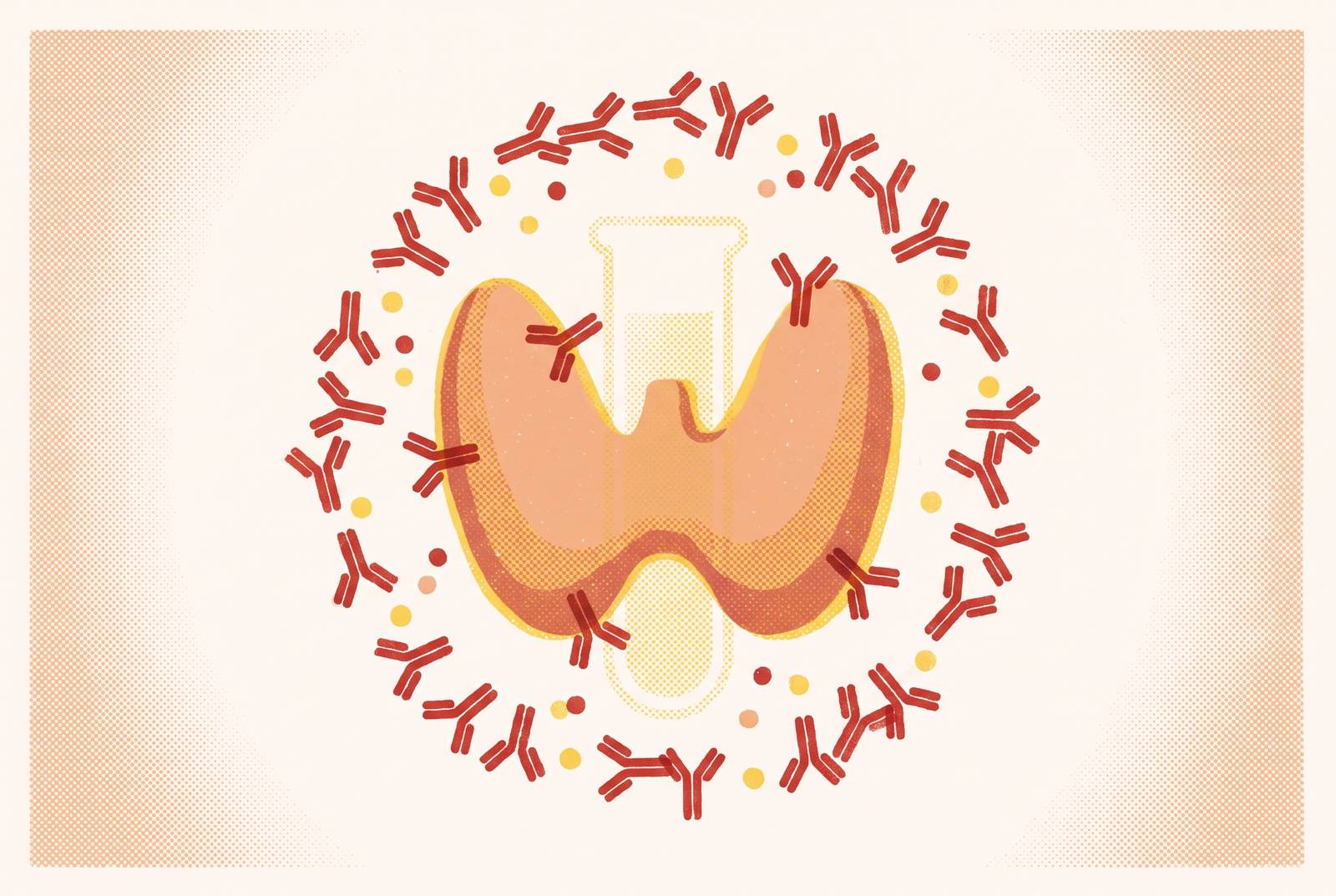
Thyroid antibody tests can show what the immune system is doing before thyroid hormone levels change. But TPOAb, TGAb, and TRAb answer different questions, and a positive result is not a diagnosis by itself. Knowing those differences helps people get checked sooner and decide what to do, without waiting for symptoms or treating an antibody number on its own.
What thyroid antibodies are and what they measure
Thyroid antibody tests measure an immune response against parts of the thyroid. The immune system sees parts of the thyroid as targets and makes antibodies against them. The target determines what each test measures.
TPOAb, or anti-thyroid peroxidase antibody, targets an enzyme involved in making thyroid hormones. Thyroid peroxidase oxidizes iodide and attaches it to thyroglobulin, a step in hormone production. TGAb, or anti-thyroglobulin antibody, targets that protein scaffold, where hormones are assembled and stored. Damage to the thyroid’s follicles can let thyroglobulin enter the blood, where it is exposed to the immune system. Inflammation, hemorrhage, or disordered growth can create that exposure.
TRAb, or thyrotropin receptor antibody, targets the TSH receptor on thyroid cells. In Graves’ disease, these antibodies stimulate the receptor and cause the thyroid to make too much hormone. This is a different process from the one marked by TPOAb and TGAb. Mayo Clinic Labs says those two antibodies are disease markers, but they have not been shown to cause thyroid destruction. Because the three markers reflect different immune processes, each answers a different clinical question.
What each antibody result actually signals, and when to run which test
TPOAb is the first-line marker for suspected autoimmune thyroid disease. Mayo Clinic Labs reports that it has higher sensitivity and equal specificity compared with TGAb. It appears in most cases of autoimmune thyroiditis and in a large proportion of Graves’ disease patients. It is not a Hashimoto’s-only marker. Alhubaish et al.’s 2023 study found that TPOAb positivity in Graves’ disease correlated with higher TRAb levels and higher free T4 at presentation.
The question TPOAb helps answer is whether autoimmunity may explain, or precede, thyroid dysfunction. Elevated TPOAb with normal TSH can signal an immune process before overt hypothyroidism develops. When TSH is abnormal, it is a stronger sign of active thyroid dysfunction and usually calls for free T4 testing and possibly imaging. Mayo Clinic Labs notes that positive thyroid antibodies with high-normal or slightly elevated TSH predict future development of more profound hypothyroidism.
TGAb is the second test when suspicion remains. It is less sensitive than TPOAb, but it can provide independent evidence when TPOAb is negative. Mayo Clinic Labs recommends measuring TGAb when TPOAb is negative but clinical suspicion remains high. Its separate role in thyroid cancer monitoring is important because TGAb can cause false-low thyroglobulin readings in immunometric assays. For that purpose, the laboratory recommends replacing its TGAB test with a dedicated thyroglobulin tumor marker reflex assay.
TRAb helps distinguish Graves’ disease from other thyroid conditions. It is found in roughly 90% or more of Graves’ patients, although it can also occur in atrophic thyroiditis and Hashimoto’s. It belongs in the initial workup when hyperthyroidism is present or distinguishing Graves’ from Hashimoto’s is necessary, because their treatment approaches differ. In atypical cases, a TRAb binding assay or thyroid-stimulating immunoglobulin bioassay is the preferred confirmation method. For confirmed Hashimoto’s without hyperthyroid features, a baseline TRAb measurement generally does not require repeated testing.
TRAb also answers a question later in Graves’ care. Alhubaish et al. report that persistent positivity at the end of treatment predicts a high likelihood of relapse within two years. The timing of a test therefore changes its purpose.
Why antibody testing catches what a TSH screen alone will miss
TSH screening assesses thyroid function rather than the immune process affecting thyroid tissue. A person can have active Hashimoto’s with normal TSH for years before hormone levels change. At diagnosis, the majority of Hashimoto’s patients are euthyroid, meaning TSH and thyroid hormones remain within their reference ranges. Others have subclinical hypothyroidism.
When antibodies are never measured, autoimmune thyroiditis may be labeled simply as hypothyroidism, leaving its immune basis unidentified. Symptoms offer no reliable shortcut. Fatigue, weight gain, cold intolerance, dry skin, hair loss, and muscle weakness can be attributed to other causes. This can delay recognition while thyroid injury progresses.
But if TSH is normal, what changes? Knowing antibody status can change how often someone is checked and allow action sooner when TSH starts to change. Mayo Clinic Labs identifies persistently elevated antibodies after postpartum thyroiditis as a sign of greater risk of permanent hypothyroidism. The laboratory also notes that TPOAb or TGAb in an infant with neonatal hypothyroidism suggests transplacental antibody transfer and a likely transient condition, which changes management.
The systemic consequences of undetected autoimmune thyroid disease
Autoimmune thyroid disease is linked to cardiovascular, metabolic, and neuropsychiatric outcomes as well as changes in how much thyroid hormone is made. Even among euthyroid patients with autoimmune thyroiditis, those with TSH in the upper normal range show a less favorable cardiometabolic profile. This includes higher LDL cholesterol and a trend toward higher hs-CRP, which is a marker of inflammation. TGAb levels also correlate positively with hs-CRP in autoimmune thyroiditis.
The evidence extends beyond these laboratory patterns. Mendelian randomization analyses indicate probable causal links between autoimmune thyroid disease and conditions including coronary atherosclerosis, deep venous thrombosis, major depression, rheumatoid arthritis, and inflammatory bowel disease. Aging-related thyroid dysfunction also has a bidirectional relationship with metabolic syndrome, diabetes, and cardiovascular disease. Hashimoto’s is linked to a higher biological age and faster metabolic aging. That raises the possibility of a systemic pro-aging effect.
Other autoimmune diseases provide a concrete example. Xin & Lu’s 2025 study found detectable TPOAb and/or TGAb in 55.6 percent of patients with myasthenia gravis, an autoimmune neuromuscular disease. Patients positive for both antibodies had a more severe disease pattern and higher relapse rates. This illustrates how thyroid autoimmunity can cluster with other autoimmune conditions, although it does not mean every antibody-positive person will develop them.
Antibody status also has a role in cancer care. Jiao et al.’s 2025 study identified pre-existing TPOAb and TRAb positivity as significant risk factors for thyroid-related immune adverse events during immune checkpoint inhibitor treatment. Baseline screening can therefore change care for people beyond those usually seen for thyroid disease. For an individual, however, these risks are reasons to interpret results carefully.
How to read a thyroid antibody result without over- or under-reacting
The useful questions are which antibody is elevated, what thyroid function looks like, and how the findings fit symptoms and risk factors. Context comes before the size of the number.
A borderline TPOAb result may be an early or nonspecific signal. It warrants monitoring and assessment with TSH and free T4. Clearly elevated TPOAb with elevated or high-normal TSH strongly supports Hashimoto’s, while elevated TPOAb with normal TSH indicates autoimmunity that calls for closer monitoring. Very high values are common in established Hashimoto’s but do not reliably predict symptom severity. Changes across successive tests can be more informative than a single value.
TGAb needs the same restraint, especially when it is only mildly elevated. Mayo Clinic Labs says people can have low thyroid antibody levels even when they have no autoimmune or other thyroid disease. Clearly elevated TGAb with negative TPOAb and continuing clinical suspicion deserves further evaluation. For someone undergoing thyroid cancer monitoring, the clinician must also account for its interference with thyroglobulin testing.
Positive TRAb with hyperthyroid symptoms is a strong sign of Graves’ disease and changes the next steps in care. After Graves’ treatment, the result helps gauge how likely relapse is. Antibody levels can fluctuate, so one measurement establishes a baseline. Rising, stable, or falling results may help guide monitoring, but antibodies cannot reliably predict an individual’s rate of progression to overt hypothyroidism. A clinician-reviewed action plan adds the most value when it combines antibodies, TSH, free T4, symptoms, and risk factors.
What the research supports for managing elevated antibodies
Selenium is the most studied non-prescription intervention for people with elevated TPOAb, but the evidence is mixed. Baseline selenium status is a key uncertainty. A 2025 meta-analysis published in Medicine found that supplementation reduced TPOAb and TSH in Hashimoto’s patients, with selenomethionine more effective than sodium selenite or selenium-yeast forms. A 2024 network meta-analysis in Frontiers in Endocrinology also found significant reductions in TPOAb and TGAb compared with control. It may work through antioxidant effects and by helping control the balance of immune cells.
A large 2026 retrospective cohort study found a different pattern. Selenium supplementation was associated with persistently higher mean TSH, free T4, and TPOAb levels, as well as increased all-cause mortality. The authors urged caution because they had no baseline selenium measurements. That missing information limits what the findings can establish about supplementation itself. Some people may have been taking selenium despite already having enough.
The contradiction argues against a generic supplement recommendation. Alongside the evidence of antibody reductions, it highlights an important distinction between correcting deficiency and supplementing someone who is already selenium-replete. Baseline selenium status should be known before supplementing. That biomarker can be measured separately from thyroid antibodies.
Research also examines dietary iodine modulation, vitamin D status, and stress management. Their evidence is thinner and more variable than selenium’s, so they should not be presented as established ways to lower antibodies. Once elevated antibodies are confirmed, monitoring focuses on TSH, free T4, and antibody trends at intervals shaped by whether TSH is normal or elevated. Personalized guidance based on those results and selenium status is more useful than a population-level supplement recommendation.
How to get a complete thyroid antibody panel without overpaying or waiting for a referral
A clinically meaningful workup can include TSH, free T4, TPOAb, and TGAb, with TRAb added when clinically indicated. Each component has a different job. TSH assesses current thyroid function, while free T4 adds detail when TSH is borderline or abnormal. TPOAb is the first-line autoimmune marker, and TGAb is most useful when TPOAb is negative but suspicion remains, or when establishing a baseline for monitoring. TRAb belongs when hyperthyroid symptoms are present or Graves’ disease needs to be distinguished from another cause.
“Complete” should therefore mean complete for the question being asked. It does not have to mean testing every antibody again at every visit. The same distinction explains why a broadly available panel and a clinician’s stepwise testing plan may contain different tests. A person with possible Graves’ needs a different antibody emphasis from someone being evaluated for Hashimoto’s.
Direct-access testing lets people get these workups without first getting a doctor’s referral or insurance authorization. Physician authorization can be included in the service, and results are typically ready within days. Direct-pay pricing can be substantially lower than hospital outpatient billing for the same tests. The quoted price is not always the final cost. Before ordering, confirming whether physician authorization, processing, and collection fees are included helps avoid surprises, while HSA/FSA eligibility may reduce the effective out-of-pocket cost.
This workup deserves particular consideration for women of reproductive age, people with symptoms that could reflect thyroid dysfunction, and those with a personal or family history of autoimmune disease. It can also provide a fuller baseline for someone who has only had TSH screening. Access to testing is only the first step. Its value comes from connecting the immune markers to current thyroid function and using that combination to decide what needs monitoring next.
Sources
- The clinical characteristics and treatment response of myasthenia gravis with positive thyroid peroxidase antibody or thyroid globulin antibody
- The Clinical Implications of Anti-thyroid Peroxidase Antibodies in Graves’ Disease in Basrah
- Commentary: Correlation between different levels of thyroid autoantibodies and immune checkpoint inhibitor-associated thyroid dysfunction
- Hashimoto’s Thyroiditis among Patients with Thyroid Disorders Visiting a Tertiary Care Centre
- Hashimoto's Thyroiditis with Subclinical Hypothyroidism ...