Free Testosterone Versus Total Testosterone in Lab Results
Free testosterone matters more than total when SHBG levels change.
Total testosterone counts all the testosterone in your blood, while free testosterone measures the part your body can use right away. The difference helps explain why a normal result may not fit how you feel. Reading both numbers with sex hormone-binding globulin, or SHBG, gives a clearer picture of how much of that hormone your body can use.
Why your total testosterone number can be misleading on its own
Your testosterone result looks normal, but you still feel fatigued, have little interest in sex, or feel flat. The report seems reassuring. The mismatch between the reassuring report and persistent symptoms raises a reasonable question about what the test has actually ruled out. A normal total testosterone result answers a narrower question than many people expect.
Total testosterone counts every molecule of testosterone circulating in the blood, whether it is bound to a protein or free. Much of that testosterone is attached to proteins, and the strength of that attachment affects whether it is available to act on tissues. The total result groups those different states together. It therefore cannot, on its own, show that tissues are receiving adequate androgen signaling.
Having hormone in the blood and having hormone available for use are linked, but one does not guarantee the other. A total testosterone test can help establish the overall level, yet it does not reveal how that supply is divided. Someone reading only the total may take a normal result as evidence that testosterone availability is adequate, even though the test has not answered that question.
Total testosterone still has a role in testing, but the mismatch alone does not prove that testosterone causes the symptoms. It identifies a gap in the information. To understand that gap, the next step is to look at the proteins that bind testosterone, especially the one that holds it most tightly.
What SHBG does and why it is the operative variable between the two numbers
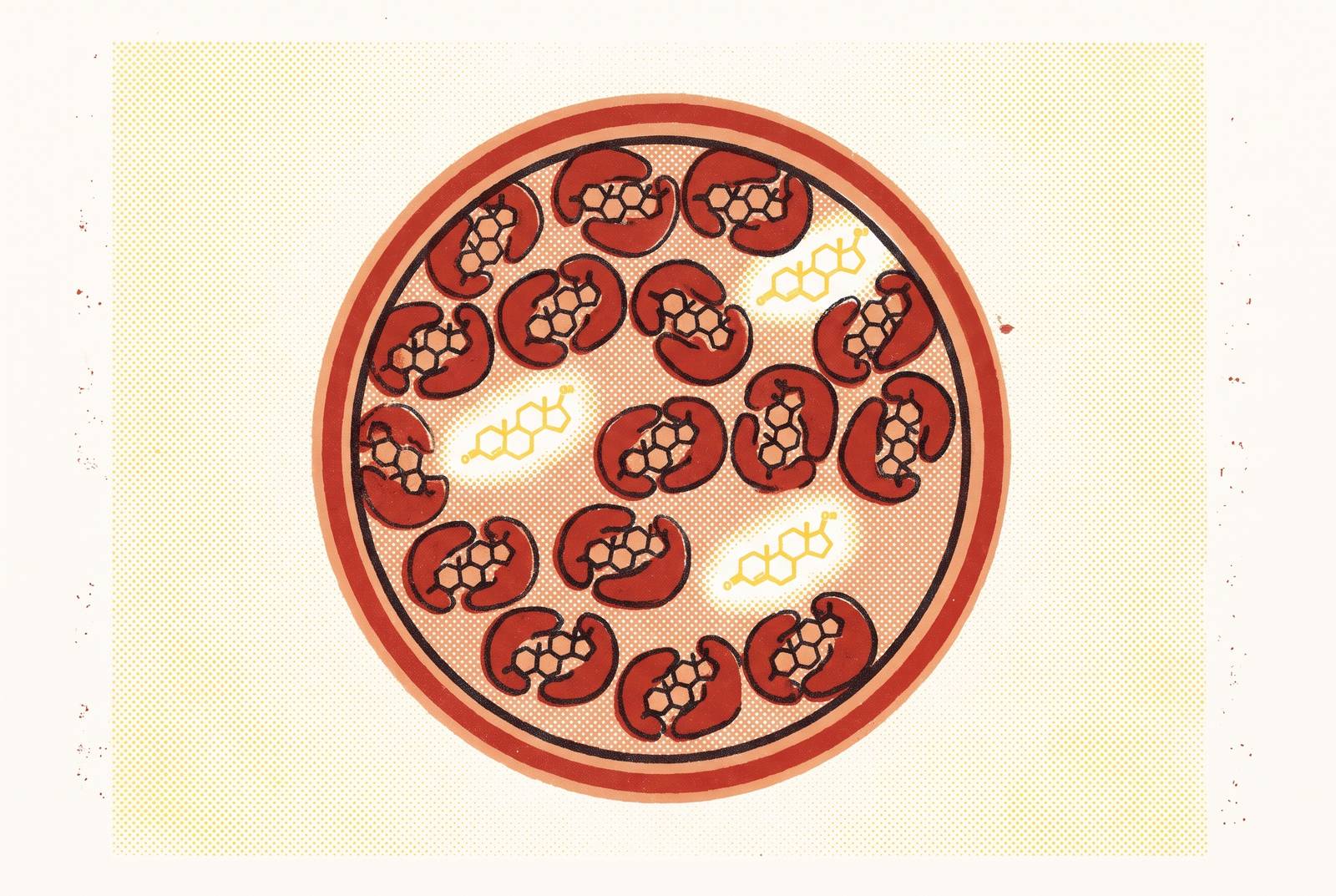
SHBG is a glycoprotein made primarily in the liver that binds testosterone tightly. Roughly half of circulating testosterone is bound to SHBG, most of the remainder is loosely bound to albumin, and approximately 2% circulates freely. The free portion is immediately available for use. Testosterone that is attached to SHBG cannot enter cells and activate androgen receptors as long as it stays bound. It is present in the blood, but held in reserve.
In that sense, SHBG acts like a dimmer switch on the total testosterone supply. A higher total does not necessarily mean more hormone is freely available, because the binding environment can change how that supply is divided. SHBG also influences how testosterone is cleared and how accessible it is to tissues. Two people with the same total testosterone can therefore have different free testosterone levels. The total alone hides that difference.
SHBG shifts throughout a person’s life with age, body composition, metabolic status, and other influences. Aging, estrogens, liver disease, hyperthyroidism, very low caloric intake, and certain anticonvulsant medications can raise it. Obesity, by contrast, can lower it. These influences explain why a change in free testosterone does not always require a matching change in total testosterone.
As SHBG rises, free or bioavailable testosterone can decline more steeply than total testosterone, leaving some older men with a normal total but free testosterone below the normal range for younger men. The 2025 JCEM Case Reports paper “Genetic SHBG Deficiency Unmasks the Discrepancy Between Biochemical and Clinical Hypogonadism” cites twin and family studies indicating that common genetic variants can explain up to 80% of variation in SHBG between individuals. Similar-looking people need not have similar binding patterns.
Where total and free testosterone diverge most, and who is most likely to be affected
The gap becomes most consequential when SHBG is unusually high or low. Consider an older man whose total testosterone is within range but whose SHBG has risen with age, leaving his free testosterone low. A total-only screen may look reassuring despite symptoms consistent with deficiency. The free result exposes what the screen could miss.
The reverse can occur in a man with obesity and insulin resistance. His total testosterone may look low, but with low SHBG, more of it is free and his free testosterone may still be in a reasonable range. In that situation, the clinical focus may be metabolic. Scott Selinger and Gregory R Thoreson’s 2025 letter in Sexual Medicine notes that BMI is inversely correlated with SHBG, while age is more directly and independently associated with rising SHBG.
Medication can create another version of the mismatch. A man who takes certain anticonvulsants may have high SHBG and a strong total testosterone result even though his free testosterone is very low. The medication history then becomes part of interpreting the result. The same letter notes the hypothesis that symptom burden and disease risk correlate better with free than total testosterone, while identifying missing free testosterone data as a limitation of the study it discusses. That warrants examining free testosterone while leaving its role in explaining every symptom uncertain.
The International Journal of Endocrinology study “Free Testosterone Reflects Metabolic as well as Ovarian Disturbances in Subfertile Oligomenorrheic Women” examined women with infrequent periods, subfertility, and suspected PCOS. Total testosterone was associated with ovarian volume and antral follicle count, but not metabolic parameters. SHBG and calculated free testosterone were associated with both ovarian and metabolic disturbances, including BMI and insulin resistance. The study also found that automated immunoassays frequently used to measure female testosterone were inaccurate, adding a measurement problem to the limits of a total-only approach.
How free testosterone is actually measured, and why the method changes what the number means
A report labeled “free testosterone” does not tell you how the number was obtained. Laboratories can isolate the free fraction, estimate it with an assay, or calculate it from other measurements. These approaches are not equally reliable. A result described as directly measured is not automatically better than a calculated one.
Equilibrium dialysis is the reference method because it directly isolates the free fraction. It is technically demanding, costly, and requires nonautomated processing, so it is rarely used in routine clinical laboratories. Direct analog immunoassays are more widely available and cheaper, but they systematically underestimate free testosterone and agree poorly with equilibrium dialysis. Many endocrinologists consider them unreliable. The convenience of an assay does not establish its accuracy.
Calculated free testosterone offers a practical alternative. The Vermeulen formula or a similar calculation uses total testosterone and SHBG as inputs, and its results correspond better with equilibrium dialysis than analog assays do, provided the input measurements are accurate. The calculation still rests on assumptions about SHBG binding. When SHBG is profoundly abnormal, those assumptions may fail.
The JCEM case report illustrates that limit in a 50-year-old man with near-absent SHBG. His SHBG was 2 nmol/L, with a reference range of 14–72 nmol/L, but his calculated free testosterone was within its normal reference range. Equilibrium dialysis found that his free testosterone was 2.9 ng/dL, with a reference range of 4.9–15.8 ng/dL, which confirmed biochemical hypogonadism that the calculation had missed. Genetic analysis found compound heterozygous SHBG variants, with p.Pro185Leu impairing steroid binding and increasing clearance, and p.Gly224Arg preventing secretion. For a reader ordering testing, the practical lesson is to ask which method will be used and whether unusual SHBG levels could make a calculated result unreliable.
What each number is and is not suited to tell you in a clinical context
Total testosterone is useful as a first-pass screen in someone without symptoms, particularly when SHBG is likely to be within its normal range. It can show when the overall testosterone level is clearly suppressed. It is less suited to settling a discrepancy between a normal result and persistent symptoms. The choice of test depends on which question remains unanswered in the person being assessed.
For someone with fatigue, low libido, reduced muscle recovery, or mood changes despite normal total testosterone, free testosterone is a necessary addition to the assessment. The same applies when SHBG is known or suspected to be elevated or suppressed, or when age-related hormonal change is the concern. The practical sequence is total testosterone first, then free testosterone when the clinical picture leaves uncertainty. This preserves the value of the initial screen without asking it to resolve a question it cannot answer alone.
A combined panel provides a clearer basis for that decision. Total testosterone establishes the overall level, SHBG describes the binding environment, and free testosterone shows the immediately available fraction. Each measurement has a distinct role. In women being assessed for conditions such as PCOS, the findings from the study of subfertile women also support looking beyond total testosterone when both ovarian and metabolic disturbances are under consideration. In either case, the panel alone is not enough to make a diagnosis.
Testosterone varies with time of day, illness, and sleep, so guidelines recommend at least one repeat morning measurement before a clinical decision is made on the basis of a low level. That assessment also needs to take account of symptoms, medications, metabolic status, and how the level was measured. The sounder decision comes from more context, rather than treating either total or free testosterone as a verdict in isolation.
How to order the right panel, what to pay for it, and what to ask when the result arrives
To put that framework into practice, order total testosterone, free testosterone, and SHBG as a combined panel. Adding estradiol can provide further context on how testosterone is being converted at the tissue level. Testing only total testosterone leaves the binding environment unmeasured, so the result can give false reassurance or cause needless worry. Including SHBG makes a disagreement between the two testosterone results something that can be investigated.
Schedule the blood draw between 7 AM and 10 AM, when testosterone is at its daily peak. Timing is part of the test’s meaning. A mid-afternoon draw can produce a systematically lower reading and trigger concern that a morning result might not support. For a result that will inform a clinical decision, the higher-confidence option is a venous blood draw analyzed at a certified clinical laboratory. At-home saliva or finger-prick kits are more convenient but less reliable for testosterone.
Cost needs to be read in relation to the method, because the least expensive free testosterone assay is also the least accurate. There is no supported dollar benchmark here for what a complete panel should cost. The available comparison is qualitative. Direct analog assays cost less, while equilibrium dialysis is costly and technically demanding. A calculated free testosterone result based on accurate total testosterone and SHBG measurements can be more clinically trustworthy than a cheap directly measured analog result.
When the report arrives, the first question is which method produced the free testosterone number. If it was calculated, ask which measurements went into the calculation. Then ask whether the SHBG level falls in a range where the calculation is dependable or whether its binding assumptions may not hold. Those questions establish what the result can support. A clinician reviewing the panel needs that information before interpreting a discrepancy as a biological problem.
If total testosterone is normal but free testosterone is low, ask what could be driving elevated SHBG, including age, medication, or metabolic status, and whether that influence is modifiable. Whether a repeat morning draw is needed must be considered before any decision. Clinician-reviewed guidance is useful because the same apparent mismatch can have different explanations. The aim is to understand whether the result reflects low hormone availability, an unusual binding pattern, or a measurement limitation before deciding what to do next.
Sources
- Free Testosterone Reflects Metabolic as well as Ovarian Disturbances in Subfertile Oligomenorrheic Women
- Genetic SHBG Deficiency Unmasks the Discrepancy Between Biochemical and Clinical Hypogonadism
- Letter to the Editor on “Association of total testosterone levels with cardiometabolic diseases in men with erectile dysfunction”